CMO fast-tracks land acquisition for coastal road phase two
Source:Indian Express ↗
Why It Matters
The coastal road project sits at the intersection of GS3 Infrastructure and GS3 Environment. It presents a classic case study of balancing urban mobility needs against ecological conservation (mangroves/marshlands), land acquisition challenges, and environmental clearance processes (CRZ, compensatory afforestation).
Summary
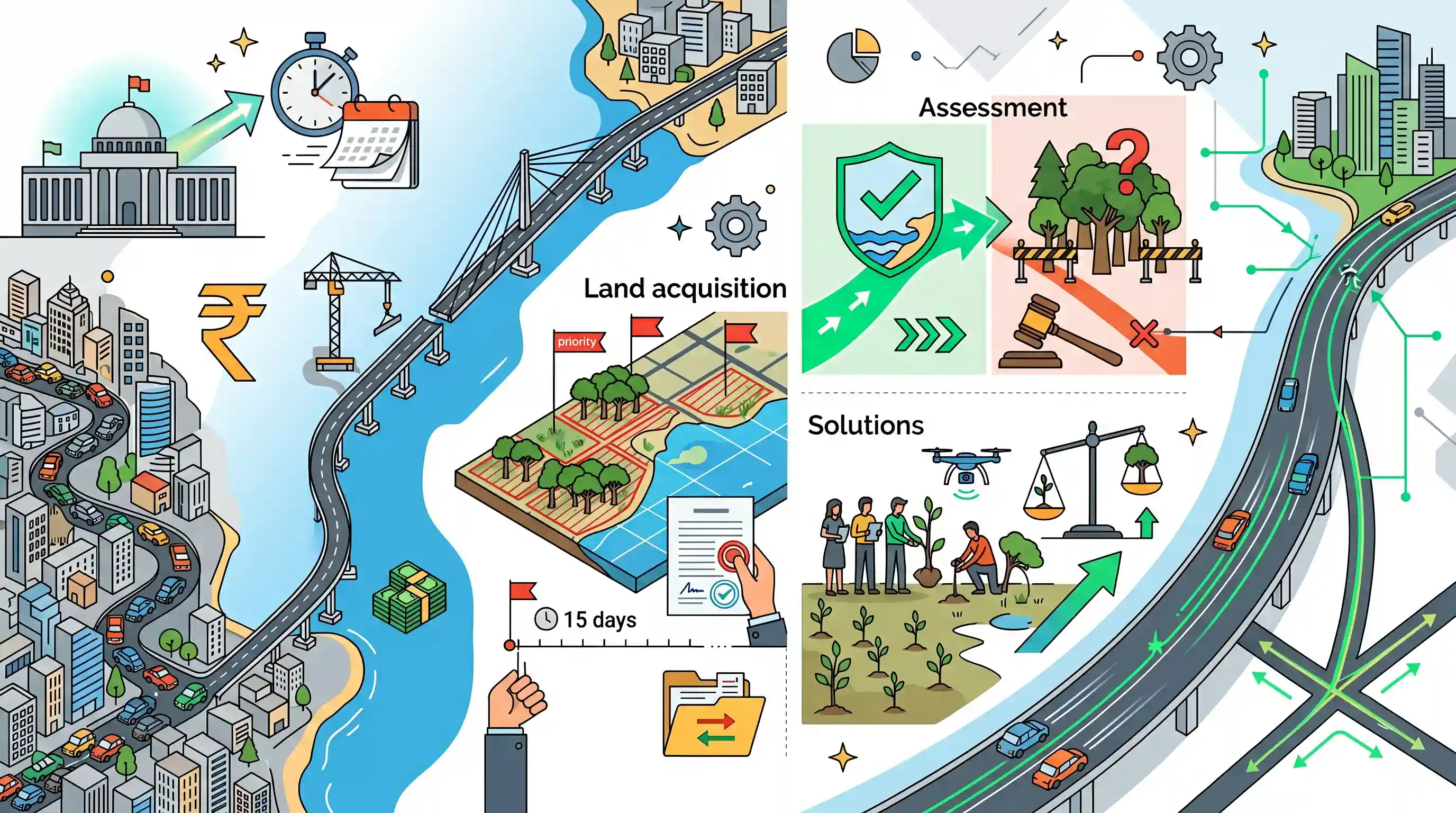
The Maharashtra government has fast-tracked Phase 2 of the Mumbai Coastal Road Project (Versova to Bhayander), directing the BMC to complete land acquisition within 15 days. The 25-km, Rs 20,000-crore infrastructure project necessitates the acquisition of 165 hectares of primarily government-owned marshy lands and mangrove patches, requiring the BMC to amend its Development Plan (2034). While coastal clearances are secured, the project awaits forest and judicial permissions to cut mangroves, which will be offset by compensatory plantation. The initiative aims to significantly upgrade urban mobility by providing a seamless north-south corridor that will eventually integrate with east-west links like the Goregaon Mulund Link Road.
Key Points
- The Maharashtra CMO has mandated the BMC to finalize land acquisition for the 25-km Versova-Bhayander Phase 2 of the coastal road within 15 days.
- The Rs 20,000-crore project will not reclaim land from the sea but will instead require 165 hectares of mangrove patches and marshy land.
- About 80% of the required land is government-owned, but the BMC must alter land-use reservations under its Development Plan (2034).
- Environmental clearances from coastal authorities are obtained, but forest department and Bombay High Court permissions are required to clear mangroves.
- The project mandates compensatory afforestation of mangroves and includes underground tunnels, a cable-stayed bridge, and vehicular interchanges to enhance connectivity.
Important Terms
Brihanmumbai Municipal Corporation (BMC)

India's wealthiest Urban Local Body (ULB), established under the Mumbai Municipal Corporation Act, 1888. It manages city infrastructure and services, functioning under the 74th Constitutional Amendment's framework for local self-government.
UPSC context
GS2 (Local Self Government). Tests understanding of ULB devolution, administrative structure, and challenges of urban governance in megacities.
Union Ministry of Environment, Forest and Climate Change (MoEFCC)
The nodal central ministry responsible for environmental protection and forestry. It grants mandatory statutory clearances for large-scale infrastructure projects involving forest land diversion and major coastal impacts.
UPSC context
GS2/GS3 (Environment & Governance). Tests awareness of the executive’s role in balancing infrastructure growth with national ecological conservation goals.
Maharashtra Coastal Zone Management Authority (MCZMA)
A statutory body under the Environment (Protection) Act, 1986, responsible for enforcing Coastal Regulation Zone (CRZ) rules. It regulates developmental activities along Maharashtra's coastline to protect sensitive marine ecosystems.
UPSC context
GS3 (Environmental Impact Assessment). Tests knowledge of regulatory frameworks for coastal protection and the implementation of CRZ notifications.
Development Plan (2034)
Mumbai's statutory master plan prepared under the MRTP Act, 1966. It regulates land-use, zoning, and Floor Space Index (FSI) to manage the city's population and infrastructure needs until 2034.
UPSC context
GS1/GS2 (Urbanization & Planning). Tests understanding of statutory planning tools and the challenges of sustainable urban development.
Mumbai Coastal Road Project
A high-speed expressway project connecting South Mumbai to the northern suburbs. Phase 2 (Versova-Bhayander) is a 25-km corridor designed to decongest arterial roads through tunnels, bridges, and interchanges.
UPSC context
GS3 (Infrastructure). Tests ability to analyze large-scale transport projects, their socio-economic benefits, and environmental trade-offs.
Goregaon Mulund Link Road (GMLR)
An upcoming 12.2 km east-west arterial link in Mumbai featuring twin tunnels beneath the Sanjay Gandhi National Park, utilizing advanced Boring Machines to minimize disturbance to local wildlife.
UPSC context
GS3 (Infrastructure/Technology). Tests knowledge of multi-modal connectivity and the integration of environmental safeguards in sensitive urban ecosystems.
Bombay High Court
The superior judicial body in Maharashtra that exercises judicial review over state actions. In infrastructure cases, it ensures project compliance with environmental laws, such as mangrove protection.
UPSC context
GS2 (Judiciary). Tests the role of judicial oversight in developmental projects and the doctrine of sustainable development.
Prelims Trap
"CRZ clearance from Coastal Zone Authorities automatically grants permission to fell mangroves for public infrastructure."
CRZ clearance and Forest clearance are separate. Felling mangroves requires explicit permission under the Forest (Conservation) Act and compensatory afforestation.
Static Concepts Connected
How are Coastal Regulation Zones (CRZ) classified in India?
- CRZ-I (Ecologically Sensitive): Mangroves, corals, sand dunes. No new construction is permitted except for atomic, defense, or specified critical public utilities.
- CRZ-II (Built-up Areas): Areas already developed up to the shoreline. Buildings are permitted landward of the hazard line.
- CRZ-III (Rural Areas): Relatively undisturbed coastal rural areas. Divided into No Development Zones (NDZ) and areas where limited regulated facilities are allowed.
- CRZ-IV (Water Areas): Territorial waters from the low tide line to the maritime limit. Regulates fishing and marine pollution.
What does the Compensatory Afforestation Fund (CAF) Act mandate?
- Equivalent Area Rule: User agencies diverting forest land for non-forest purposes must pay for afforestation on an equivalent area of non-forest land.
- Fund Split (90:10): The collected funds are distributed 90% to the State funds (SCAF) and 10% to the National fund (NCAF).
- Strict Utilization: Money must strictly be utilized for wildlife management, forest fire prevention, and catchment area treatment, not administrative expenses.
Cross-Topic Patterns
Urban mobility vs Coastal resilience
Mega-projects in coastal cities directly pit urban congestion relief against the destruction of CRZ-I mangroves, which act as vital natural barriers against storm surges and climate-induced sea-level rise.
Judicial oversight in eco-clearances
The necessity for High Court approval to cut mangroves, despite executive CRZ clearances, highlights the judiciary's continuing active role in bridging enforcement gaps in environmental governance.

A mixed-statement Prelims question testing the overlap of CRZ-I norms, mangrove protection status and CAF Act rules is highly likely.
Linked PYQs · 3
Linked PYQs · 3
- 2014MainsGS3
National Urban Transport Policy emphasises on 'moving people' instead of 'moving vehicles'. Discuss critically the success of the various strategies of the Government in this regard.
- 2022MainsGS3
Explain the causes and effects of coastal erosion in India. What are the available coastal management techniques for combating the hazard?
- 2023PrelimsGS1
Which one of the following is the best example of repeated falls in sea level, giving rise to present-day extensive marshland?
