Mumbai Municipal Waste Management and Behavioral Challenges
Source:Indian Express ↗
Why It Matters
Highlights the socio-ethical and governance dimensions of urban solid waste management. It serves as an excellent case study for GS-3 (Environmental Pollution & Degradation), GS-2 (Urban Local Bodies functioning), and GS-4 (Role of Attitude and Public Participation in governance).
Summary
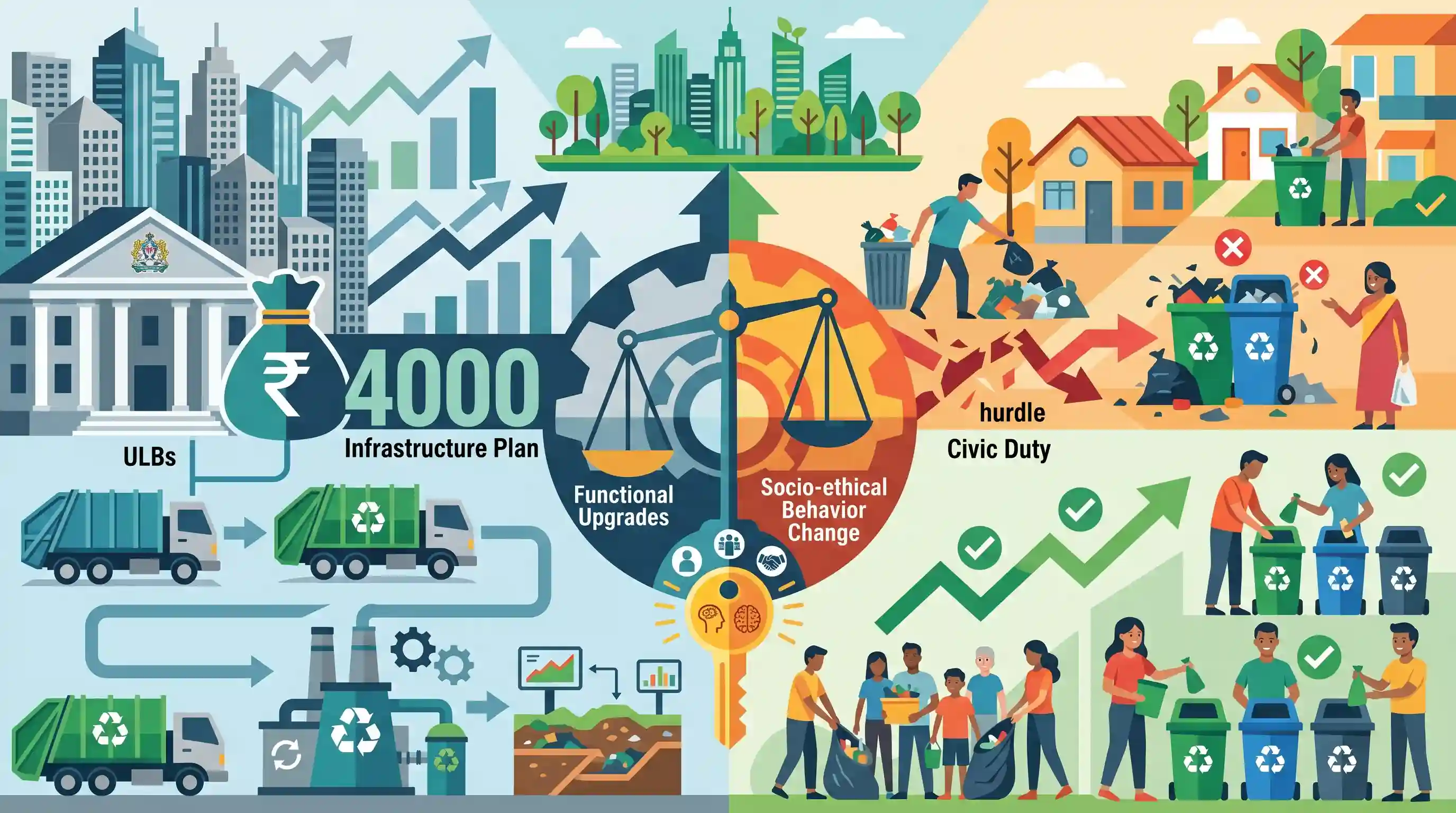
Brihanmumbai Municipal Corporation (BMC) Deputy Municipal Commissioner Kiran Dighavkar discussed the upcoming ₹4,000-crore infrastructure plan to tackle Mumbai's solid waste management issues. He emphasized that while financial and functional upgrades are essential, the most significant hurdle remains the behavioral patterns and attitudes of the public toward waste segregation and sanitation. The initiative highlights the critical intersection of urban local body governance, environmental infrastructure, and the necessity of socio-ethical behavioral change for achieving sustainable civic cleanliness.
Key Points
- BMC has proposed a new ₹4,000-crore comprehensive plan to overhaul the solid waste management (SWM) infrastructure in Mumbai.
- According to BMC Deputy Municipal Commissioner Kiran Dighavkar, the primary challenge to effective SWM is not just infrastructure, but the entrenched behavioral patterns of the public.
- Issues such as a lack of waste segregation at the source and general civic apathy severely impede municipal efforts.
- The scenario underscores that the functional and financial empowerment of Urban Local Bodies (ULBs) must be coupled with active civic participation and behavioral change to achieve sustainable urban sanitation.
Important Terms
Solid Waste Management (SWM) Rules, 2016

Comprehensive regulations mandating waste segregation into three categories (wet, dry, hazardous) and introducing Extended Producer Responsibility (EPR). They apply to all urban agglomerations and emphasize scientific processing over landfilling.
UPSC context
GS Paper 3 (Environment); tests knowledge of regulatory frameworks for pollution control and sustainable urban development.
Urban Local Bodies (ULBs)
Constitutional self-governing units in urban areas, categorized into Municipal Corporations, Councils, and Nagar Panchayats. They are responsible for 18 functional items, including public health and sanitation.
UPSC context
GS Paper 2 (Governance); central to questions on decentralized administration and local self-government.
74th Constitutional Amendment Act, 1992
The 1992 Act that granted constitutional status to urban local governments by adding Part IXA. It mandated regular elections and the functional devolution of subjects like waste management to municipalities.
UPSC context
GS Paper 2 (Polity); foundational for topics regarding urban decentralization and constitutional provisions.
Behavioral Change (Nudge Theory)
A socio-psychological strategy under the Swachh Bharat Mission focusing on shifting public attitude from apathy to civic participation. It utilizes 'nudges' to ensure sustainable usage and maintenance of sanitation infrastructure.
UPSC context
GS Paper 4 (Ethics); tests application of attitude change, persuasion, and social influence in public policy.
Brihanmumbai Municipal Corporation (BMC)
India’s richest and oldest municipal corporation, established under the 1888 Act. It governs Mumbai's infrastructure and serves as a primary case study for metropolitan administration and megacity governance.
UPSC context
GS Paper 2 (Governance); serves as a benchmark for analyzing urban local body (ULB) autonomy and infrastructure management.
Waste Segregation at Source
The mandatory process of separating waste into biodegradable, non-biodegradable, and domestic hazardous streams at the generation point. It is a critical prerequisite for scientific processing and circular economy goals.
UPSC context
GS Paper 3 (Economy/Environment); vital for understanding circular economy principles and efficient waste management systems.
Prelims Trap
Waste generators must segregate waste into two categories: wet and dry at the source.
The SWM Rules 2016 mandate segregation into THREE streams: biodegradable (wet), non-biodegradable (dry), and domestic hazardous waste (e.g., diapers, mosquito repellents).
Static Concepts Connected
What are the key mandates for waste generators under the Solid Waste Management Rules, 2016?
- Three-stream Segregation: Generators must separate waste into biodegradable, non-biodegradable, and domestic hazardous waste before handing it to collectors.
- Spot Fines: Local bodies have the authority to levy spot fines for littering or failing to segregate waste at the source.
- Event Organizers: Organizers of events gathering more than 100 persons must ensure waste segregation and handover to the designated agency.
How does 'Nudge Theory' apply to civic governance and sanitation?
- Non-coercive Persuasion: It uses positive reinforcement and indirect suggestions to influence public behavior without coercive legal mandates.
- Swachh Bharat Application: Extensively utilized during the Swachh Bharat Abhiyan to transform sanitation from a government mandate into a behavioral civic movement.
- Civic Duty Alignment: It appeals to social norms and fundamental duties (like protecting the environment under Article 51A(g)) to overcome entrenched apathy.
Cross-Topic Patterns
Source Segregation + Waste-to-Energy viability
Unsegregated municipal solid waste has high moisture content and low calorific value, which severely reduces the efficiency of Waste-to-Energy (WtE) plants and causes toxic emissions.
74th Amendment + ULB Financial Empowerment
The 74th Amendment lists SWM in the 12th Schedule. Massive infrastructure outlays highlight the persistent gap in ULB financial autonomy, requiring state or central grants for basic civic duties.

Expect a GS3 or GS4 Mains question linking 'Nudge Theory' and civic apathy to the operational failures of urban environmental policies.
Linked PYQs · 4
Linked PYQs · 4
- 2018MainsGS3
What are the impediments in disposing the huge quantities of discarded solid wastes which are continuously being generated? How do we remove safely the toxic wastes that have been accumulating in our habitable environment?
- 2023MainsGS2
“The states in India seem reluctant to empower urban local bodies both functionally as well as financially.” Comment.
- 2024MainsGS2
Analyse the role of local bodies in providing good governance at local level and bring out the pros and cons merging the rural local bodies with the urban local bodies.
- 2016MainsGS4
Our attitudes towards life, work, other people and society are generally shaped unconsciously by the family and the social surroundings in which we grow up. Some of these unconsciously acquired attitudes and values are often undesirable in the citizens of a modern democratic and egalitarian society. How can such undesirable attitudes be changed and socio-ethical values considered necessary in public services be cultivated in the aspiring and serving civil servants ?
