Capital expenditure concentration in municipal infrastructure planning
Source:Indian Express ↗
Why It Matters
The financial health and expenditure priorities of major municipal corporations like the BMC serve as a case study for urban governance, decentralization, and infrastructure financing in India. It is highly relevant for GS-2 (Local Bodies functioning/finances) and GS-3 (Infrastructure and Urbanization).
Summary
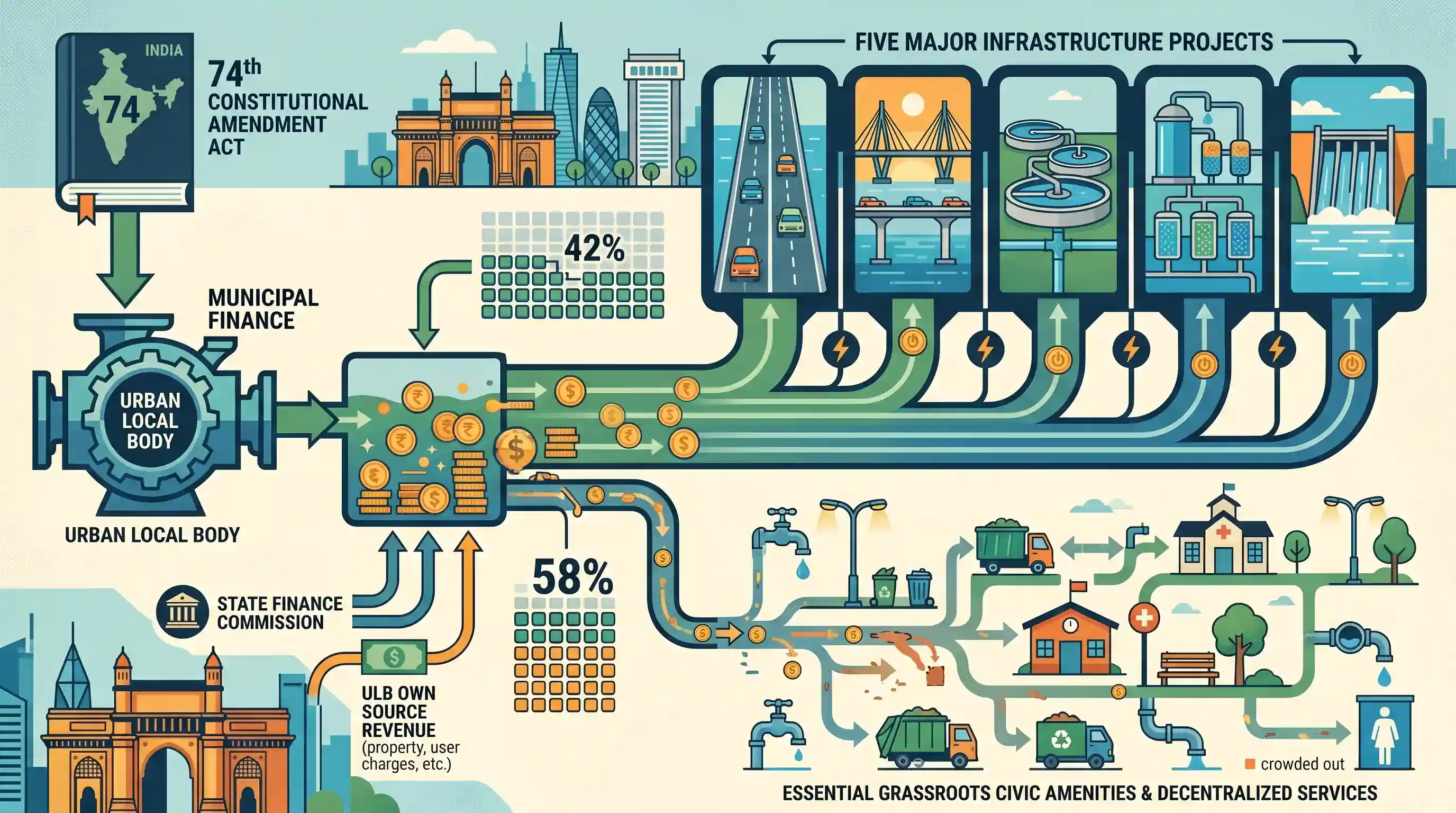
The Brihanmumbai Municipal Corporation (BMC) has allocated 42% of its total capital expenditure for the 2026-27 fiscal year to just five major infrastructure projects. While this underlines a strong push for large-scale urban development, mobility, and modernization in Mumbai, it also reflects a concentration of municipal finances that could potentially crowd out funding for other essential grassroots civic amenities and decentralized services. The budgetary trend highlights broader challenges in urban local body (ULB) finances, prioritizing capital-intensive mega projects over widespread municipal needs.
Key Points
- Five major civic infrastructure projects account for 42% of the Brihanmumbai Municipal Corporation's (BMC) capital expenditure for 2026-27.
- The heavy concentration of municipal funds in a few mega infrastructure projects highlights the prioritization of large-scale urban mobility and modernization in Mumbai.
- Such skewed capital allocation can raise concerns regarding the underfunding of other essential decentralised civic services, such as primary health, education, and localized sanitation.
- The financial strategies of India's richest civic body reflect broader challenges and trends in municipal finance and urban infrastructure planning in mega cities.
Important Terms
74th Constitutional Amendment Act (1992)

The 1992 amendment that institutionalized urban self-government (Part IX-A), creating a uniform three-tier municipal structure and providing constitutional status to local bodies.
UPSC context
GS-II (Polity/Governance); tests knowledge of democratic decentralization and the constitutional framework for urban governance.
Urban Local Bodies (ULBs)
Local self-government institutions (Municipal Corporations, Councils, Nagar Panchayats) responsible for managing urban areas, including urban planning, public health, and infrastructure development.
UPSC context
GS-II (Governance) and GS-III (Urbanization); relevant for discussing the '3F' (Functions, Funds, Functionaries) challenges.
Capital Expenditure (CapEx)
Government spending used to create, maintain, or improve long-term physical assets such as infrastructure, which facilitates economic growth and asset creation.
UPSC context
GS-III (Economy/Budgeting); essential for understanding the fiscal health and infrastructure priorities of government bodies.
Municipal Finance
The fiscal management of ULBs, involving revenue generation (property tax, user fees) and expenditures. It is often marked by high dependency on intergovernmental transfers.
UPSC context
GS-II (Fiscal Federalism); tests understanding of the financial autonomy and resource mobilization challenges of local governments.
Brihanmumbai Municipal Corporation (BMC)
India's wealthiest municipal body, governing Mumbai's civic infrastructure and administration under the Mumbai Municipal Corporation Act, 1888.
UPSC context
GS-II (Local Government); used as a primary case study for municipal governance and large-scale urban infrastructure management.
Twelfth Schedule
A schedule added by the 74th Amendment listing 18 functional items (e.g., water supply, sanitation, urban planning) that may be devolved to municipalities.
UPSC context
GS-II (Polity); foundational for identifying the specific responsibilities and functional domain of urban local governments.
Prelims Trap
"The 74th Amendment Act mandates the devolution of all 18 functional items in the 12th Schedule to Municipalities."
Article 243W does not mandate the transfer. It leaves the devolution of powers, including the 18 items, to the discretion of State Legislatures.
Static Concepts Connected
What are the main sources of municipal finance for Indian ULBs?
- Tax Revenue: Primarily property taxes, but these suffer from a limited base due to outdated valuation, poor assessment, and weak collection mechanisms.
- Grants-in-aid: Tied and untied transfers from the central and state governments, based on Finance Commission recommendations.
- Non-Tax Revenue: User charges for water, sanitation, and electricity, alongside building permission fees and municipal property rents.
- Market Borrowings: Issuance of municipal bonds and loans from state governments or multilateral institutions for specific projects.
What are the core mandates of Municipalities under the 12th Schedule (74th CAA)?
- Urban Planning: Regulation of land use, town planning, and preparation of plans for economic and social development.
- Public Health: Provision of domestic/industrial water supply, sanitation, solid waste management, and public health infrastructure.
- Poverty Alleviation: Implementation of urban poverty alleviation programs, slum improvement, and upgrading schemes.
- Public Amenities: Maintenance of street lighting, parking lots, bus stops, and public conveniences.
Cross-Topic Patterns
Municipal Finance + Green Bonds
As traditional revenues stagnate at 0.6% of GDP, ULBs are increasingly turning to municipal and green bonds (e.g., Indore, Vadodara) to fund capital-intensive civic infrastructure independently.
Mega-projects vs Urban Flooding
The skew towards mobility mega-projects often crowds out funding for critical climate-resilient infrastructure, such as storm-water drains, directly exacerbating India's recurrent urban flooding crises.

Expect a GS2 question on the paradox of poor ULB fiscal autonomy yet high unspent municipal funds due to capacity deficits in 2026.
Linked PYQs · 3
Linked PYQs · 3
- 2023MainsGS2
“The states in India seem reluctant to empower urban local bodies both functionally as well as financially.” Comment.
- 2016MainsGS3
What are 'Smart Cities'? Examine their relevance for urban development in India. Will it increase rural-urban differences? Give arguments for 'Smart Villages' in the light of PURA and RURBAN Mission.
- 2024MainsGS2
Analyse the role of local bodies in providing good governance at local level and bring out the pros and cons merging the rural local bodies with the urban local bodies.
