Blue micromoon phenomenon and lunar orbital mechanics
Source:Indian Express ↗
Why It Matters
Understanding lunar terminology like apogee, perigee, Blue Moon, and Supermoon is important for UPSC Prelims Geography and Science & Technology (Space), as it tests fundamental knowledge of the Earth-Moon system, planetary orbits, and celestial phenomena.
Summary
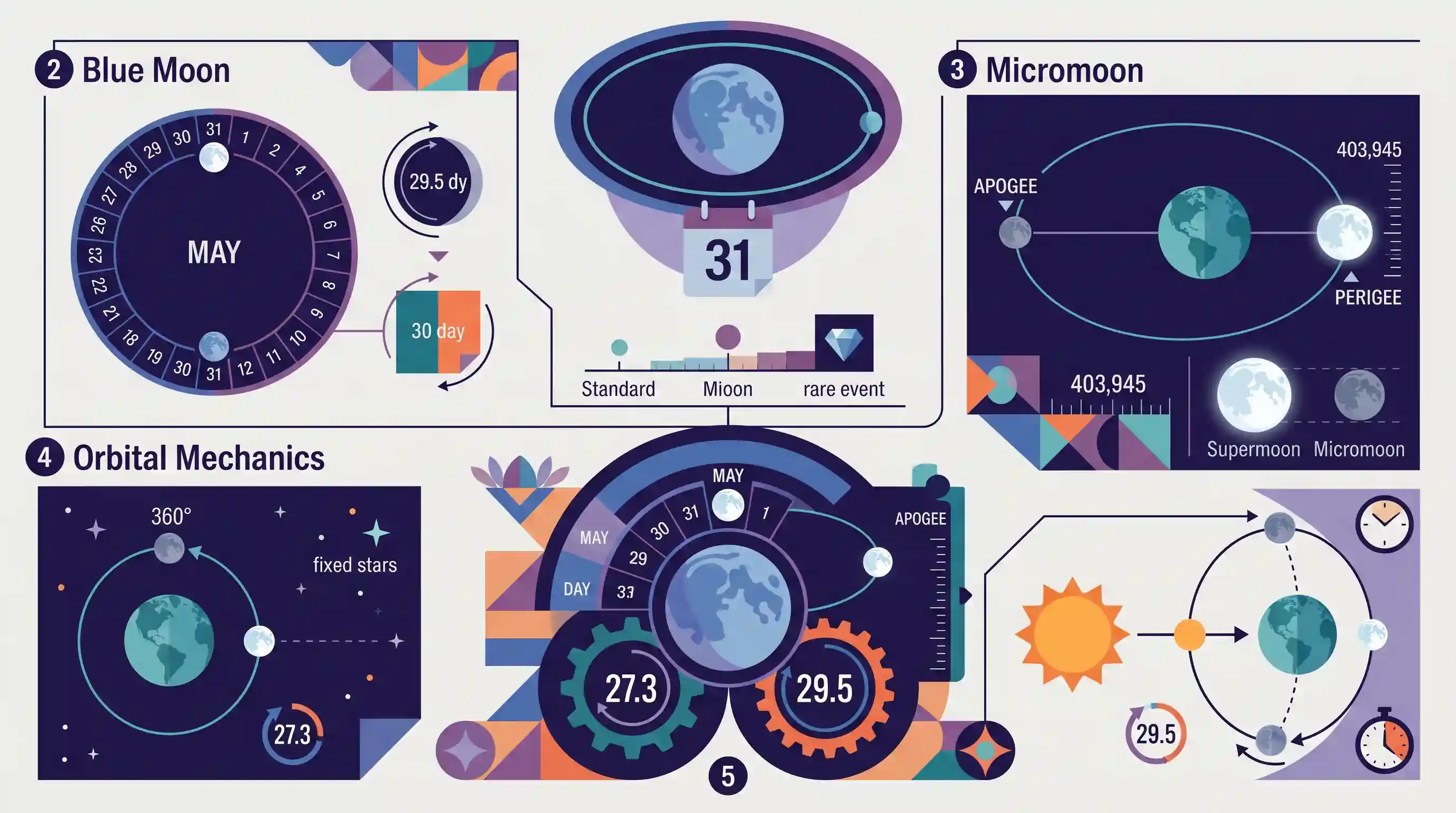
On May 31, 2026, a rare astronomical event known as a 'Blue Micromoon' will occur. A Blue Moon refers to the second full moon occurring within a single calendar month, a consequence of the 29.5-day lunar phase cycle being shorter than most calendar months. A Micromoon happens when a full moon coincides with the Moon's apogee—its farthest point from Earth along its elliptical orbit, approximately 403,945 kilometers away. In contrast, a Supermoon occurs at perigee (closest approach). These phenomena highlight fundamental orbital mechanics, stemming from the moon's 27.3-day orbital period and 29.5-day synodic phase cycle.
Key Points
- A 'Blue Moon' is the term for the second full moon occurring within a single calendar month.
- The moon takes 27.3 days to complete an orbit around Earth, but a full lunar phase cycle (synodic month) takes 29.5 days, leading to two full moons in a month occasionally.
- A 'Micromoon' happens when a full moon coincides with its apogee, the farthest point from Earth in its elliptical orbit (about 403,945 km away).
- Conversely, a 'Supermoon' occurs when a full moon coincides with perigee, its closest point to Earth (about 363,711 km away).
- On May 31, 2026, a rare 'Blue Micromoon' will occur, combining both phenomena.
Prelims Trap
"A Blue Moon refers to a lunar phenomenon where atmospheric scattering makes the moon appear blue."
A Blue Moon strictly denotes the second full moon in a calendar month, a result of the 29.5-day synodic cycle. It has absolutely no relation to actual physical colour or atmospheric optics.
Static Concepts Connected
What is the difference between a Sidereal and a Synodic month?
- Sidereal month: Takes 27.3 days. It is the time taken for the Moon to complete one orbit around Earth relative to distant fixed stars.
- Synodic month: Takes 29.5 days. It is the time taken for a full cycle of lunar phases (e.g., from full moon to full moon).
- The discrepancy: Because Earth also revolves around the Sun simultaneously, the Moon must travel an extra distance to realign its phase with both the Earth and the Sun.
How do Apogee/Perigee differ from Aphelion/Perihelion?
- Apogee and Perigee: These refer to the farthest (apogee) and closest (perigee) points of the Moon's, or any satellite's, elliptical orbit around the Earth.
- Aphelion and Perihelion: These refer to Earth's farthest (aphelion) and closest (perihelion) points in its elliptical orbit around the Sun.
Cross-Topic Patterns
Apogee/Perigee effect on Ocean Tides
A perigean full moon (Supermoon) causes unusually high 'King Tides'. Conversely, a Micromoon at apogee leads to weaker spring tides, directly impacting coastal navigation and estuarine ecosystems.
Lunar Eclipses vs. Orbital Tilt
Despite having two full moons in a month, eclipses remain rare. This is because the moon's orbit is tilted 5 degrees to Earth's ecliptic plane, only aligning at specific orbital nodes.

Statement-based Prelims question testing the distinction between sidereal (27.3 days) and synodic (29.5 days) lunar cycles is highly likely.
Linked PYQs · 2
Linked PYQs · 2
- 2017PrelimsGS1
The terms 'Event Horizon', 'Singularity', 'String Theory' and 'Standard Model' are sometimes seen in the news in the context of
- 2023PrelimsGS1
Consider the following pairs: Objects in space Description 1. Cepheids: Giant clouds of dust and gas in space 2. Nebulae: Stars which brighten and dim periodically 3. Pulsars: Neutron stars that are formed when massive stars run out of fuel and collapse How many of the above pairs are correctly matched?
