IISER Study on Blue Light Exposure and DNA Mutations in Yeast
Source:The Hindu ↗
Why It Matters
With the pervasive use of LEDs and digital devices, understanding the biological and genetic impacts of blue light is increasingly critical. This research highlights how environmental light spectrums can induce DNA damage and mutations, forming a vital component of UPSC's Science & Technology syllabus regarding everyday technology's effects on human health.
Summary
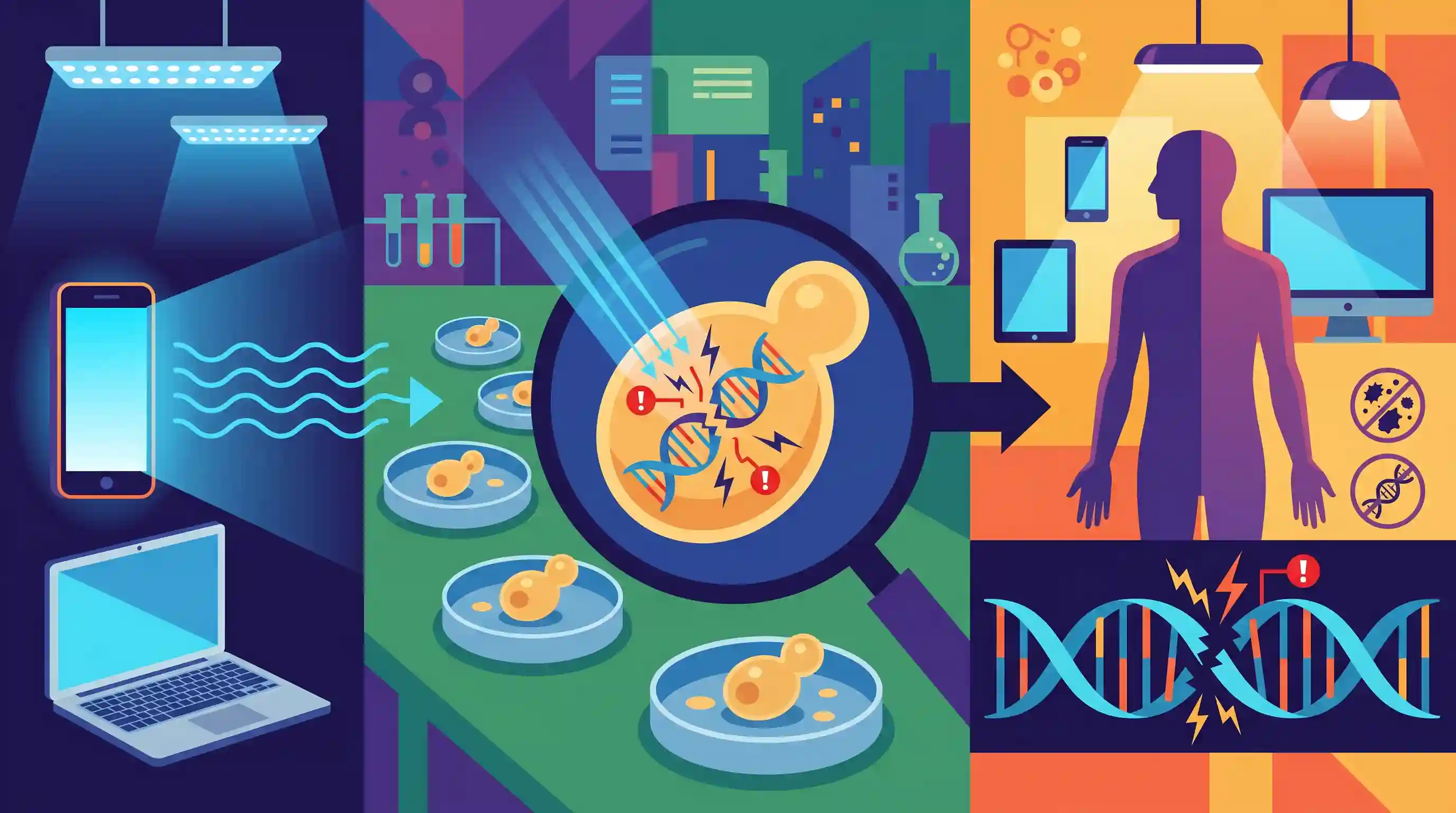
Researchers at the Indian Institute of Science Education and Research (IISER) Thiruvananthapuram have discovered that exposure to blue light increases DNA mutations in yeast. Because yeast is a well-established model organism whose cellular processes closely mirror those of humans and other higher eukaryotes, these findings have significant implications. The research sheds light on the potential genetic and biological risks posed by constant environmental exposure to artificial blue light, commonly emitted by LEDs and digital screens, and underscores its possible role in driving mutagenesis and associated diseases.
Key Points
- A recent study by IISER Thiruvananthapuram demonstrated that exposure to blue light elevates the rate of DNA mutations in yeast.
- Yeast is a highly reliable model organism for genetics and molecular biology, as many of its essential cellular mechanisms are shared with higher organisms, including humans.
- The study hints at the broader biological hazards associated with modern artificial lighting environments, particularly the ubiquitous use of blue-light-emitting LEDs and electronic screens.
- Given that DNA mutations can trigger a cascade of cellular dysfunction leading to aging and diseases like cancer, the findings emphasize the need to study the impact of specific light spectrums on the genome.
Important Terms
Indian Institute of Science Education and Research (IISER)

A group of seven autonomous premier institutes in India dedicated to high-quality science education and research, declared as 'Institutes of National Importance' by the Parliament.
UPSC context
GS Paper II (Education) and Paper III (Science & Technology); tests knowledge of India's premier R&D institutional framework.
Model Organism
A non-human species (like yeast) studied to understand biological processes, because its cellular mechanisms closely mirror those of humans and other complex organisms.
UPSC context
GS Paper III (Biotechnology); essential for understanding how scientific research translates from laboratory findings to human health applications.
Mutagenesis
The process by which the genetic material of an organism is changed, resulting in a mutation; can occur naturally or be induced by physical or chemical agents.
UPSC context
GS Paper III (Science & Tech/Genetics); relevant for understanding disease causes, evolution, and the impacts of environmental factors like radiation.
Loss of Heterozygosity (LOH)
A genetic mutation where one of the two alleles at a specific locus is lost, which can unmask recessive harmful mutations and is a key step in cancer development.
UPSC context
GS Paper III (Health/Genetics); a specialized term for genetic stability and disease mechanisms, often tested in Prelims or Science & Tech mains.
Oxidative Stress
An imbalance between the production of reactive oxygen species (free radicals) and the body's ability to detoxify them, leading to cellular and DNA damage.
UPSC context
GS Paper III (Science/Human Health); fundamental for understanding how environmental stressors like blue light or pollution cause biological aging and disease.
Eukaryotes
Organisms whose cells contain a nucleus and other membrane-bound organelles. This group includes yeast, plants, and animals, sharing fundamental biological pathways.
UPSC context
GS Paper III (General Science); a foundational biological classification necessary for understanding genetics, biotechnology, and microbiology.
Prelims Trap
"Yeast is a prokaryotic organism used extensively to study human cellular and disease mechanisms."
Yeast is a unicellular eukaryote, not a prokaryote. Its eukaryotic cellular structure and DNA repair mechanisms mirror those of humans, making it a reliable model organism.
Static Concepts Connected
How does blue light differ from other visible light in terms of physics?
- Shorter Wavelength: Blue light sits at the lower end of the visible spectrum, meaning it has a much shorter wavelength (approx 380-500 nm) compared to red or yellow light.
- High Photon Energy: Because wavelength is inversely proportional to energy, blue light has higher frequencies and carries the highest photon energy of all visible light.
How does artificial blue light affect human physiology and sleep?
- Melatonin Suppression: Exposure to blue light suppresses the secretion of melatonin, a critical sleep-regulating hormone produced by the pineal gland.
- Circadian Rhythm Disruption: This hormonal suppression tricks the brain into perceiving daylight, which disrupts the body's natural 24-hour internal clock (the circadian rhythm) and the sleep-wake cycle.
Cross-Topic Patterns
Light Pollution and Ecology
Artificial Light At Night (ALAN), particularly blue-rich LEDs, disrupts wildlife navigation and behaviors, severely impacting species like sea turtle hatchlings and migratory birds.
Urban Infrastructure vs. Health
The urban shift from traditional sodium streetlamps to energy-efficient LEDs reduces carbon footprints but introduces new public health concerns regarding chronic high-energy blue light exposure.

Expect a 2026 multi-statement question linking blue light from LEDs to melatonin suppression, circadian rhythm disruption, and mutagenesis.
Linked PYQs · 4
Linked PYQs · 4
- 2009PrelimsGS1
Which one among the following has the highest energy?
- 2021PrelimsGS1
With reference to street-lighting, how do sodium lamps differ from LED lamps? 1. Sodium lamps produce light in 360 degrees but it is not so in the case of LED lamps. 2. As street-lights, sodium lamps have longer life span than LED lamps. 3. The spectrum of visible light from sodium lamps is almost monochromatic while LED lamps offer significant colour advantages in street-lighting. Select the correct answer using the code given below.
- 2023PrelimsGS1
'Microsatellite DNA' is used in the case of which one of the following?
- 2021MainsGS3
What are the research and developmental achievements in applied biotechnology? How will these achievements help to uplift the poorer sections of the society?
