Rajasthan IVF centre penalised over ad violating PCPNDT and ART acts
Source:The Hindu ↗
Why It Matters
The case highlights the intersection of modern medical technologies (IVF, surrogacy) with deep-rooted social issues like son meta-preference and female foeticide. It tests the enforcement of the PCPNDT Act and the newer ART (Regulation) Act, 2021, and holds relevance for questions on demographic indicators (sex ratio) and women's rights in India.
Summary
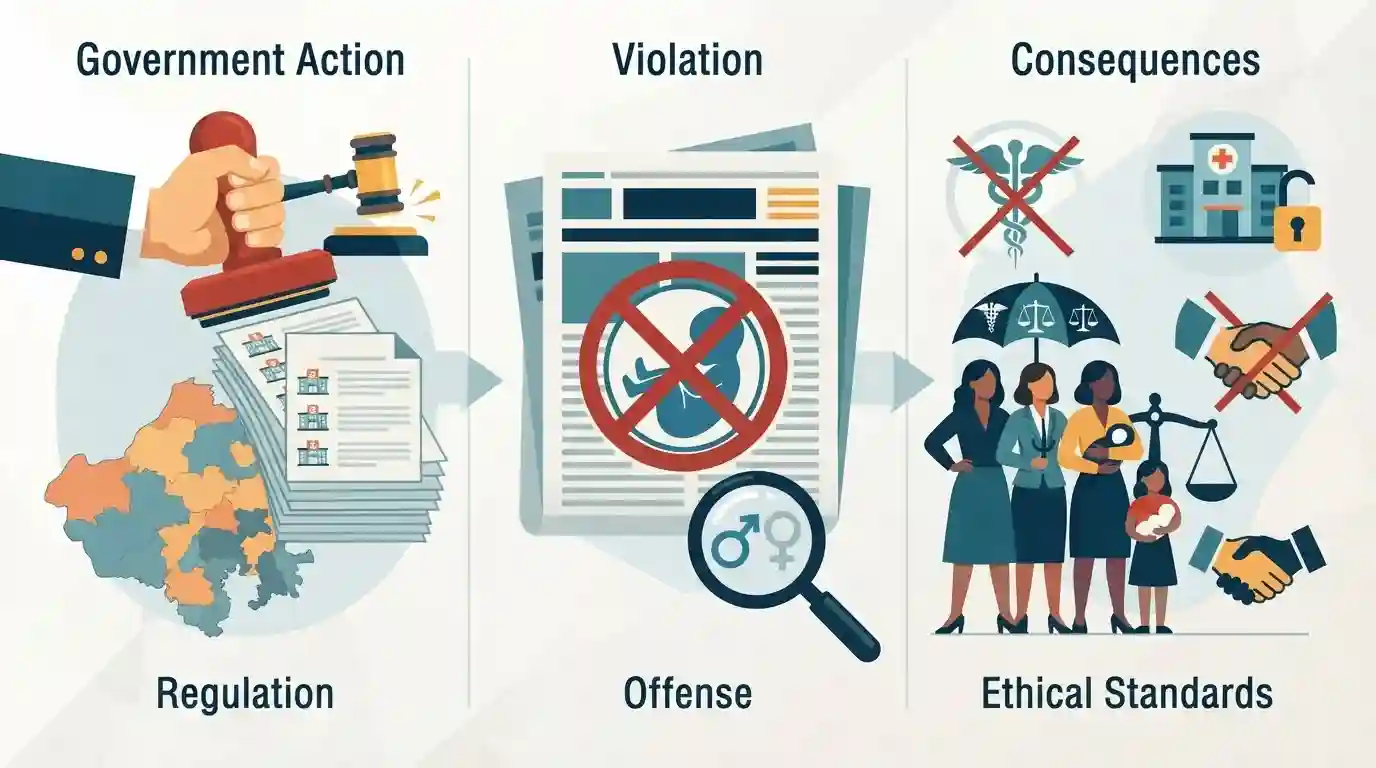
The Rajasthan government has taken strict action against an IVF and surrogacy clinic in Dausa for publishing a newspaper advertisement that depicted a blue-coloured foetus, a symbol commonly associated with a male child. Interpreting this as a violation of anti-sex selection laws and ethical standards, the Appropriate Authority for Assisted Reproductive Technology (ART) and Surrogacy suspended nine of the clinic's registration certificates under the ART (Regulation) Act, 2021. The Indian Medical Association (IMA) also condemned the advertisement for its implicit promotion of sex determination, which is strictly prohibited under the Pre-Conception and Pre-Natal Diagnostic Techniques (PCPNDT) Act. This incident underscores the state's ongoing efforts to regulate reproductive technologies and combat female foeticide.
Key Points
- The Rajasthan government suspended nine registration certificates of Neelkanth Fertility and Women’s Care Hospital in Dausa over a newspaper advertisement depicting a blue-coloured foetus.
- The advertisement was widely interpreted as an implicit promotion of sex selection, promoting a male child.
- Action was taken under the Assisted Reproductive Technology (Regulation) Act, 2021 by the State's Appropriate Authority for ART and Surrogacy.
- The Indian Medical Association (IMA) highlighted the unethical nature of the ad, arguing it violated the PCPNDT Act designed to prevent female foeticide.
Important Terms
Assisted Reproductive Technology (Regulation) Act, 2021

A central legislation enacted to monitor and regulate fertility clinics and gamete banks. It ensures ethical practices, prevents the commercialization of embryos, and protects the rights of donors and children born through ART.
UPSC context
Relevant for RAS Mains Paper III (Law) and Paper II (Science), testing knowledge of reproductive regulations and medical ethics.
Pre-Conception and Pre-Natal Diagnostic Techniques (PCPNDT) Act
A parliamentary act that prohibits prenatal sex determination and strictly regulates diagnostic techniques like ultrasounds. It aims to combat female foeticide and improve India's declining child sex ratio.
UPSC context
Crucial for RAS Mains Paper I (Sociology) and Paper III (Law), testing state mechanisms against gender discrimination and female foeticide.
Appropriate Authority for Assisted Reproductive Technology (ART) and Surrogacy
A statutory state-level regulatory body mandated by the ART and Surrogacy Acts. It enforces compliance, investigates complaints, and possesses the power to grant, suspend, or cancel clinic registrations.
UPSC context
Important for RAS Mains Paper III (Public Administration), illustrating state-level enforcement bodies regulating healthcare operations in Rajasthan.
Indian Medical Association (IMA)
Established in 1928, the IMA is the largest voluntary organization of modern medical doctors in India. It works to advance public health, uphold medical ethics, and protect the interests of medical professionals.
UPSC context
Useful for RAS Mains Paper III (Current Affairs), highlighting the role of professional bodies in upholding medical ethics and public health.
Prelims Trap
The clinic's registration was suspended under the PCPNDT Act for sex determination.
While the ad violated the spirit of the PCPNDT Act, the actual suspension of the IVF clinic's registration was executed under the ART (Regulation) Act, 2021.
Static Concepts Connected
What are the core prohibitions under the PCPNDT Act, 1994?
- Pre-conception ban: Bans the use of any sex selection techniques before or after conception (including IVF sex selection).
- Communication ban: Strictly prohibits communicating the sex of the foetus to anyone via words, signs, symbols, or gestures.
- Advertising ban: Bans all forms of advertisements (print, digital, or implicit symbols) promoting pre-natal sex determination.
What are the key facts regarding Rajasthan's sex ratio (Census 2011)?
- State Average: The state average is 928 females per 1000 males, which is below the national average.
- Rural vs Urban: The rural sex ratio (933) is significantly higher than the urban sex ratio (914).
- Top Performer: Pali is the only district in Rajasthan where the rural sex ratio exceeds 1000 (1003).
Cross-Topic Patterns
ART Act meets Census Demographics
Questions often link regulatory acts like ART/PCPNDT with Rajasthan’s skewed demographic data, specifically district-wise child sex ratios and government schemes like Beti Bachao Beti Padhao.
Bioethics and Reproductive Tech
The intersection of IVF commercialization, surrogacy regulation, and ethical medical advertising is a rising theme in Mains GS Paper II (Social Justice and Health policies).

Expect a multi-statement Prelims question combining provisions of the ART Act 2021 with Rajasthan's 2011 Census sex ratio data.
Linked PYQs · 2
Linked PYQs · 2
- 2016RPSC_PRELIMSGS1
According to the 2011 census, which of the following statements are correct regarding the sex ratio (number of women per 1000 men) in Rajasthan? Choose the correct answer using the code below – 1. In 2011, the sex ratio in Rajasthan was lower than the national average. 2. In 2011, the sex ratio was less than 1000 in all districts of Rajasthan. 3. In 2011, the sex ratio was less than 1000 in all rural areas of Rajasthan (except Pali district). 4. In 2011, the sex ratio was less than 1000 in all urban areas of Rajasthan (except Dhaulpur district). Code:
- 2021RPSC_PRELIMSGS1
According to the 2011 census, in which districts of Rajasthan is the rural-urban sex ratio highest? Rural Sex Ratio – Urban Sex Ratio (A) Rajsamand – Banswara (B) Dungarpur – Tonk (C) Pali – Churu (D) Jalore – Nagaur
