Supreme Court Ruling on Governor Assent and State Bills
Source:The Hindu ↗
Why It Matters
The editorial highlights a critical shift in the balance of power between the Union executive (via Governors) and State Legislatures, directly impacting the federal structure of India. It emphasizes the lack of a time frame for giving assent to bills, a recurring point of contention in polity and center-state relations.
Summary
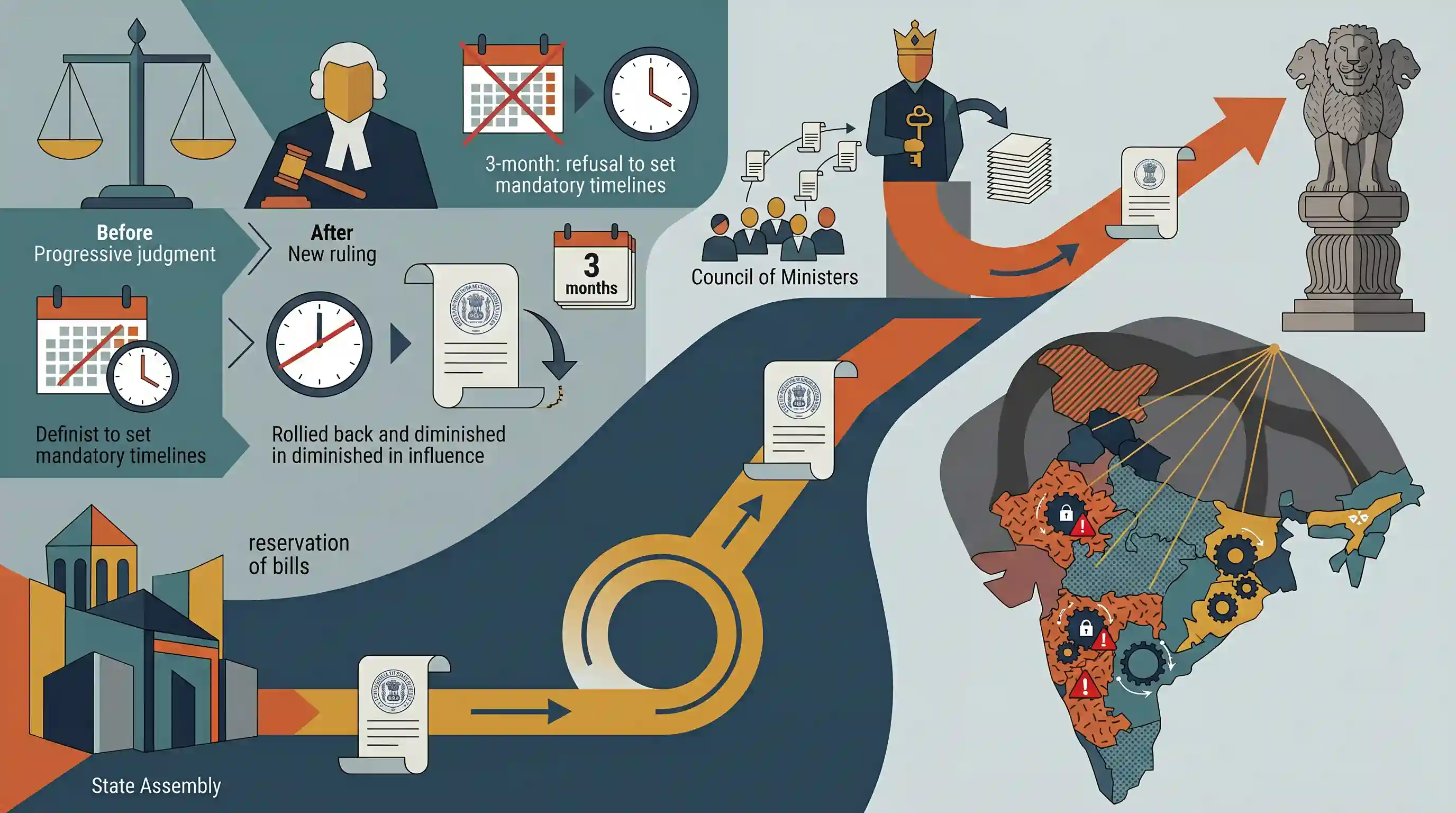
The Supreme Court ruling on the 16th Presidential Reference refused to set mandatory timelines for Governors or the President to act on State Bills, reversing a previous progressive judgment that mandated a three-month deadline and employed Article 142 for deemed assent. The Court affirmed that Governors are not bound by the aid and advice of the Council of Ministers in this context and allowed them to reserve bills for the President even after a state assembly repasses them. This diverges from the original constitutional intent, overrides the Punchhi Commission's six-month recommendation, and leaves Opposition-ruled states vulnerable to unchecked executive overreach and prolonged legislative paralysis.
Key Points
- The Supreme Court rejected the concept of deemed consent and reversed an earlier April 2025 judgment that had established a three-month timeline for deciding on State Bills using Article 142.
- The 16th Presidential Reference opinion permits Governors to withhold assent without relying on the aid and advice of the Council of Ministers.
- Governors can now reserve bills for the President even after they have been re-passed by a State Legislature, defeating the mandatory nature of a second passage.
- The ruling disregards the historical omission of the phrase in his discretion from Articles 200 and 201 during the framing of the Constitution.
- The verdict ignores the Punchhi Commission’s recommendation limiting a Governor's decision window to a maximum of six months.
- The judgment deals a blow to federalism by enabling executive overreach, particularly affecting Opposition-ruled States by leaving them without remedies against indefinite legislative delays.
Important Terms
Article 200

Article outlining the Governor’s options for State Bills: grant assent, withhold assent, return for reconsideration (non-Money Bills), or reserve for the President. It uses the phrase "as soon as possible."
UPSC context
GS Paper-II (Polity); tests the Governor's legislative role, discretionary powers, and the impact of delays on state autonomy.
Article 201
Governs the President’s role for State Bills reserved by a Governor. The President may grant assent, withhold it, or direct the Governor to return the Bill for reconsideration.
UPSC context
GS Paper-II (Federalism); examines Union-State legislative relations and the President's discretionary power over regional laws.
16th Presidential Reference
A landmark 2025 Supreme Court advisory opinion under Article 143 ruling that the judiciary cannot fix mandatory timelines for the Governor or President to act on State Bills.
UPSC context
GS Paper-II; tests knowledge of the Supreme Court's advisory jurisdiction and the evolving boundaries between judicial and executive powers.
Article 142
Empowers the Supreme Court to issue orders to ensure "complete justice." Previously used to set bill deadlines, the 16th Reference clarified it cannot override specific constitutional provisions.
UPSC context
GS Paper-II; crucial for evaluating judicial activism vs. restraint and the limits of the Court's extraordinary powers.
Punchhi Commission
A 2007 commission on Centre-State relations that recommended a six-month window for Governors to decide on Bills and suggested making the Governor’s office more detached from politics.
UPSC context
GS Paper-II; standard reference for mains answers on improving federal relations and reforming the Governor's office.
Federalism
A constitutional setup where power is divided between the Centre and States. Gubernatorial delays on State Bills are often viewed as a challenge to cooperative federalism.
UPSC context
GS Paper-II (Basic Structure); tests the ability to analyze tensions between appointed federal agents and elected state governments.
Council of Ministers
The body of ministers headed by the Chief Minister. While usually providing "aid and advice," the SC clarified that Governors exercise independent discretion regarding Bill assent.
UPSC context
GS Paper-II (Executive); explores the nuance between the Governor's ministerial-dependent and discretionary constitutional functions.
Prelims Trap
A Governor must grant assent to a repassed State Bill and cannot reserve it for the President.
The recent SC ruling in the 16th Presidential Reference explicitly permits Governors to reserve a State Bill for the President even after the State Legislature has repassed it.
Static Concepts Connected
What are the Governor's four alternatives under Article 200 for a State Bill?
- Grant Assent: The Governor may sign the bill, making it an enacted law.
- Withhold Assent: The Governor may reject the bill, effectively ending its legislative journey (except for repassed bills).
- Return the Bill: The Governor can send non-Money Bills back to the House for reconsideration of specific provisions.
- Reserve for President: The Governor can reserve the bill for the President. This is mandatory if the bill endangers the position of the State High Court.
What is the Supreme Court's Advisory Jurisdiction under Article 143?
- Public Importance Consultations: The President can seek the SC's opinion on any question of law or fact of public importance.
- Pre-Constitution Treaties: The President can seek advice on disputes arising from pre-constitutional treaties, agreements, or sanads, where the SC must tender its opinion.
- Non-Binding Nature: The opinions delivered are purely advisory and do not constitute binding judicial pronouncements on the President or lower courts.
Cross-Topic Patterns
Discretion vs. Representative Democracy
The tension between appointed Governors withholding legislative assent and elected State governments heavily parallels the ongoing constitutional debates regarding the discretionary powers of the Lieutenant Governor in the NCT of Delhi.
Judicial Restraint and Article 142
By refusing to invoke Article 142 to impose timelines on constitutional authorities (Article 361 immunity), the SC exhibited judicial restraint, reversing its previous proactive stance on executive accountability.

A 2026 Prelims question will likely test the exact sequence of Article 200/201 and whether a repassed bill can be reserved for the President.
Linked PYQs · 3
Linked PYQs · 3
- 2022MainsGS2
Discuss the essential conditions for exercise of the legislative powers by the Governor. Discuss the legality of re-promulgation of ordinances by the Governor without placing them before the Legislature.
- 2025PrelimsGS1
Consider the following statements : I. The Constitution of India explicitly mentions that in certain spheres the Governor of a State acts in his/her own discretion. II. The President of India can, of his/her own, reserve a bill passed by a State Legislature for his/her consideration without it being forwarded by the Governor of the State concerned. Which of the statements given above is/are correct?
- 2023PrelimsGS1
Consider the following statements: 1. If the election of the President of India is declared void by the Supreme Court of India, all acts done by him/her in the performance of duties of his/her office of President before the date of decision become invalid. 2. Election for the post of the President of India can be postponed on the ground that some Legislative Assemblies have been dissolved and elections are yet to take place. 3. When a Bill is presented to the President of India, the Constitution prescribes time limits within which he/she has to declare his/her assent. How many of the above statements are correct?
