Lok Sabha Speaker denial of speech to opposition leader in Parliament
Source:The Hindu ↗
Why It Matters
The dispute highlights structural and procedural issues related to the functioning of Parliament, the impartiality expected of the Speaker, and the essential democratic role of the Opposition in holding the executive accountable. These are core themes for UPSC GS Paper 2 (Polity and Governance).
Summary
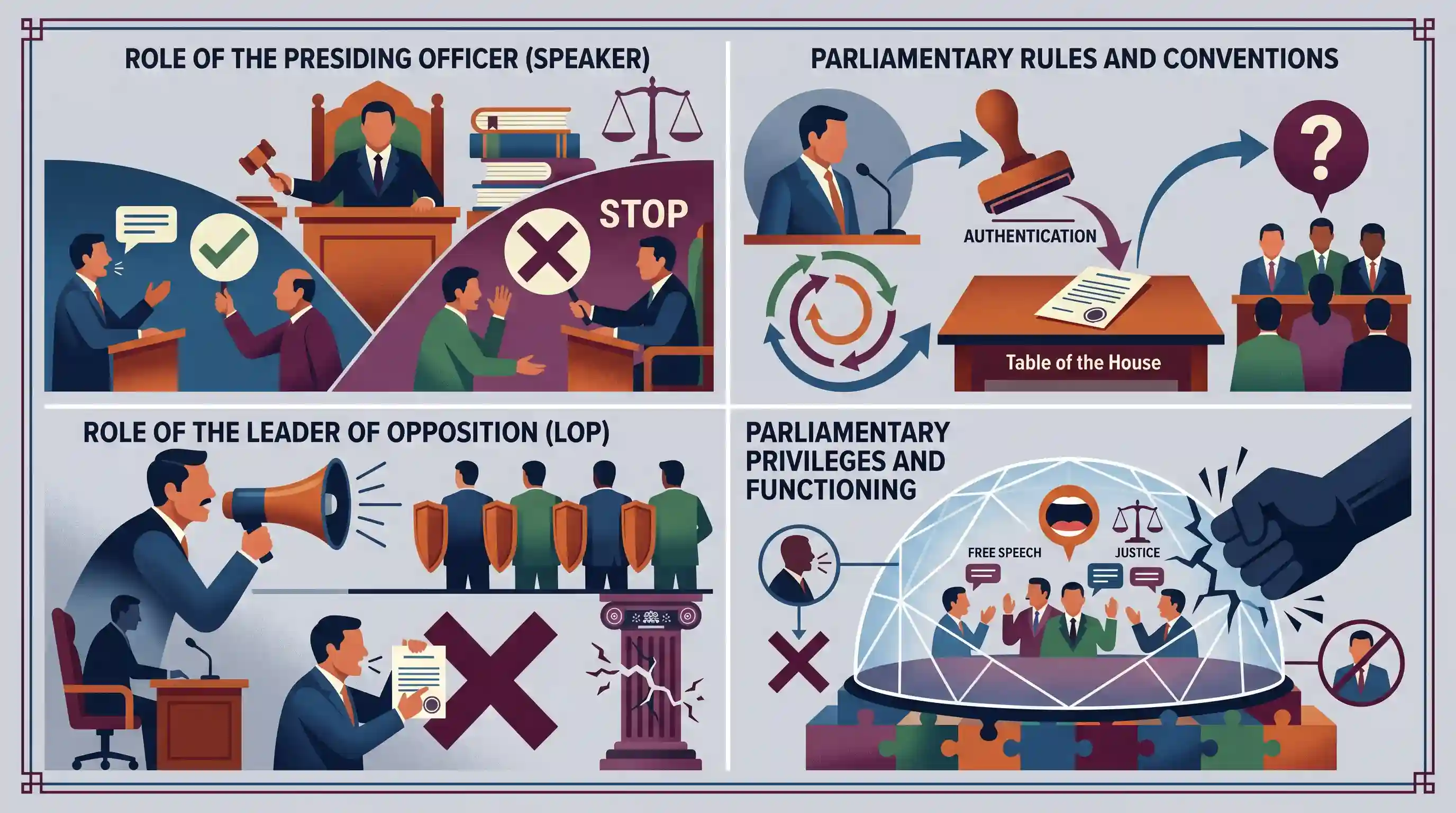
Leader of the Opposition Rahul Gandhi lodged a formal protest with Lok Sabha Speaker Om Birla after being denied permission to speak in the House regarding the 2020 India-China conflict. Gandhi had fulfilled the procedural requirement of authenticating a magazine article that quoted former Army Chief M.M. Naravane's unpublished memoir. He argued that according to established parliamentary conventions and prior Speaker rulings, once a member authenticates a document, they should be allowed to present their view, transferring the responsibility of a response to the government. Labeling the Speaker's actions a "blot on our democracy," Gandhi asserted that silencing the Leader of the Opposition in this manner violates fundamental democratic rights and parliamentary traditions.
Key Points
- Leader of Opposition Rahul Gandhi was denied permission to speak in the Lok Sabha by Speaker Om Birla despite authenticating a document, breaking parliamentary convention.
- Gandhi sought to raise issues concerning the 2020 India-China border conflict based on a magazine article quoting former Army Chief M.M. Naravane's unpublished memoir.
- According to established parliamentary rules, once a member authenticates a document and accepts responsibility for it, the Chair's role concludes and the member must be allowed to speak.
- Gandhi criticized the Speaker's obstruction as a 'blot on democracy' and an unprecedented violation of the rights of the Opposition and Parliamentarians.
Important Terms
Lok Sabha Speaker

The constitutional head of the Lok Sabha (Article 93) responsible for maintaining order, interpreting rules, and protecting the rights of members. The Speaker's decisions on house procedures are final.
UPSC context
GS Paper II: Parliament; critical for understanding the neutrality and authority of the presiding officer in legislative debates.
Leader of the Opposition (LoP)
A statutory post (Salaries and Allowances of Leaders of Opposition in Parliament Act, 1977) held by the leader of the largest opposition party having at least one-tenth strength of the House.
UPSC context
GS Paper II: Legislature; essential for studying the role of the opposition in ensuring executive accountability and shadow governance.
Authentication of Documents
A procedural requirement (Rule 369) where a member quoting from a private document must certify its authenticity, thereby taking personal responsibility for its accuracy before it can be part of the House record.
UPSC context
GS Paper II: Parliamentary Procedures; tests knowledge of the rules governing evidence-based debate and the responsibilities of members.
Parliamentary Privileges
Special legal rights and immunities (Article 105) granted to members of Parliament and committees to ensure they can perform their duties without fear of obstruction or legal action.
UPSC context
GS Paper II: Powers, Privileges and Immunities of Parliament; focuses on the balance between free speech in the House and legislative decorum.
Rules of Procedure and Conduct of Business
The formal guidelines framed under Article 118(1) that regulate the internal functioning of the Lok Sabha, the conduct of its members, and the sequence of legislative business.
UPSC context
GS Paper II: Functioning of Legislature; important for understanding how the House manages debates and maintains order.
Parliamentary Conventions
Unwritten traditions and established precedents that guide parliamentary behavior and decision-making where the written rules are silent, ensuring the smooth functioning of democracy.
UPSC context
GS Paper II: Constitutional Governance; involves the evolution of legislative practices and the importance of precedents in democratic institutions.
Prelims Trap
"The Constitution of India explicitly details the criteria for recognizing the Leader of the Opposition in the Lok Sabha."
The LoP is not mentioned in the Constitution. It is a statutory post governed by the Salary and Allowances of Leaders of Opposition in Parliament Act, 1977.
Static Concepts Connected
What is the procedural and statutory basis of the Leader of the Opposition (LoP)?
- Statutory backing: Formally recognized under the Salary and Allowances of Leaders of Opposition in Parliament Act, 1977.
- 10% Quorum rule: By convention (Mavalankar rule), the LoP's party must hold at least 1/10th of the total strength of the House to be recognized.
- Selection panels: The LoP is a statutory member of critical selection committees for the CBI Director, CVC, Lokpal, and Chief Election Commissioner.
What powers does the Speaker hold regarding Parliamentary debates and documents?
- Regulating debate: Under Rule 350, the Speaker maintains absolute discretion over the floor; members may only speak when their names are called.
- Authenticating documents: Under Rule 369, any paper laid on the Table must be authenticated by the member, who then assumes responsibility for its accuracy.
- Absence of neutrality: Unlike the UK convention, an Indian Speaker does not resign from their political party, leading to frequent debates regarding partisan bias.
Cross-Topic Patterns
Speaker's Powers vs. Executive Accountability
The tension between the Speaker's authority to regulate House rules and the Opposition's mandate to hold the executive accountable frequently appears in Mains GS-II questions on institutional functioning.
National Security & Parliamentary Oversight
Discussing the 2020 India-China border conflict through a former Army Chief's memoir links parliamentary privilege directly with civil-military relations and external security transparency.

Expect a Prelims statement comparing the statutory status of the LoP with constitutional offices, or a Mains Q on the Speaker's neutrality.
Linked PYQs · 4
Linked PYQs · 4
- 2020MainsGS2
Once a Speaker, Always a Speaker' ! Do you think this practice should be adopted to impart objectivity to the office of the Speaker of Lok Sabha ? What could be its implications for the robust functioning of parliamentary business in India?
- 2021MainsGS2
To what extent, in your view, the Parliament is able to ensure accountability of the executive in India?
- 2019MainsGS2
Individual Parliamentarian's role as the national law maker is on a decline, which in turn, has adversely impacted the quality of debates and their outcome. Discuss.
- 2022PrelimsGS1
With reference to Deputy Speaker of Lok Sabha, consider the following statements: 1. As per the Rules of Procedure and Conduct of Business in Lok Sabha, the election of Deputy Speaker shall be held on such date as the Speaker may fix. 2. There is a mandatory provision that the election of a candidate as Deputy Speaker of Lok Sabha shall be from either the principal opposition party or the ruling party. 3. The Deputy Speaker has the same power as of the Speaker when presiding over the sitting of the House and no appeal lies against his rulings. 4. The well established parliamentary practice regarding the appointment of Deputy Speaker is that the motion is moved by the Speaker and duly seconded by the Prime Minister. Which of the statements given above are correct?
