Pune election office opposes census duty deployment for BLOs
Source:Indian Express ↗
Why It Matters
This highlights the practical administrative bottlenecks at the grassroots level, where the same set of field workers (like BLOs and teachers) are deployed for both electoral roll management and census enumeration. It is highly relevant for GS2 (Governance, Election Commission, Local Administration) and understanding state capacity constraints.
Summary
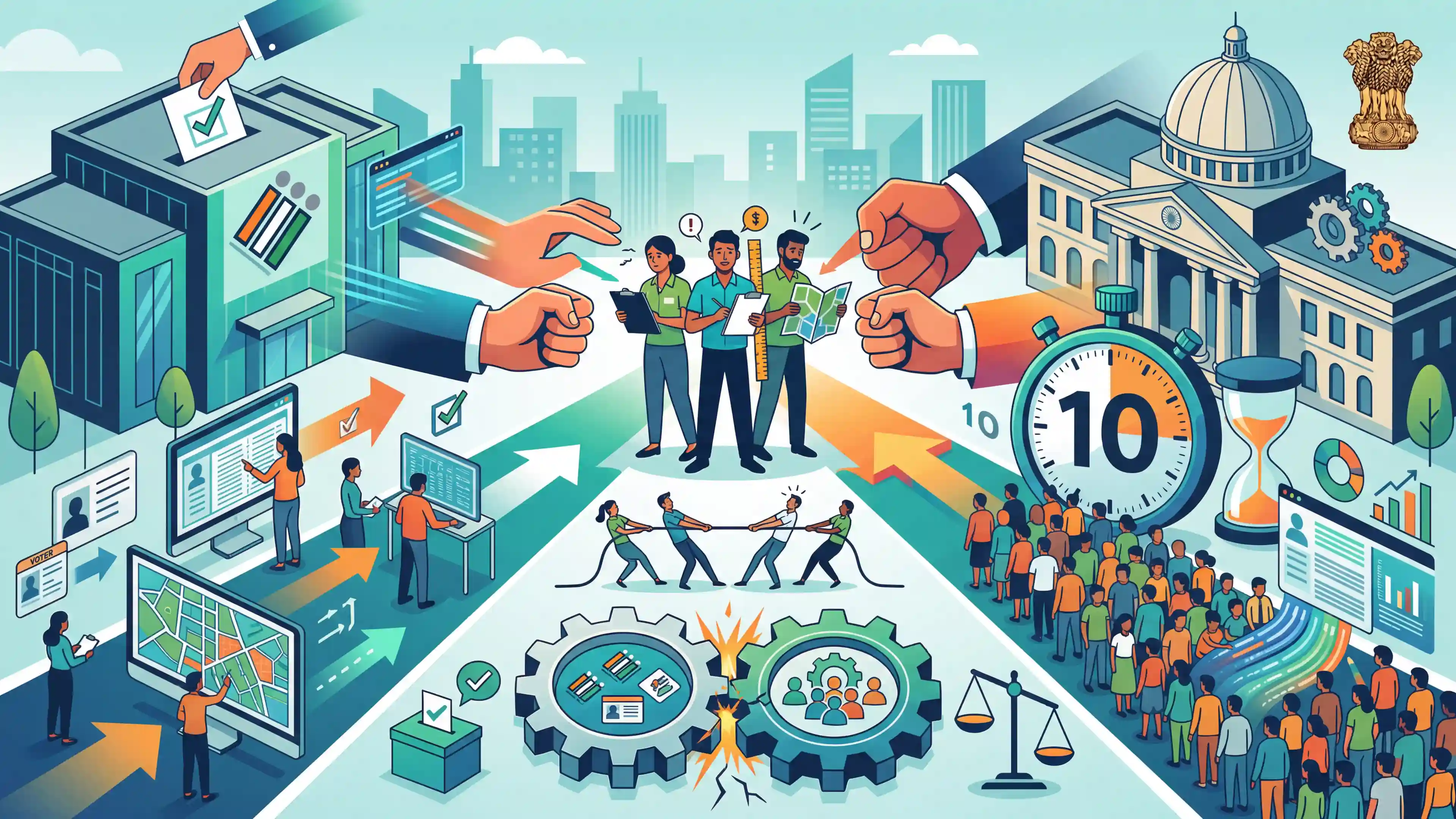
A jurisdictional and administrative dispute has emerged between the Pune district election office and the Pune Municipal Corporation (PMC) over the deployment of Block Level Officers (BLOs). The election office requested that BLOs be exempted from census duties to focus on 'pre-SIR mapping' and electoral roll revisions. However, district authorities maintained that the upcoming decadal census is a time-bound, paramount national priority that supersedes electoral roll updates during non-election periods. This friction underscores the chronic capacity constraints and human resource challenges faced by urban local bodies and district administrations when managing overlapping democratic and demographic exercises.
Key Points
- The Pune district election office requested the Pune Municipal Corporation (PMC) to exempt Block Level Officers (BLOs) from upcoming census duties.
- The election office cited that census work is delaying 'pre-SIR (Standardised Information on Residents) mapping', which involves verifying current voter lists against 2002 records.
- The PMC countered that the decadal census is a paramount, time-bound national priority, especially since no local elections are imminent.
- The census schedule includes self-enumeration from May 1 to May 15, followed by field operations from May 16 to June 14.
- The incident highlights the administrative strain and inter-departmental friction regarding the allocation of grassroots personnel for overlapping national exercises.
Important Terms
Block Level Officer (BLO)

A local government or semi-government official appointed by the Election Commission to maintain the electoral roll at the polling booth level through house-to-house verification and voter facilitation.
UPSC context
GS-II: Governance and Elections. Tests knowledge of grassroots electoral administration and the personnel responsible for 'error-free' voter lists.
Special Intensive Revision (SIR)
An exhaustive, time-bound house-to-house verification drive by the ECI to cleanse electoral rolls of duplicates and 'ghost voters' while ensuring 100% inclusion of eligible citizens.
UPSC context
GS-II: Electoral Reforms. Tests understanding of different types of electoral roll updates (summary vs. intensive) and their statutory basis.
Decadal Census
A massive national exercise conducted under the Census Act, 1948, to collect demographic, social, and economic data, serving as the basis for resource allocation and policy formulation.
UPSC context
GS-II: Governance/Human Resources. Tests knowledge of the constitutional/legal mandate of population enumeration and its administrative priority over other duties.
Representation of the People Act, 1950
The principal legislation governing the preparation of electoral rolls, the qualification of voters, and the delimitation of constituencies in India.
UPSC context
GS-II: Salient features of the Representation of People's Act. A core syllabus area for both Prelims and Mains.
Urban Local Bodies (ULBs)
Constitutional local government institutions (e.g., Municipal Corporations) established under the 74th Amendment Act to manage urban governance and provide civic services.
UPSC context
GS-II: Devolution of powers and finances to local levels. Highlights the '3F' (Functions, Funds, Functionaries) challenges in urban administration.
Article 324
A constitutional provision that grants the Election Commission of India plenary powers for the 'superintendence, direction, and control' of the preparation of electoral rolls.
UPSC context
GS-II: Constitutional Bodies. Fundamental for understanding the ECI's authority over state and local administrative staff during election-related work.
Prelims Trap
BLOs are exclusive staff of the Election Commission and cannot be requisitioned for non-election duties.
BLOs are state/local government employees. Under the Census Act 1948, the government has a legally binding mandate to requisition local personnel for census duties.
Static Concepts Connected
What is the constitutional and legal basis of the Decadal Census?
- Constitutional Status: It is a Union subject under Article 246 (Entry 69 of the Seventh Schedule).
- Nodal Authority: Conducted by the Office of the Registrar General and Census Commissioner, under the Ministry of Home Affairs.
- Statutory Framework: Governed by the Census Act, 1948, which allows the government to legally requisition services of local body personnel for enumeration.
Who appoints Block Level Officers (BLOs) and under what authority?
- Appointment Authority: Electoral Registration Officers (EROs) appoint them under Section 13B(2) of the Representation of the People Act, 1950.
- Personnel Sourcing: They are not exclusive ECI staff; they are drawn from state government, local bodies, or public sector undertakings (e.g., teachers, clerks).
- Core Role: Their primary statutory responsibility is to maintain, update, and verify electoral rolls at the polling station level.
Cross-Topic Patterns
Article 324 vs Census Act mandates
The tug-of-war between continuous electoral roll revision and time-bound demographic exercises exposes jurisdictional overlaps between the Election Commission's mandate and the Ministry of Home Affairs.
ULB capacity and overlapping national exercises
High staff vacancies in urban local bodies force the same grassroots workers to execute multiple concurrent national priorities, highlighting a major governance bottleneck at the district level.

Expect a multi-statement question in 2026 on the statutory powers of the ECI vs MHA to requisition local body staff for national exercises.
Linked PYQs · 2
Linked PYQs · 2
- 2022MainsGS2
Discuss the role of the Election Commission of India in the light of the evolution of the Model Code of Conduct.
- 2024MainsGS1
What is the concept of a 'demographic winter'? Is the world moving towards such a situation? Elaborate.
