US Interventionism and Geopolitics of Venezuela Oil Reserves
Source:The Hindu ↗
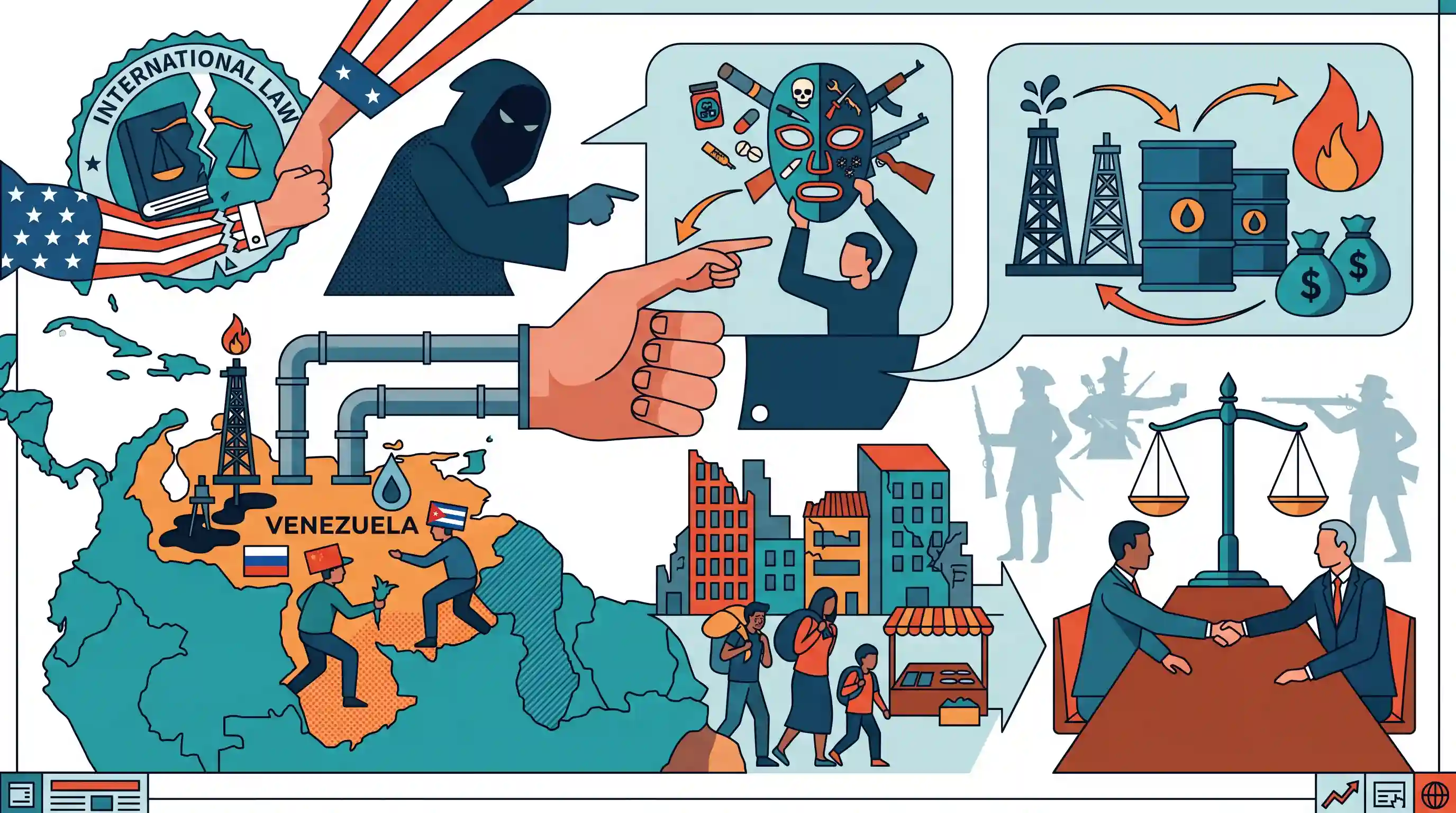
Why It Matters
It highlights the continuing impact of US interventionism and Cold War-era tactics on global geopolitics, offering critical context on energy security, resource nationalism, and the violation of international law.
Summary
The editorial strongly criticizes the Trump administration's authorization of covert CIA operations against Nicolás Maduro's government in Venezuela, describing it as illegal interventionism. While acknowledging the Maduro regime's democratic backsliding and economic mismanagement—which has caused a severe refugee crisis—the piece argues that the US is using false pretexts like "narcoterrorism" to justify its actions. The true motives are identified as a desire to control Venezuela's vast oil and natural gas reserves and to counter the geopolitical influence of Russia, China, and Cuba. The article draws parallels to historical US interference in Latin America and urges diplomatic engagement over violations of international law.
Key Points
- The US administration under President Donald Trump has admitted to authorising covert CIA operations against the government of Nicolás Maduro in Venezuela.
- These actions are part of a long historical pattern of destabilising US interventions in Latin America, such as in Guatemala (1954), Cuba, Chile (1973), and Nicaragua (1980s).
- The US justifies these measures by citing Venezuela's disputed elections, the massive refugee crisis, and unproven claims that Maduro is a "narcoterrorist".
- The real motive behind the aggression is perceived to be control over Venezuela's massive petroleum and natural gas reserves and countering Russian, Chinese, and Cuban influence in the region.
- The editorial calls for the international community to reject Cold War-era regime change tactics and support diplomatic solutions that respect Venezuela's sovereignty.
Important Terms
CIA (Central Intelligence Agency)

The primary U.S. foreign intelligence service, responsible for gathering human intelligence (HUMINT) and conducting covert operations to protect national security interests globally.
UPSC context
GS II (International Relations); tests understanding of foreign intelligence influence and the impact of covert actions on global stability and bilateral relations.
National Intelligence Council (NIC)
A strategic body within the U.S. intelligence community that bridges intelligence and policy, producing long-term assessments like 'Global Trends' to guide senior policymakers.
UPSC context
GS II (International Relations); relevant for analyzing how strategic intelligence analysis shapes the foreign policy and grand strategy of global powers.
Monroe Doctrine
A 19th-century U.S. foreign policy opposing European interference in the Americas, historically expanded (Roosevelt Corollary) to justify U.S. intervention and dominance in Latin American affairs.
UPSC context
GS I (World History) & GS II (International Relations); essential for understanding the roots of U.S. hegemony in Latin America.
Narcoterrorism
The nexus between drug trafficking and terrorist activities, where illicit trade funds violence. It is often cited as a national security pretext for foreign military or covert intervention.
UPSC context
GS III (Internal Security); tests knowledge of the nexus between organized crime and terrorism and its use in justifying international security operations.
Sovereignty
The legal principle of a state's absolute authority over its territory. In international relations, it often conflicts with concepts of humanitarian intervention and foreign political pressure.
UPSC context
GS II (Polity & IR); core concept for evaluating the legitimacy of foreign interventions and the tension between national autonomy and international law.
Venezuela Refugee Crisis
The ongoing mass migration of millions from Venezuela due to hyperinflation and political instability; it is currently the largest recorded displacement crisis in the Americas.
UPSC context
GS II (International Relations/Global Migration); case study for regional instability and the role of international bodies like the UNHCR.
Prelims Trap
"Venezuela is the largest producer and exporter of crude oil in the world."
Venezuela holds the world's largest proven oil reserves, but its actual production and exports are severely low due to infrastructural decay and US sanctions.
Static Concepts Connected
What is the Monroe Doctrine and its historical relevance?
- Core Principle: An 1823 US policy opposing European colonialism in the Americas, effectively declaring the Western Hemisphere an exclusive US sphere of influence.
- Roosevelt Corollary: A 1904 addition asserting the US's right to intervene militarily to stabilize the economies of Latin American and Caribbean nations.
- Modern Context: Historically used for interventions (Operation Condor), the doctrine is implicitly invoked today to counter Chinese and Russian geopolitical footprints in the region.
What are the key geographical features of Venezuela relevant to UPSC?
- Orinoco Belt: A vast territory in central Venezuela along the Orinoco River that holds massive deposits of extra-heavy crude oil.
- Lake Maracaibo: A large tidal bay in northwest Venezuela, heavily polluted but historically the center of the country's immense oil wealth.
- Darién Gap: A highly dangerous, dense jungle region connecting Colombia and Panama, functioning as a major transit route for the current Venezuelan migration crisis.
Cross-Topic Patterns
Energy Security + Sanctions Diplomacy
US sanctions on Venezuela and Iran complicate India's energy import diversification strategy, forcing heavier reliance on Middle Eastern or Russian crude despite strategic autonomy efforts.
Pink Tide + China's BRI
The resurgence of left-wing governments in Latin America (Pink Tide) has accelerated China's Belt and Road investments, challenging US hegemony and sparking Cold War-style proxy competition.

Map questions on Latin America (Darién Gap, Orinoco) or a Mains Q on US-China proxy rivalry in the region are highly likely in 2026.
Linked PYQs · 3
Linked PYQs · 3
- 2024PrelimsGS1
Consider the following statements : Statement-I : Recently, Venezuela has achieved a rapid recovery from its economic crisis and succeeded in preventing its people from fleeing/emigrating to other countries. Statement-II : Venezuela has the world's largest oil reserves. Which one of the following is correct in respect of the above statements?
- 2025MainsGS2
"Energy security constitutes the dominant kingpin of India's foreign policy, and is linked with India's overarching influence in Middle Eastern countries.” How would you integrate energy security with India's foreign policy trajectories in the coming years?
- 2017MainsGS2
The question of India's Energy Security constitutes the most important part of India's economic progress. Analyze India's energy policy cooperation with West Asian countries.
