Urban terrorism threat and central intelligence investigative response
Source:The Hindu ↗
Why It Matters
The incident underscores the persistent threat of urban terrorism targeting critical infrastructure and heritage sites. It provides a real-world case study for UPSC aspirants on the immediate mobilization and roles of central agencies (NIA, NSG) in responding to and investigating complex internal security challenges.
Summary
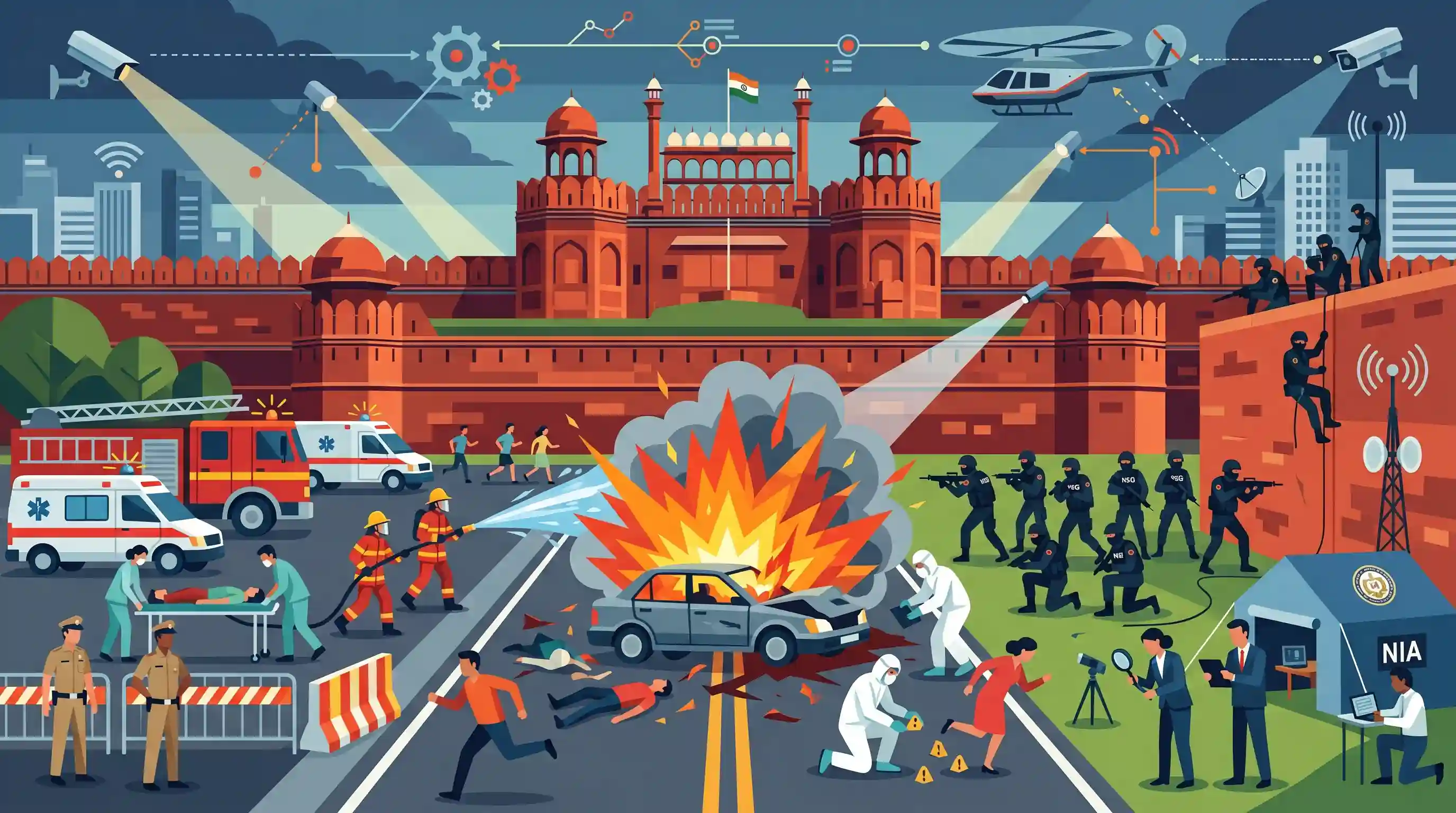
A high-intensity explosion in a slow-moving car outside the Red Fort in central Delhi has killed at least nine people and injured several others. The incident triggered a massive security response, with specialized central investigative agencies, including the National Investigation Agency (NIA) and the National Security Guard (NSG), along with forensic experts, rushing to the scene. The blast highlights critical vulnerabilities in urban internal security and the immediate coordinated response required by emergency and intelligence frameworks to manage suspected terror attacks.
Key Points
- A high-intensity blast in a car near the Red Fort in Central Delhi resulted in the deaths of at least nine people and injured dozens of others.
- The National Investigation Agency (NIA), National Security Guard (NSG), and Forensic Sciences Laboratory (FSL) teams were immediately dispatched to secure the site and analyze the high-grade explosives used.
- Authorities are treating the incident as a major security breach and suspected terror attack, given the proximity to a high-security heritage monument.
- The Central Government, including the Prime Minister and Home Minister, condemned the blast, assuring a thorough investigation to dismantle the network responsible.
Important Terms
National Investigation Agency (NIA)

India's premier federal counter-terrorism agency established under the NIA Act, 2008. It investigates offenses affecting national security and integrity with pan-India jurisdiction, often without requiring state government consent.
UPSC context
GS Paper III (Internal Security); tests understanding of the central investigative framework and its role in combating terrorism.
National Security Guard (NSG)
An elite counter-terrorism unit under the Ministry of Home Affairs, established in 1986. It serves as a federal contingency force for high-risk operations like hostage rescue and neutralizing terrorist threats.
UPSC context
GS Paper III (Various Security Forces); tests knowledge of specialized agencies and their specific roles in crisis management.
Forensic Sciences Laboratory (FSL)
Scientific institutions providing expert analysis of physical, biological, and digital evidence. They assist law enforcement and the judiciary by providing objective reports to establish facts in criminal cases.
UPSC context
GS Paper III (Criminal Justice System); focuses on the role of technology and scientific evidence in criminal investigations.
Delhi Police
The law enforcement agency for India’s capital, reporting directly to the Union Ministry of Home Affairs. Its control over public order, police, and land remains with the Central Government.
UPSC context
GS Paper II (Governance/Federalism); highlights Delhi's unique constitutional status under Article 239AA and the division of power.
Prelims Trap
The NIA requires prior consent from the respective State Government to investigate terror cases.
Under the NIA Act 2008, the NIA has concurrent jurisdiction and can take suo motu cognizance to investigate scheduled offences anywhere in India without state consent.
Static Concepts Connected
What are the core powers and mandate of the National Investigation Agency (NIA)?
- Statutory backing: Established under the NIA Act 2008 post-26/11 attacks, acting as India's central counter-terrorism law enforcement agency.
- Jurisdiction: Can investigate and prosecute scheduled offenses affecting national security across states without requiring prior state government consent.
- Scheduled Offences: Empowered to probe offences under specific laws like UAPA, Weapons of Mass Destruction Act, and Anti-Hijacking Act.
What is the role of the National Security Guard (NSG)?
- Federal Contingency Force: Raised in 1984 and governed by the NSG Act 1986 to tackle severe manifestations of terrorism as a federal contingency force.
- Specialized Roles: Tasked with counter-hijacking, neutralizing terror threats in vital installations, and post-blast investigations via the National Bomb Data Centre.
Cross-Topic Patterns
Urban terrorism and NDMA guidelines
Terrorist attacks in dense urban centers overlap with disaster management. NDMA guidelines for managing man-made disasters require swift multi-agency coordination between local police, central intelligence, and health infrastructure.
Heritage monuments as soft terror targets
Targeting monuments like the Red Fort brings ASI security protocols, CISF deployment policies, and the psychological warfare aspect of terrorism into the Internal Security syllabus.

Mains 2026 could ask to evaluate India's post-26/11 central security architecture (NIA, NSG, MAC) against evolving urban terror threats.
Linked PYQs · 3
Linked PYQs · 3
- 2023MainsGS3
What are the internal security challenges being faced by India? Give out the role of Central Intelligence and Investigative Agencies tasked to counter such threats.
- 2021MainsGS3
Analyse the complexity and intensity of terrorism, its causes, linkages and obnoxious nexus. Also suggest measures required to be taken to eradicate the menace of terrorism.
- 2017MainsGS3
The scourge of terrorism is a grave challenge to national security. What solutions do you suggest to curb this growing menace? What are the major sources of terrorist funding?
