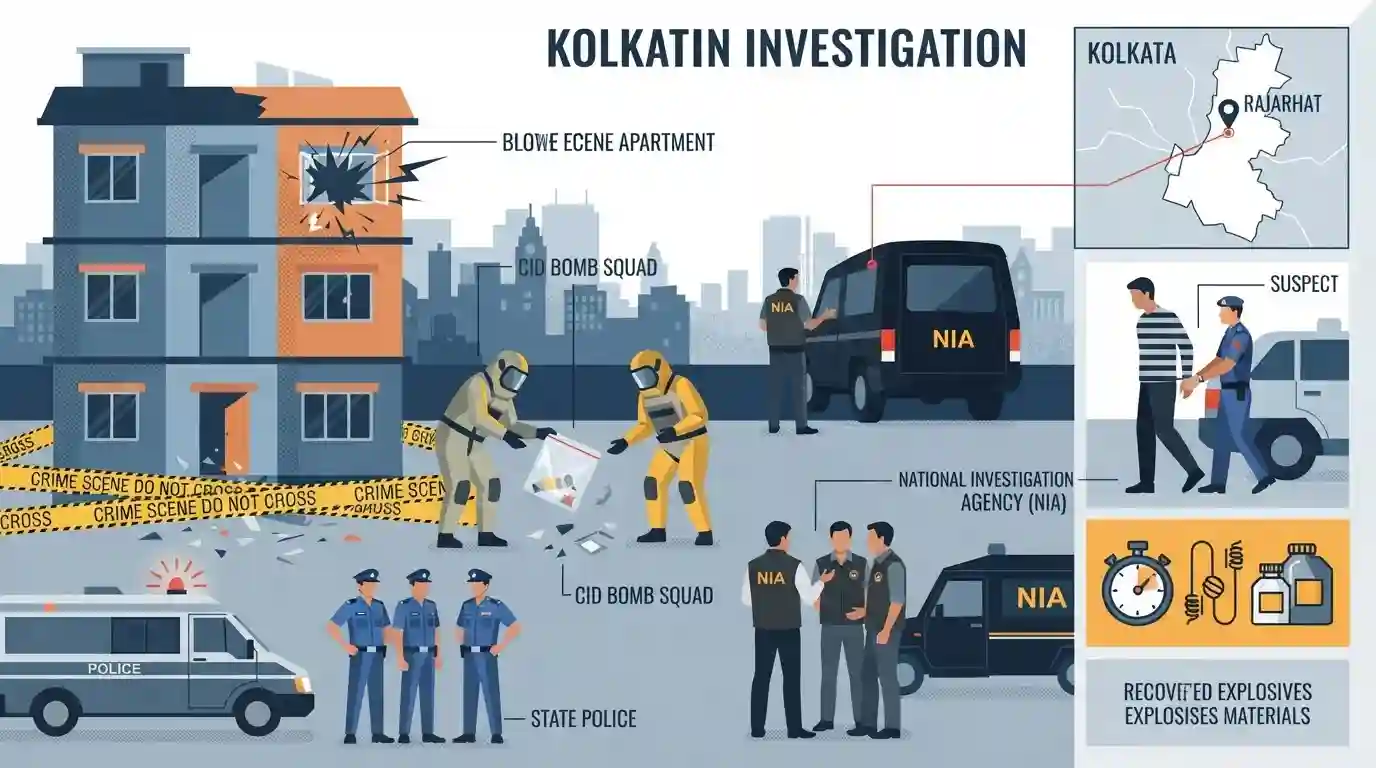
Rajarhat residential building damaged in suspected explosive blast
Source:etv-bharat ↗
কেন এটি গুরুত্বপূর্ণ
Highlights internal security challenges regarding illicit explosive manufacturing in urban and peri-urban areas, and underscores the role of central and state agencies (NIA, CID) in responding to local terrorism or organized crime incidents.
সারসংক্ষেপ
A residential building in Kolkata's Rajarhat area suffered severe damage from an explosion suspected to involve crude bomb manufacturing. Explosives-related materials were recovered, and one suspect was detained. The incident has drawn the involvement of state police, the CID bomb squad, and the National Investigation Agency (NIA) for further investigation.
মূল বিষয়
- A suspected crude bomb explosion damaged a residential building in the Dakshin Narayanpur area of Rajarhat, Kolkata.
- Police recovered raw materials used for making explosives, including nails, iron powder, and ropes, indicating illicit bomb manufacturing.
- The National Investigation Agency (NIA), along with state police, CID bomb disposal squad, and STF, have initiated preliminary investigations into the incident.
- A tenant of the building, Md Shamim alias Salim, was injured in the blast and subsequently detained, while search efforts are on for another suspect.
গুরুত্বপূর্ণ শব্দ
National Investigation Agency (NIA)

India's premier statutory central counter-terrorism agency, established under the NIA Act 2008 post-26/11. It is empowered to investigate and prosecute terror-related offenses across the country without requiring prior permission from state governments.
UPSC context
GS-III (Internal Security) & GS-II. Tests knowledge of counter-terrorism bodies, federal relations, and statutory law enforcement agencies.
Criminal Investigation Department (CID)
The primary investigation and intelligence wing of a state police force in India. Headed by senior officers, it handles serious, complex, or high-profile cases like organized crime, riots, and murders referred by the state government.
UPSC context
GS-II & GS-III (Internal Security). Crucial for understanding state police structures, crime investigation procedures, and center-state policing dynamics.
Special Task Force (STF)
A specialized elite unit within state police forces in India, established to address specific, high-level threats such as organized crime syndicates, insurgencies, poaching networks, and terrorism.
UPSC context
GS-III (Internal Security). Important for evaluating state-level capacities in anti-terrorism, counter-insurgency, and dismantling organized criminal networks.
Crude Bomb
A low-tech improvised explosive device (IED) constructed using cheap, readily available materials like firecrackers, agricultural chemicals, and scrap shrapnel. Though unreliable, they are extremely dangerous and frequently utilized in sabotage or local turf violence.
UPSC context
GS-III (Internal Security). Relevant to discussions on IEDs, non-state actors, localized law and order challenges, and explosive materials regulation.
প্রিলিমস ফাঁদ
The NIA requires state government consent to initiate investigations into explosive-related cases occurring within a state's territorial limits.
Under Section 6 of the NIA Act, the Central Government can direct the NIA to investigate scheduled offences suo motu without state consent, unlike the CBI.
সংযুক্ত স্থির ধারণা
What are the jurisdictional powers of the NIA regarding state consent and scheduled offences?
- Suo motu power: The Central Government can direct the NIA to investigate any scheduled offence anywhere in India without requiring consent from the state government.
- Scheduled offences: The NIA's jurisdiction is limited to specific laws listed in the Schedule of the NIA Act, which includes the Explosive Substances Act, 1908.
- Connected offences: The Supreme Court ruled that the NIA can investigate non-scheduled offences if they are connected to a scheduled offence under investigation.
How do appeals operate against the rulings of NIA Special Courts?
- Appellate authority: An appeal against any judgment, sentence, or order of an NIA Special Court lies directly to the High Court of the concerned state.
- Bench composition: Such appeals must be heard by a Division Bench consisting of two Judges of the High Court.
- Scope of appeal: Appeals can be filed on both questions of fact and questions of law, but not against interlocutory orders.
আন্তঃবিষয় প্যাটার্ন
Federalism vs Central security mandates
Internal security falls under public order (State List), but NIA's suo motu investigative power over scheduled offences highlights the constitutional friction between central agencies and state autonomy.
Dual-use chemical regulation
Recovering explosive precursors like iron powder connects chemical supply-chain monitoring under the Explosives Act to urban counter-terrorism strategies and regulatory oversight.

A 2026 question may contrast NIA's suo motu powers and High Court appeal mechanism with CBI's state-consent requirements under federal structures.
সংযুক্ত PYQ · 1
সংযুক্ত PYQ · 1
- 2020WBCS_PRELIMSGS1
The Supreme Court of India upheld that RTI was applicable to the
