Industrial Safety and Solid Propellant Manufacturing Plant Blast
Source:The Hindu ↗
Why It Matters
The incident connects directly to the Science and Technology (Defence) syllabus, specifically regarding solid propellants and missile technology (DRDO). It also falls under Disaster Management, illustrating the risks and regulatory challenges associated with industrial chemical accidents and factory safety.
Summary
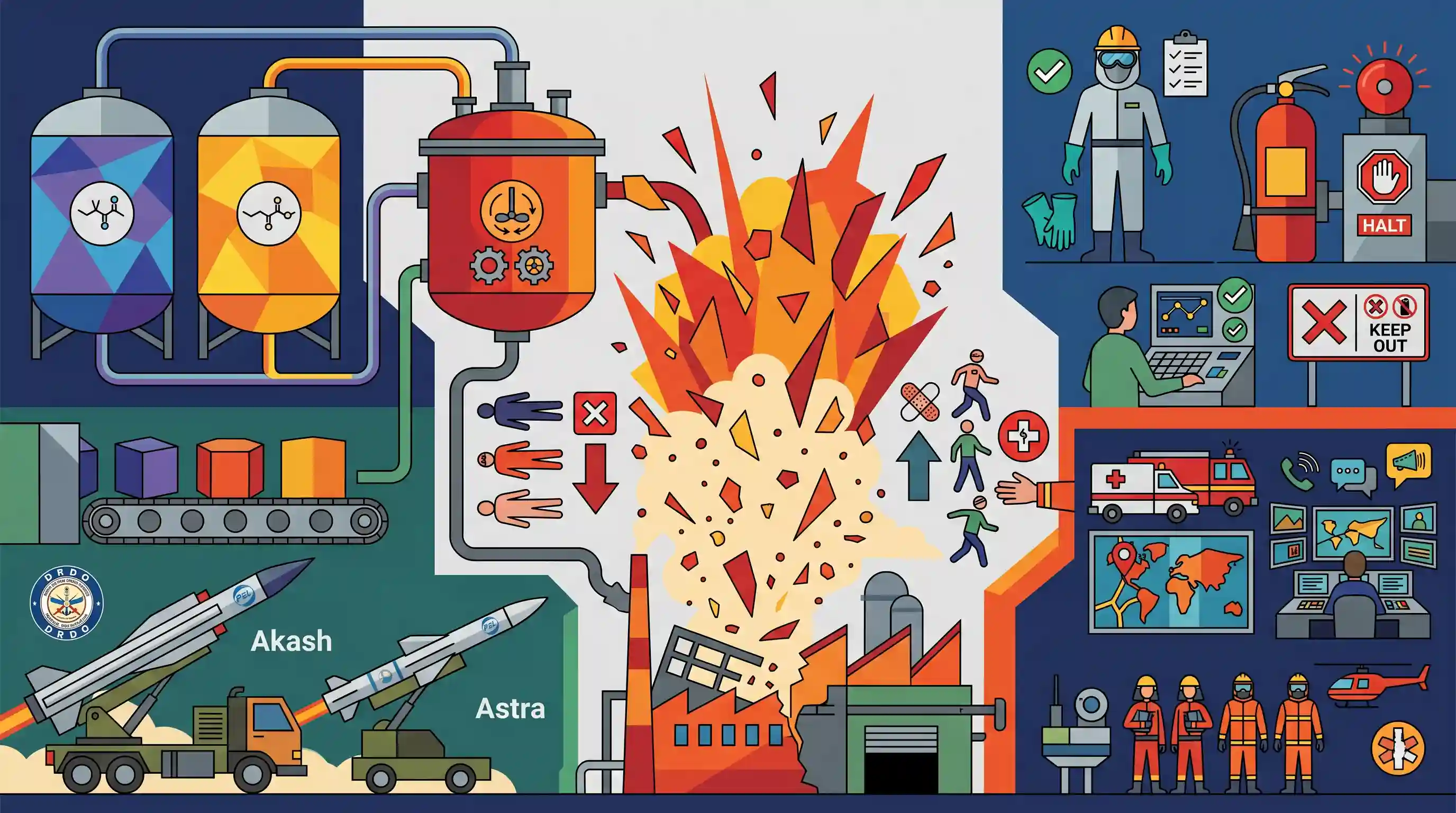
A fatal blast at a DRDO-linked rocket propellant manufacturing unit in Telangana's Yadadri Bhongir district has killed three workers and injured three others. The explosion occurred at Premier Explosives Limited (PEL) during the mixing of highly combustible chemicals—hydroxyl-terminated polybutadiene (HTPB) and dioctyl adipate (DOA)—used in solid propellants for missiles like Akash and Astra. The tragedy highlights the critical need for stringent industrial safety protocols and disaster management in hazardous chemical manufacturing facilities.
Key Points
- A massive explosion at the Premier Explosives Limited (PEL) plant in Telangana's Yadadri Bhongir district claimed the lives of three workers and left three others injured.
- The facility manufactures solid propellants for DRDO-developed defense systems, including Akash, Astra, and LRSAM missiles.
- The blast occurred while workers were mixing hydroxyl-terminated polybutadiene (HTPB) and dioctyl adipate (DOA), which are highly combustible chemical components used in solid rocket propellants.
- The incident raises concerns about industrial safety and regulatory oversight in chemical and explosive manufacturing units, triggering an investigation by the Directorate of Factories and local authorities.
Important Terms
Premier Explosives Limited (PEL)

A private Indian company specializing in high-energy materials, manufacturing solid propellants for missiles (e.g., Akash, Astra) and explosives. It operates propellant plants for DRDO and ISRO.
UPSC context
GS Paper III: Defense Technology and Indigenization. Tests understanding of private sector participation in the "Atmanirbhar Bharat" defense manufacturing ecosystem.
Defence Research and Development Organisation (DRDO)
The R&D wing of India's Ministry of Defence, tasked with developing indigenous military technologies across aeronautics, armaments, missiles, and naval systems to achieve self-reliance.
UPSC context
GS Paper III: Science and Technology. Essential for questions on indigenous defense capabilities, missile programs, and research-industry partnerships.
National Disaster Response Force (NDRF)
A specialized force under the Ministry of Home Affairs, established via the Disaster Management Act, 2005, for proactive response to natural and man-made disasters, including chemical emergencies.
UPSC context
GS Paper III: Disaster Management. Tests knowledge of the institutional framework for crisis response and management of industrial/CBRN disasters.
Directorate of Factories
A state-level regulatory body (often called DISH) responsible for enforcing the Factories Act, 1948, ensuring industrial safety, health, and welfare standards in manufacturing units.
UPSC context
GS Paper II & III: Governance and Industrial Safety. Relevant for issues concerning labor welfare, regulatory enforcement, and workplace safety protocols.
Prelims Trap
"The Ministry of Home Affairs is the nodal ministry for managing chemical and industrial disasters in India."
While the Ministry of Home Affairs is the nodal authority for general disasters, the Ministry of Environment, Forest and Climate Change (MoEFCC) is specifically the nodal ministry for chemical disasters.
Static Concepts Connected
What are the core characteristics of the Akash and Astra missiles?
- Akash Missile: An indigenously developed, medium-range surface-to-air missile (SAM) designed to neutralize aerial targets.
- Astra Missile: A highly agile, Beyond Visual Range (BVR) air-to-air missile developed by DRDO to engage and destroy highly maneuvering supersonic aircraft.
- Propulsion: Solid rocket propellants using binders like HTPB provide the necessary thrust, stability, and storability required for these quick-reaction tactical missiles.
What is the legal framework governing chemical and industrial disasters in India?
- Factories Act, 1948: Amended heavily in 1987 post-Bhopal to regulate hazardous processes, mandate safety committees, and extend protections to the general public near factories.
- Public Liability Insurance Act: Mandates that industries handling hazardous chemicals must maintain insurance to provide immediate, 'no-fault' interim financial relief to victims of industrial accidents.
Cross-Topic Patterns
Private sector risks in defence indigenisation
As DRDO increasingly outsources critical components like solid propellants to private entities (e.g., PEL), industrial safety regulations at these tier-2 suppliers are becoming a national security imperative.
Chemicals in everyday & strategic use
UPSC frequently asks about specific chemicals (e.g., BPA, Triclosan). HTPB and DOA could appear as a 'match the following' pair for their specific application in solid rocket propellants.

Expect a 2026 Prelims matching question pairing chemicals (HTPB/DOA) with strategic uses, or testing MoEFCC as the nodal disaster body.
Linked PYQs · 3
Linked PYQs · 3
- 2024PrelimsGS1
What is the common characteristic of the chemical substances generally known as CL-20, HMX and LLM-105, which are sometimes talked about in media?
- 2007PrelimsGS1
Consider the following statements: 1. In November, 2006, DRDO successfully conducted the interception test using Prithvi-II missile. 2. Prithvi-II is a surface-to-surface missile and can be deployed to guard the metros against air attacks. Which of the statements given above is/are correct?
- 2020MainsGS3
Discuss the recent measures initiated in disaster management by the Government of India departing from the earlier reactive approach.
