BKTC Issues Vigilance Directives for Uttarakhand Shrines
Source:etvbharat ↗
Why It Matters
This article is highly relevant for UKPSC PCS Prelims because it links statutory temple administration in Uttarakhand (under the 1939 Act) with specific geographical and cultural markers of the state, such as Panch Kedar, Panch Badri, the five Shilas, and the five Streams. Questions on Uttarakhand temple geography and historical pilgrim footfalls are frequently asked in the state civil services exam.
Summary
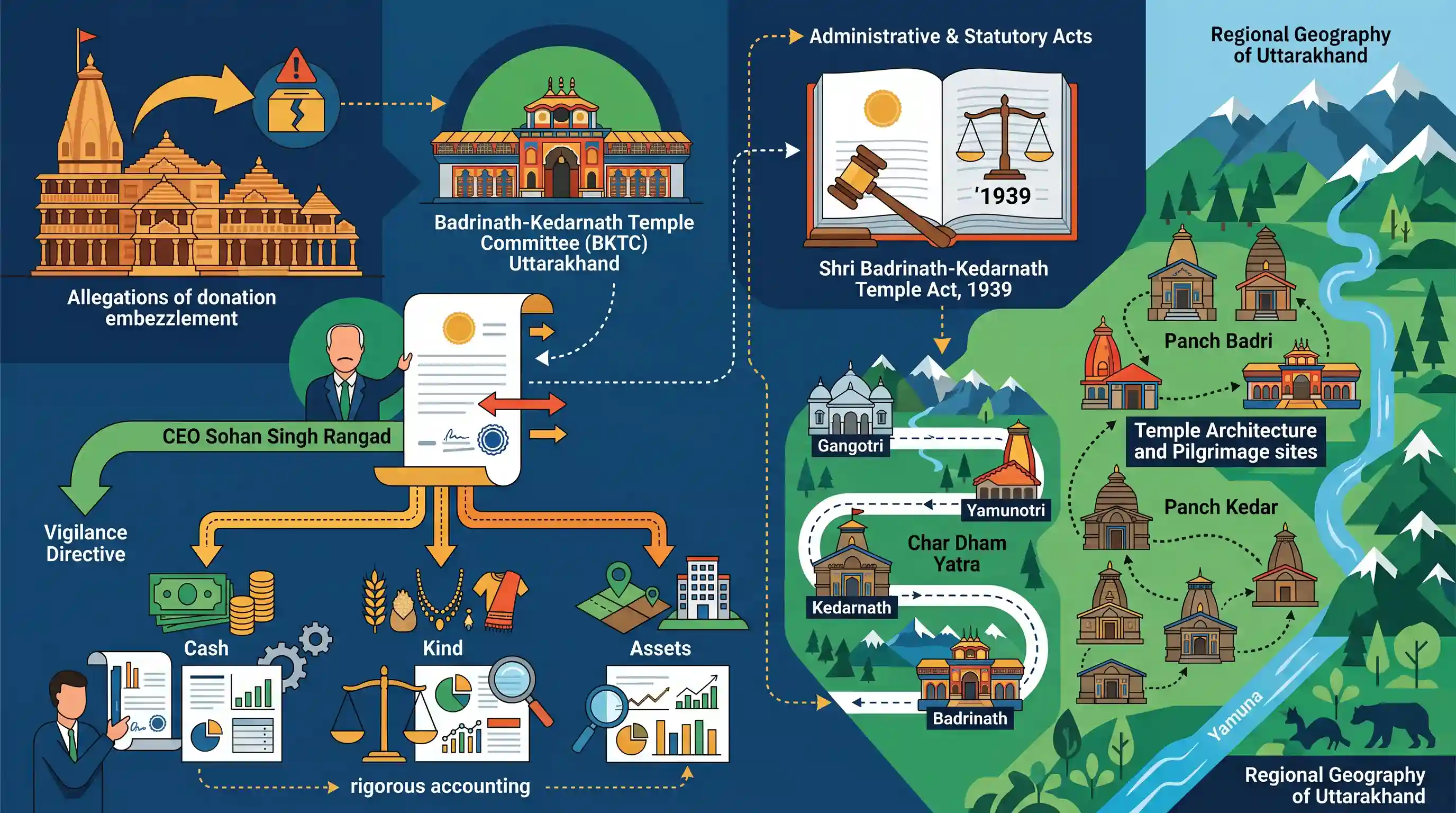
Prompted by allegations of donation embezzlement at the Ayodhya Ram Temple, the Badrinath-Kedarnath Temple Committee (BKTC) has issued a comprehensive vigilance directive to all 47 major shrines under its jurisdiction in Uttarakhand. The memorandum, issued by CEO Sohan Singh Rangad, mandates rigorous accounting of all cash, kind, and assets. BKTC operates under the Shri Badrinath-Kedarnath Temple Act, 1939, and oversees primary regional landmarks, including the Panch Badri and Panch Kedar networks, ensuring proper governance and budget management for the Char Dham Yatra.
Key Points
- The Chief Executive Officer (CEO) of the Badrinath-Kedarnath Temple Committee (BKTC), Sohan Singh Rangad, has issued a strict office memorandum requiring maximum transparency, systematic accounting, and vigilance in managing temple donations, offerings, rents, and other income.
- The directive was prompted by recent media reports concerning the alleged theft/misappropriation of donations at the Ram Temple in Ayodhya, Uttar Pradesh.
- The BKTC governs approximately 52 temples (including 47 major shrines) in Uttarakhand, which includes both Badrinath and Kedarnath Dhams, other Panch Badri and Panch Kedar sites, and critical geological/historical markers.
- Geographical and historical landmarks mentioned under BKTC include the Five Shilas of Badrinath (Narada, Nrisimha, Barahi, Garuda, Markandeya) and the Five Streams (Prahlad Dhara, Kurma Dhara, Bhrigu Dhara, Urvashi Dhara, Indira Dhara).
- Administratively, the BKTC is a statutory body established under the Shri Badrinath-Kedarnath Temple Act, 1939. Its current president is BJP leader Hemant Dwivedi, and it approved a budget of Rs 121 crore for the Char Dham Yatra 2026.
Important Terms
Badrinath-Kedarnath Temple Committee (BKTC)

A statutory body in Uttarakhand constituted to administer, govern, and manage the Badrinath and Kedarnath temples, as well as dozens of subordinate shrines and associated temple assets.
UPSC context
GS Paper I (Art and Culture) and Paper II (Statutory Bodies); tests governance of religious institutions and cultural heritage management.
Shri Badrinath-Kedarnath Temple Act, 1939
A statutory legislative act enacted to provide for the better administration and governance of the Shri Badrinath and Shri Kedarnath temples, vesting management and funds in a state-constituted committee.
UPSC context
GS Paper II (Government Policies and Interventions); tests legal frameworks governing religious endowments and the administration of national heritage sites.
Shri Ram Janmabhoomi Teerth Kshetra Trust
An autonomous trust set up by the Government of India in 2020 following a Supreme Court verdict to oversee the construction, management, and governance of the Ram Mandir in Ayodhya.
UPSC context
GS Paper I (Art & Culture) and GS Paper II (Judiciary); tests execution of landmark judicial verdicts and management of socio-cultural institutions.
Char Dham Yatra
A revered Hindu pilgrimage circuit in the Garhwal Himalayas of Uttarakhand, comprising four sacred high-altitude shrines: Yamunotri, Gangotri, Kedarnath, and Badrinath.
UPSC context
GS Paper I (Art and Culture / Indian Geography); tests knowledge of sacred geography, cultural corridors, and tourism infrastructure.
Panch Badri
A holy group of five temples dedicated to Lord Vishnu situated in the Chamoli district of Uttarakhand, consisting of Badrinath, Yogadhyan Badri, Bhavishya Badri, Vridha Badri, and Adi Badri.
UPSC context
GS Paper I (Art and Culture); tests temple architecture, regional pilgrimage networks, and historical-mythological circuits of Uttarakhand.
Panch Kedar
A sacred circuit of five high-altitude Shaivite temples in Uttarakhand (Kedarnath, Tungnath, Rudranath, Madhyamaheshwar, and Kalpeshwar) where different physical manifestations of Lord Shiva are worshipped.
UPSC context
GS Paper I (Art and Culture); tests regional religious traditions, temple architecture, and mythological geography of the Himalayas.
Prelims Trap
All five temples of the sacred Panch Kedar circuit close during the winter season due to heavy snowfall in the Garhwal Himalayas.
Kalpeshwar is a critical exception in the Panch Kedar circuit; it is the only temple that remains open to pilgrims throughout the year.
Static Concepts Connected
What are the Panch Kedar shrines and their specific iconographic significance?
- Kedarnath: Represents the hump of the bull form assumed by Lord Shiva.
- Tungnath: The highest temple in the circuit, representing the arms (Bahu).
- Rudranath: Represents the face (Mukh) of Lord Shiva, worshipped in a natural rock cave.
- Madhyamaheshwar: Represents the navel (Nabhi) and stomach of the divine form.
- Kalpeshwar: Represents the matted hair (Jata) and is the only shrine open year-round.
What is the constitutional basis for state regulation of religious endowments?
- Secular Regulation: Article 25(2)(a) permits the State to regulate financial, political, or other secular activities associated with religious practices.
- Concurrent Jurisdiction: Charities and religious institutions fall under Entry 28 of the Concurrent List, empowering both Union and States to legislate.
- Temporal vs. Spiritual: State-appointed administrators handle temporal matters (assets, security, queues) while leaving core spiritual/ritual practices to traditional priests.
Cross-Topic Patterns
Pilgrimage management vs. Eco-fragility
Balancing massive pilgrim footfall managed by statutory boards like BKTC with the ecological carrying capacity of the highly fragile Zone-V Himalayan landscape.
Temple control vs. Freedom of religion
State management of temples under local acts vs. Article 26 constitutional rights, a recurring judicial debate over secular control of religious properties.

UPSC may combine Panch Kedar geographical features with the statutory/constitutional limits of state control over religious endowments.
Linked PYQs · 2
Linked PYQs · 2
- 2016UKPSC_PRELIMSGS1
Which one of the following shrines of Uttarakhand was visited by maximum number of tourists in the year 2015?
- 2024UKPSC_PRELIMSGS1
Which of the following pairs is not correctly matched ?
