BJP Electoral Challenges and Expansion Strategy in Telangana
Source:Indian Express ↗
Why It Matters
Understanding state-level electoral dynamics and the interaction between national and regional political parties is crucial for analyzing India's political federalism, regionalism, and the debate between centralization and state autonomy.
Summary
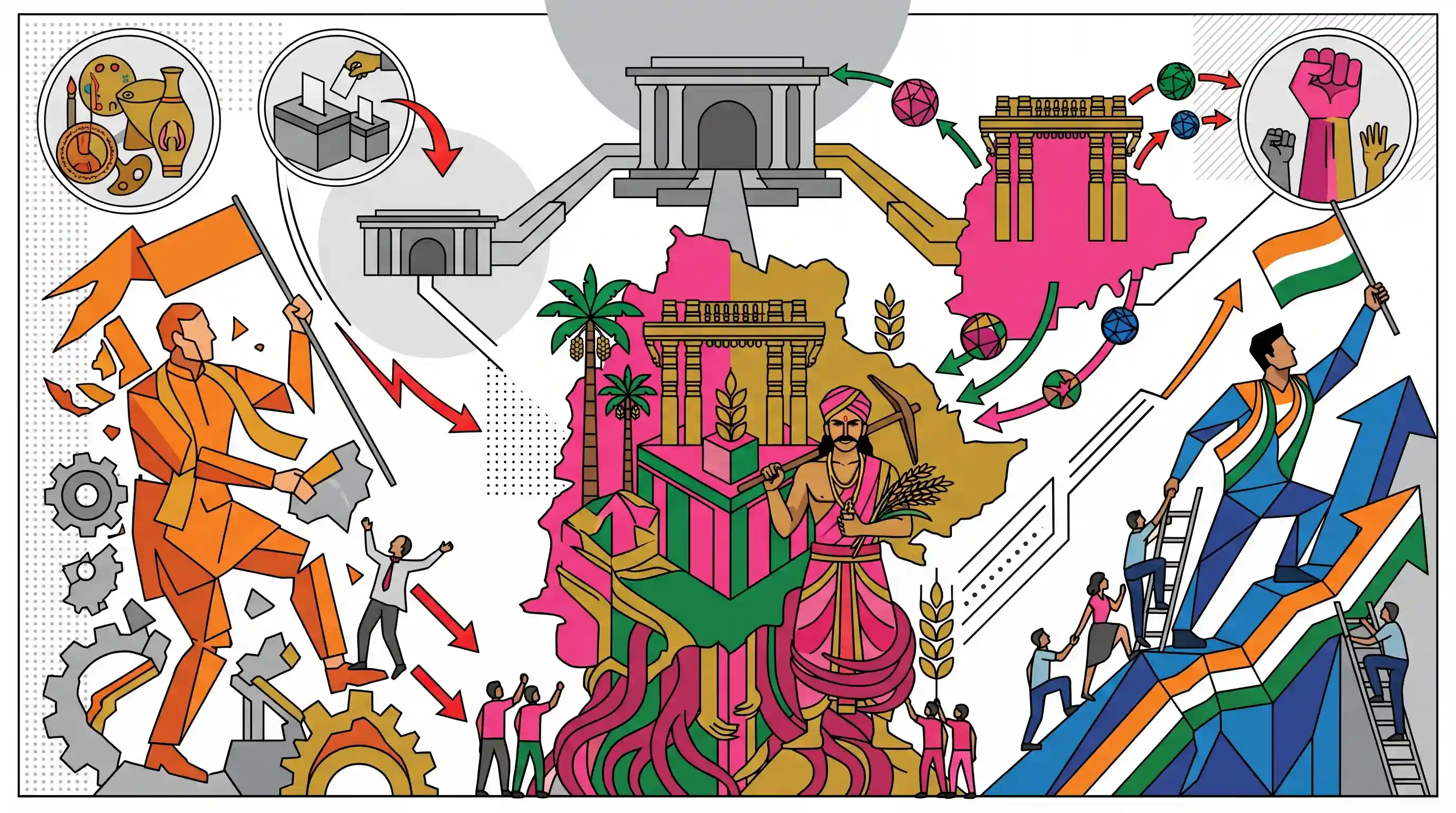
The article analyzes the electoral challenges and strategic setbacks faced by the Bharatiya Janata Party (BJP) in Telangana. Despite intensive efforts to establish the state as its "second southern bastion" after Karnataka, the party's progress has faltered. This is attributed to internal organizational issues, a lack of prominent local leadership, and formidable competition from strong regional forces and a resurgent Congress. The scenario highlights the broader political dynamics in India where national parties often struggle to penetrate regions characterized by deeply entrenched regional identities and strong regional political entities.
Key Points
- The BJP aimed to establish Telangana as its 'second southern bastion' after Karnataka to expand its footprint in South India.
- The party's growth has been hampered by internal dissension, a lack of cohesive state-level leadership, and organizational weaknesses.
- Strong regional identity and the dominance of deeply entrenched regional parties pose significant challenges to national parties trying to establish dominance.
- The resurgence of the Congress party in the state has created a complex multi-cornered electoral contest, complicating the BJP's strategy.
- The political dynamics reflect the broader struggle of national parties attempting to centralize narratives against regional forces championing sub-nationalism and state autonomy.
Important Terms
Bharatiya Janata Party (BJP)

A national political party in India, currently in power at the Centre, which champions 'integral humanism' and has been expanding its electoral footprint into Southern India beyond its stronghold in Karnataka.
UPSC context
GS Paper 2: Political Parties; tests understanding of national party strategies, regional expansion, and the impact of national leadership on state elections.
Indian National Congress (INC)
A centrist national party that recently regained power in Telangana (2023), leveraging welfare-oriented 'guarantees' and anti-incumbency against long-standing regional dominance to re-establish its presence in the South.
UPSC context
GS Paper 2: Electoral Politics; relevant for analyzing party revival strategies, welfare politics, and the competitive dynamics between national and regional entities.
Bharat Rashtra Samithi (BRS)
A prominent regional party (formerly Telangana Rashtra Samithi) that spearheaded the Telangana statehood movement and governed the state for two terms before becoming the primary opposition in 2023.
UPSC context
GS Paper 2: Regional Parties; essential for discussing the role of sub-nationalism, statehood movements, and the challenges regional forces pose to national parties.
Regional Parties
Political entities that operate within a specific state or region, focusing on local identity, linguistic traditions, and state autonomy, often challenging the dominance of pan-Indian national parties.
UPSC context
GS Paper 2: Federalism and Governance; tests the impact of regionalism on national politics and the evolution of the 'coalition era.'
Federalism
The constitutional distribution of power between the Union and the States; in politics, it involves the interplay between national interests and state-specific regional aspirations.
UPSC context
GS Paper 2: Functions and responsibilities of the Union and the States; crucial for understanding tensions in the Indian political fabric and decentralization.
Electoral Politics
The study and practice of competition for power through elections, involving voter behavior, party manifestos, social engineering (caste/religion), and the strategic use of local vs. national issues.
UPSC context
GS Paper 2: Salient features of the Representation of People’s Act; relevant for analyzing election trends, vote share consolidation, and democratic processes.
Prelims Trap
The criteria for recognizing political parties as National or State parties is defined in the Constitution of India.
Party recognition criteria are not mentioned in the Constitution or the RPA 1951. They are defined by the Election Commission under the Election Symbols Order, 1968.
Static Concepts Connected
What are the primary criteria for ECI recognition as a State Political Party?
- Vote & Assembly Seats: 6% of valid votes polled in the state assembly election plus winning at least 2 MLAs.
- Assembly Seat Quota: 3% of total assembly seats in the state or 3 MLAs, whichever is higher.
- Vote Share Exception: 8% of total valid votes polled in the state during general Assembly or Lok Sabha elections.
How do regional parties influence India's federal structure?
- Policy Decentralization: They compel national frameworks like NITI Aayog to accommodate localized developmental issues and state-specific policy priorities.
- Coalition Dynamics: By controlling critical MP blocs, they force central governments to rely on consensus, inadvertently strengthening cooperative federalism.
- Sub-national Checks: They act as a democratic counterweight to the homogenizing and centralizing narratives often pushed by dominant national parties.
Cross-Topic Patterns
Multi-party system & Schedule 10
Fragmented mandates driven by regional parties frequently lead to unstable coalitions, deeply testing the Anti-Defection Law and the Governor's discretionary powers during government formation.
Fiscal Federalism & Tax Devolution
Strong state-level parties heavily influence Finance Commission debates, pushing back against central cesses and demanding higher proportional tax devolution to ensure state autonomy.

GS2 will likely test how the resurgence of regional parties acts as a bulwark against centralization in India's federal structure.
Linked PYQs · 1
Linked PYQs · 1
- 2022MainsGS2
“While the national political parties in India favour centralisation, the regional parties are in favour of State autonomy.” Comment.
