Himachal chief minister condemns assembly opposition protest
Source:theprint ↗
Why It Matters
The political developments in Himachal Pradesh illustrate key constitutional and governance issues, such as the functioning of the State Legislature, the implications of cross-voting and the Anti-Defection Law, and the controversial use of central agencies (like the ED) in state politics. These are highly relevant topics for the Polity and Governance sections of the HPAS Prelims exam.
Summary
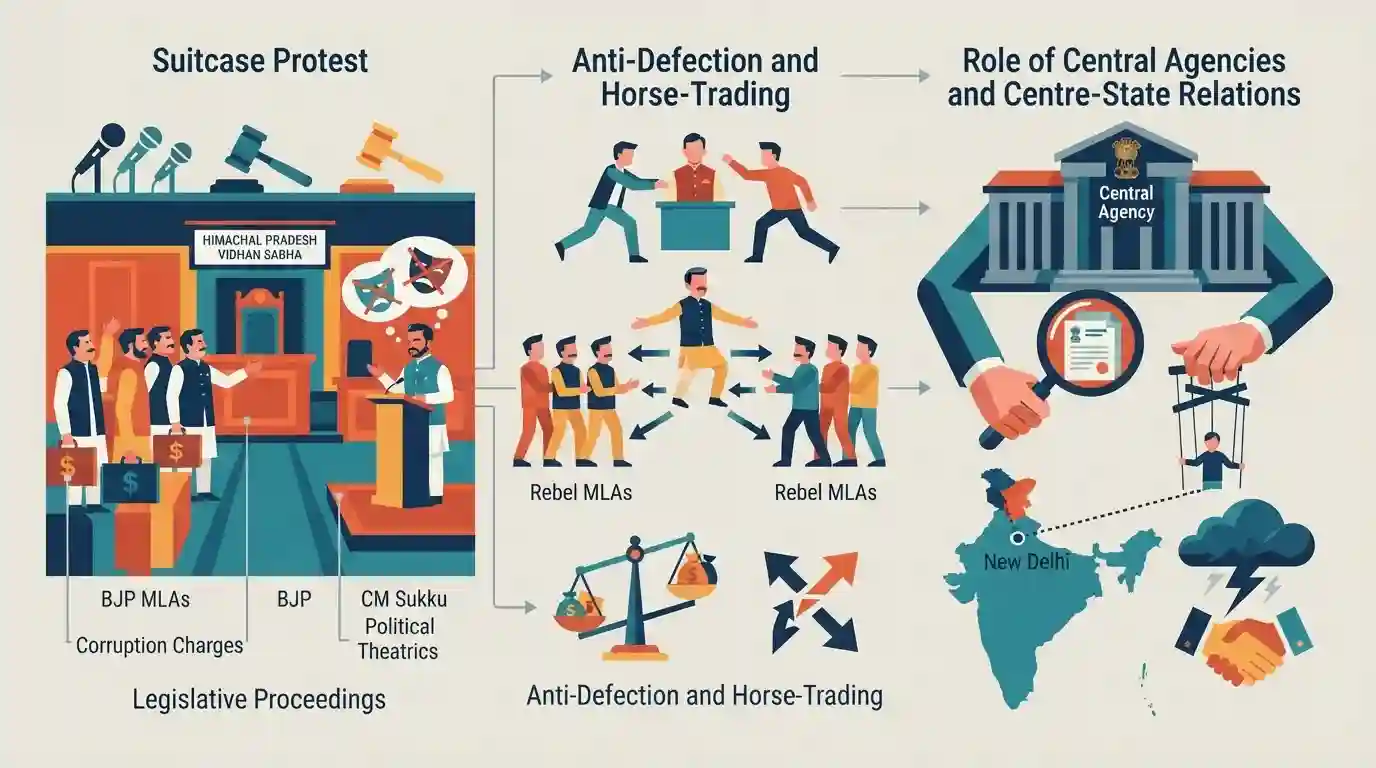
Himachal Pradesh Chief Minister Sukhvinder Singh Sukhu condemned a 'suitcase protest' organized by BJP MLAs in the Vidhan Sabha complex, dismissing it as political theatrics meant to distract from pressing issues. The protest was aimed at leveling corruption charges against the state government. In response, Sukhu accused the BJP of attempting to destabilize his elected government through horse-trading, specifically referencing the recent cross-voting by six rebel Congress MLAs during Rajya Sabha elections. He further alleged that the opposition leverages central investigative agencies like the Enforcement Directorate (ED) for political harassment, highlighting ongoing Centre-State tensions and concerns over legislative integrity.
Key Points
- Himachal Pradesh CM Sukhvinder Singh Sukhu criticized BJP MLAs for staging a 'suitcase protest' in the Vidhan Sabha to allege state corruption.
- Sukhu alleged the protest was a diversion tactic to deflect attention from the BJP's involvement in horse-trading six rebel Congress MLAs during recent Rajya Sabha elections.
- The Chief Minister accused the BJP of attempting to destabilize his democratically elected government using illicit funds and central agencies like the Enforcement Directorate (ED).
- The opposition's theatrics in the state assembly underscore the ongoing political volatility and debates around legislative decorum and the misuse of central investigative bodies.
Important Terms
Anti-Defection Law

Added by the 52nd Amendment (10th Schedule), it disqualifies elected legislators who voluntarily give up their party membership or vote against the party whip, curbing political instability.
UPSC context
Crucial for GS Paper II (Polity). Tests understanding of the 10th Schedule, Speaker's powers, and recent MLA disqualification issues in Himachal Pradesh.
Enforcement Directorate (ED)
A specialized financial investigation agency under the Ministry of Finance. It enforces economic laws and combats financial crimes like money laundering under PMLA and FEMA.
UPSC context
Important for GS Paper II (Governance). Explores Centre-State relations, allegations of agency misuse, and statutory bodies' mandates.
Vidhan Sabha
The directly elected lower house of a state legislature in India, empowered to enact state laws, pass budgets, and hold the state executive accountable.
UPSC context
Essential for GS Paper II (State Legislature). Evaluates state governance structures, legislative powers, and the functioning of the state government machinery.
Prelims Trap
"Cross-voting by an MLA in Rajya Sabha elections attracts automatic disqualification under the Tenth Schedule."
The Supreme Court clarified that cross-voting in Rajya Sabha polls does not attract the anti-defection law, as party whips do not apply. It only invites internal disciplinary action.
Static Concepts Connected
Who decides the disqualification of MLAs in the State Legislature?
- Tenth Schedule: Disqualification on grounds of defection is decided exclusively by the Speaker or Chairman of the respective House.
- Other Grounds: For non-defection constitutional grounds, the Governor decides the matter after obtaining the mandatory, binding opinion of the Election Commission.
What is the statutory mandate of the Enforcement Directorate (ED)?
- Nodal Ministry: Operates under the Department of Revenue, Ministry of Finance, not the Ministry of Home Affairs.
- Core Laws: Primarily enforces the Prevention of Money Laundering Act (PMLA), 2002, and the Foreign Exchange Management Act (FEMA), 1999.
Cross-Topic Patterns
10th Schedule & Rajya Sabha polls
The tension between an MLA's voting rights in Rajya Sabha elections (not covered by the whip) and horse-trading allegations exposes critical loopholes in the Anti-Defection Law.
Federal friction & Central Agencies
Frequent ED interventions in opposition-ruled states connect statutory mandates of economic offenses (PMLA) directly to the syllabus theme of Centre-State relations and political federalism.

Expect a multi-statement question distinguishing the Speaker's powers under the 10th Schedule from the Governor's powers via the EC.
Linked PYQs · 5
Linked PYQs · 5
- 2025HPAS_PRELIMSGS1
Who decides the disqualification of members of State Legislative Assembly, for matters other than those in the Tenth Schedule of the Constitution ?
- 2022HPAS_PRELIMSGS1
Who decides the matter of disqualification of MLA for matters other than those given in the Tenth Schedule of the Constitution ?
- 2022HPAS_PRELIMSGS1
The purpose of an adjournment motion is to :
- 2013HPAS_PRELIMSGS1
What were the main findings of the N.N. Vohra Committee ?
- 2023HPAS_PRELIMSGS1
Given below are two statements : Statement I : President can dissolve the Lok Sabha on the advice of Speaker. Statement II : Rajya Sabha under Article 312 enjoys special power to appoint members of Human Rights Commission. In the light of the above statements, choose the most appropriate answer from the options given below :
