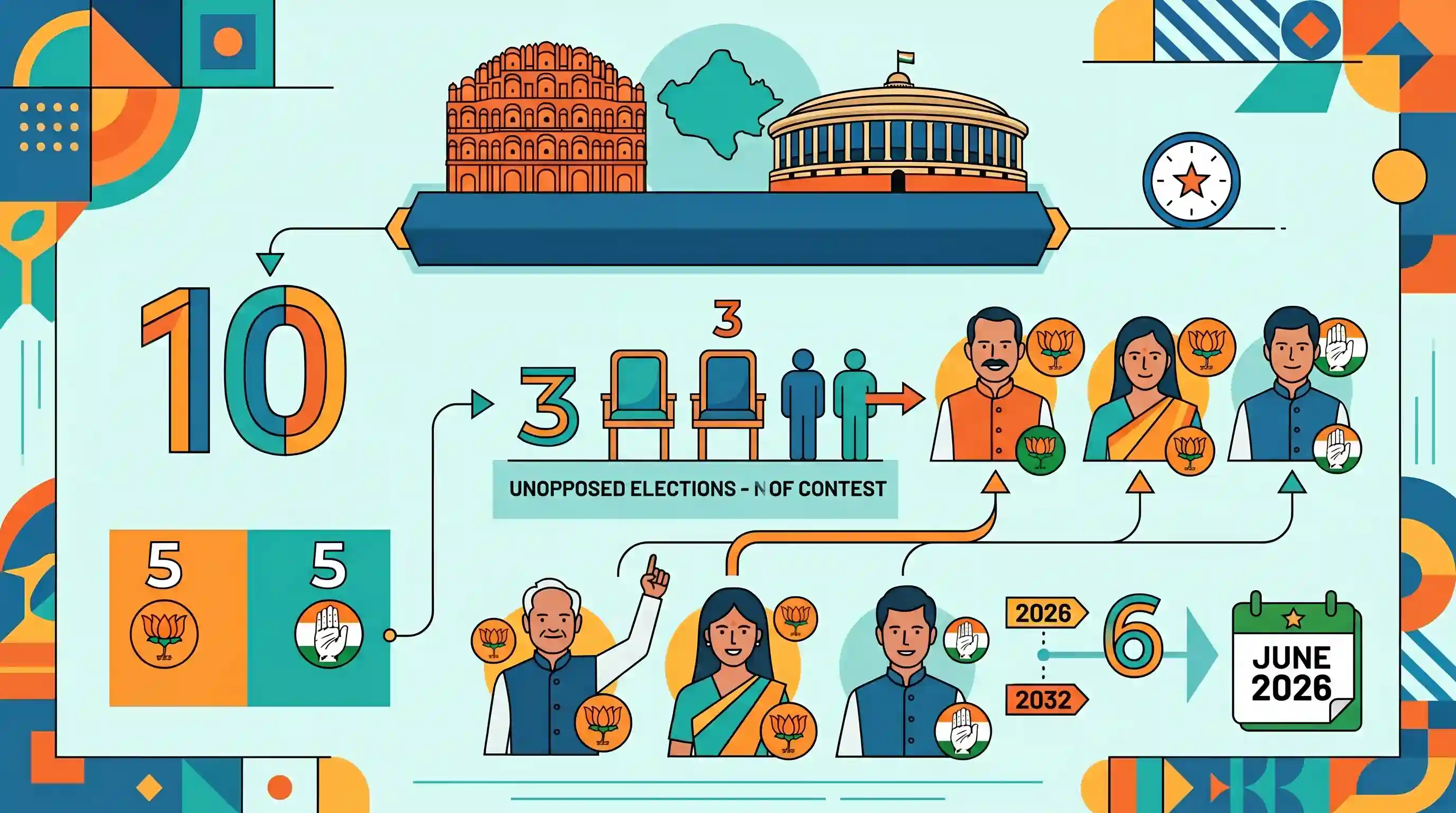
Three candidates elected unopposed to Rajya Sabha from Rajasthan
Source:The Hindu ↗
Why It Matters
Understanding state representation in the Rajya Sabha, the distribution of seats, constitutional provisions under Article 80, and the statutory mechanism of uncontested elections under the Representation of the People Act, 1951, are key topics for RPSC RAS Prelims state polity and governance syllabus.
Summary
BJP's Satish Poonia and Alka Gurjar, alongside Congress's Neeraj Dangi, were elected unopposed to the Rajya Sabha from Rajasthan on June 11, 2026. With this development, the total 10 Rajya Sabha seats from Rajasthan are now equally split, with five members each representing the BJP and the Congress. The biennial election became uncontested as the number of candidates matched the vacant seats resulting from the term expirations of Neeraj Dangi, Rajendra Gehlot, and Ravneet Singh Bittu. The newly elected members will serve a six-year term until June 2032.
Key Points
- In June 2026, three candidates were elected unopposed to the Rajya Sabha from Rajasthan: Satish Poonia (BJP), Alka Gurjar (BJP), and Neeraj Dangi (Congress).
- Following this election, Rajasthan has an equal representation in the Upper House, with five Rajya Sabha MPs each from the ruling BJP and the Opposition Congress out of a total of 10 seats.
- The biennial elections were held as the terms of three MPs—Neeraj Dangi (Congress), Rajendra Gehlot (BJP), and Ravneet Singh Bittu (BJP)—were set to expire on June 21, 2026. Neeraj Dangi was renominated and secured a second consecutive term.
- State Assembly Secretary and Returning Officer Bharat Bhushan Sharma declared the election results on June 11, 2026, following the deadline for withdrawal of nominations, making the scheduled voting on June 18 unnecessary.
- The newly elected Rajya Sabha MPs from Rajasthan will serve a six-year term ending in June 2032.
Important Terms
Representation of the People Act, 1951

A foundational Act of Parliament that governs the actual conduct of elections in India, laying down qualifications/disqualifications for members of legislature, election offences, and procedures for resolving electoral disputes.
UPSC context
GS Paper II (Polity & Governance). Key topic under "Salient features of the Representation of People's Act," frequently tested in Mains.
Constitution of India
The supreme law of India establishing the political framework, fundamental rights, and duties. In the context of Rajya Sabha, Article 80 of the Constitution provides for its composition and indirect election of its representatives.
UPSC context
GS Paper II (Polity). Central to the entire syllabus, testing constitutional provisions, amendments, and functioning of the executive/legislature.
Rajasthan Legislative Assembly
The unicameral state legislature of Rajasthan, consisting of 200 elected members. Under Article 80, its elected representatives form the electoral college to elect members representing Rajasthan in the Rajya Sabha.
UPSC context
GS Paper II (State Legislature). Tests the structure, powers, privileges, and election of state legislative assemblies and council representatives.
Bharatiya Janata Party (BJP)
One of the major national political parties in India, recognized by the Election Commission. Under ECI guidelines, it holds national party status by meeting specific criteria like state-level recognition across multiple states.
UPSC context
GS Paper II (Polity & Elections). Relevant under political parties, pressure groups, and the criteria for recognition as a national party.
Indian National Congress (INC)
One of India's oldest and major national political parties. Recognized by the Election Commission, it meets the specified electoral performance criteria, which grants it privileges like a reserved symbol and star campaigners.
UPSC context
GS Paper II (Polity & Elections). Relevant for studying political party dynamics, parliamentary opposition, and national party recognition criteria.
Prelims Trap
MLAs cross-voting in Rajya Sabha elections face automatic legislative disqualification under the Tenth Schedule.
The Supreme Court in Kuldip Nayar (2006) held that Tenth Schedule disqualification does not apply to Rajya Sabha polls; parties can only take internal disciplinary action.
Static Concepts Connected
What constitutional and statutory rules govern Rajya Sabha elections?
- Constitutional Basis: Elected by elected MLAs of States using proportional representation with single transferable vote (STV) under Article 80(4). Nominated MLAs cannot vote.
- Open Ballot System: Requires party MLAs to show marked ballots to authorized party agents to curb bribery, though independent MLAs cannot show theirs.
- Section 53(2) RPA: Requires that if the number of candidates matches the vacancies, they are declared elected unopposed without actual voting.
How do Anti-Defection and NOTA rules apply to Rajya Sabha elections?
- Tenth Schedule Exclusion: The Supreme Court ruled that cross-voting in Rajya Sabha elections does not attract disqualification under the Tenth Schedule.
- No NOTA Option: Held that NOTA is restricted to direct elections and cannot be used in proportional representation STV elections of the Rajya Sabha.
Cross-Topic Patterns
Statutory election laws and federalism
The removal of the state domicile requirement for Rajya Sabha candidates in 2003 altered state-specific representation, illustrating how statutory amendments can reshape India's federal structure.
Judicial review of ECI powers
The Supreme Court's ruling in PUCL v. UOI (2018) restricting NOTA in indirect elections reflects judicial boundary-setting on electoral mechanisms.

2026 prelims will likely test Rajya Sabha election exceptions: Tenth Schedule non-applicability, open ballot rules, and NOTA exclusion.
Linked PYQs · 3
Linked PYQs · 3
- 2024RPSC_PRELIMSGS1
Which one of the following statements is NOT correct supporting 'Rajasthan Parliament'? A. Minimum turnover (in persons) in by-elections take place in Rajasthan. B. Out of 7 in 3 assembly segments. C. Maximum ballot papers for service voters were found to be unsatisfactory. D. Out of 7 segments, one segment re-election is to take place in Rajasthan.
- 2024RPSC_PRELIMSGS1
Which of the following statements is NOT correct regarding the Rajasthan Vidhan Sabha?
- 2025RPSC_PRELIMSGS1
Which of the following statements is incorrect with respect to the election of the President of India?
