Bankipur Bypoll Defeat Highlights Political Shifts in Bihar
Source:The Hindu ↗
Why It Matters
Highlights the shifting political landscape in Bihar with the entry of the Jan Suraaj Party as a significant electoral force, and sheds light on ongoing administrative and law enforcement challenges in the state.
Summary
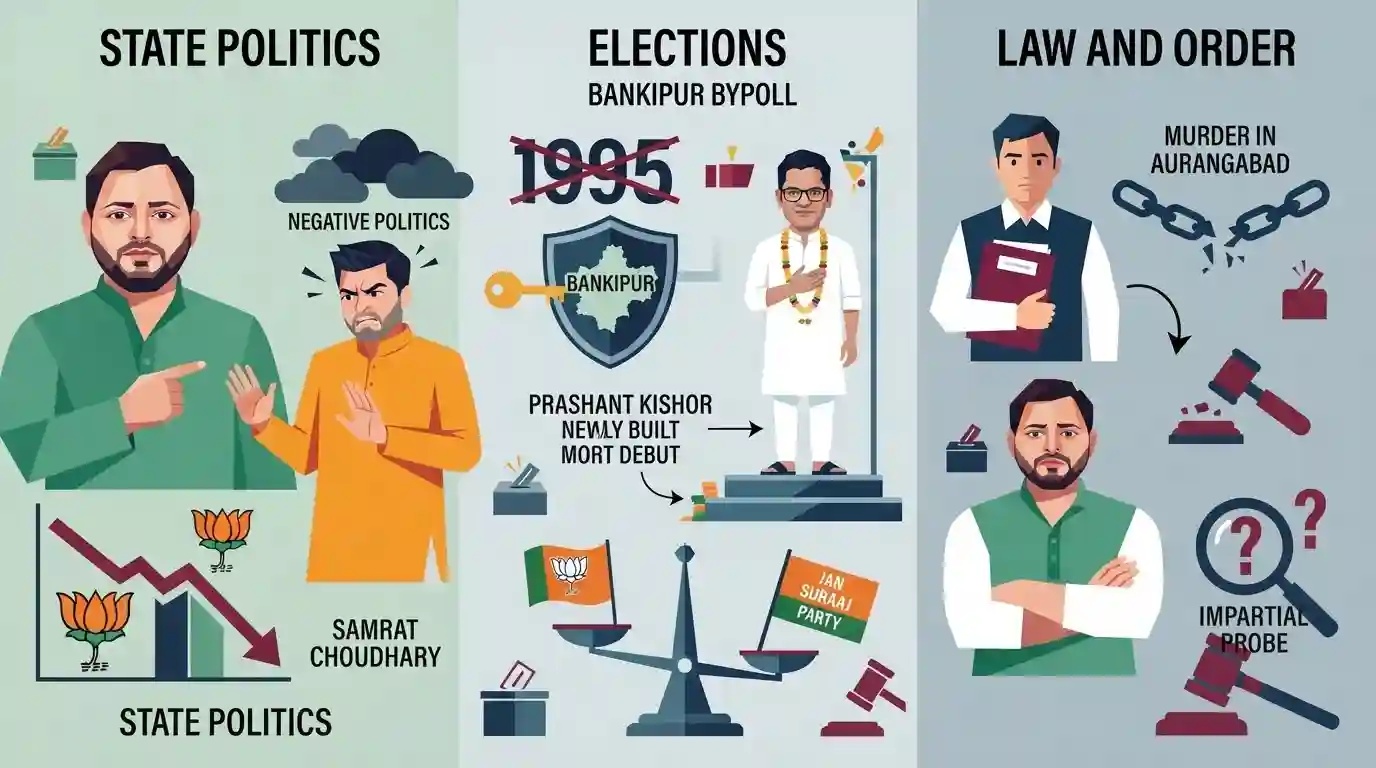
RJD leader Tejashwi Yadav attributed the BJP's crushing defeat in the Bankipur Assembly bypoll to the 'negative politics' of Deputy Chief Minister Samrat Choudhary. Political strategist-turned-politician Prashant Kishor, founder of the Jan Suraaj Party, made a successful electoral debut by capturing the Bankipur seat, which had been a BJP stronghold since 1995. Additionally, Tejashwi Yadav highlighted concerns regarding Bihar's deteriorating law and order following the murder of an Executive Officer in Aurangabad, demanding an impartial probe.
Key Points
- RJD leader Tejashwi Yadav blamed BJP's loss in the Bankipur Assembly bypoll on the 'negative politics' of Bihar Deputy CM Samrat Choudhary.
- Jan Suraaj Party (JSP) founder Prashant Kishor secured a massive victory in his electoral debut from the Bankipur seat, defeating BJP candidate Neeraj Kumar.
- The Bankipur constituency had been a BJP stronghold since 1995, most recently held by Nitin Nabin before his elevation to the Rajya Sabha.
- Yadav also criticized the Bihar government's handling of law and order, pointing to the recent murder of Vimal Kumar, an executive officer of the Dehri-Dalmianagar Municipal Council, in Aurangabad district.
Important Terms
Jan Suraaj Party

A Bihar-based political party launched in 2024 by strategist Prashant Kishor. Emerging from a grassroots governance campaign, it focuses on addressing youth migration and improving public service delivery, recently winning its maiden seat in the Bankipur bypoll.
UPSC context
GS-2 (Political Parties). Tests understanding of regional political dynamics, electoral movements, and grassroots governance alternatives.
Dehri-Dalmianagar Municipal Council
An urban local body in Bihar's Rohtas district. It recently made headlines after its Executive Officer was murdered in Aurangabad, prompting opposition leaders to raise serious concerns regarding deteriorating law, order, and safety of civil servants.
UPSC context
GS-2 (Local Governance) and GS-3 (Security). Highlights the vulnerabilities and security challenges faced by field-level administrative officers in India.
Rashtriya Janata Dal (RJD)
A prominent regional political party in Bihar led by Tejashwi Yadav. Rooted in social justice politics, it currently serves as the principal opposition, actively challenging the ruling state government on governance and law-and-order issues.
UPSC context
GS-2 (State Politics). Relevant for studying coalition politics, regional party influence, and the opposition's role in democratic accountability.
Bharatiya Janata Party (BJP)
India's ruling national political party and a key player in Bihar's ruling coalition. It recently lost its three-decade stronghold in the Bankipur assembly constituency bypoll, sparking debates over local anti-incumbency and state leadership dynamics.
UPSC context
GS-2 (Political Parties). Important for understanding national versus regional electoral shifts, incumbency challenges, and state-level coalition politics.
Prelims Trap
The Election Commission must mandatorily conduct a by-election within six months of any legislative vacancy without exception.
Section 151A of the RPA 1951 waives this requirement if the remaining term of the vacant seat is less than one year, or if the ECI and Centre deem holding it impractical.
Static Concepts Connected
What are the criteria for a political party to be recognized as a 'State Party'?
- Vote and Seat Share: Secures at least 6% of valid votes in a State Assembly election and wins at least 2 Assembly seats.
- Assembly Seat Threshold: Wins at least 3% of total Assembly seats or 3 seats, whichever is more, in a general election.
- Alternative Vote Share: Secures at least 8% of the total valid votes in the State, even without winning any legislative seats.
What rules govern legislative by-elections under the RPA, 1951?
- Six-Month Rule: Section 151A mandates filling any vacancy in Parliament or State Legislatures within six months of its occurrence.
- Term Exception: No by-election is held if the remaining term of the member is less than one year.
- ECI Discretionary Power: ECI can defer by-elections if it certifies, in consultation with the Centre, that holding them is difficult.
Cross-Topic Patterns
Regional party rise & Coalition federalism
The emergence of hyper-local political forces challenges dominant national parties, signaling a shift toward highly localized federal bargaining and regional identity assertion.
Civil servant security & Grassroots administration
Violence against municipal officers highlights the governance deficit and security vulnerabilities of state-level public servants executing development mandates in volatile regions.

RPA 1951 provisions on by-election timelines (Sec 151A) and ECI's discretionary power to defer them will likely be tested in 2026.
Linked PYQs · 4
Linked PYQs · 4
- 2024-IBPSC_PRELIMSGS1
Which of the following Acts converted Unicameral Legislature of Bihar into Bicameral : Bihar Legislative Assembly and Bihar Legislative Council?
- 2023BPSC_PRELIMSGS1
Match the following political parties listed in List-I with their years of establishment in List-II: List-I (Political Parties) List-II (Years of Establishment) a. Communist Party of India (Marxist) 1. 1964 b. Communist Party of India 2. 1998 c. Bahujan Samaj Party 3. 1925 d. All India Trinamool Congress (AITC) 4. 1984
- 2024-EBPSC_PRELIMSGS1
Manvi Madhu Kashyap recently became Bihar’s first transgender
- 2024-IBPSC_PRELIMSGS1
What is the system of governance in the Panchayat Raj set-up?
