Dehradun land and irrigation dispute law and order challenges
Source:india-today ↗
Why It Matters
The incident underscores the administration of law and order, police interventions, and the administrative challenges of managing land and irrigation disputes in the agricultural and semi-urban plain regions of Uttarakhand.
Summary
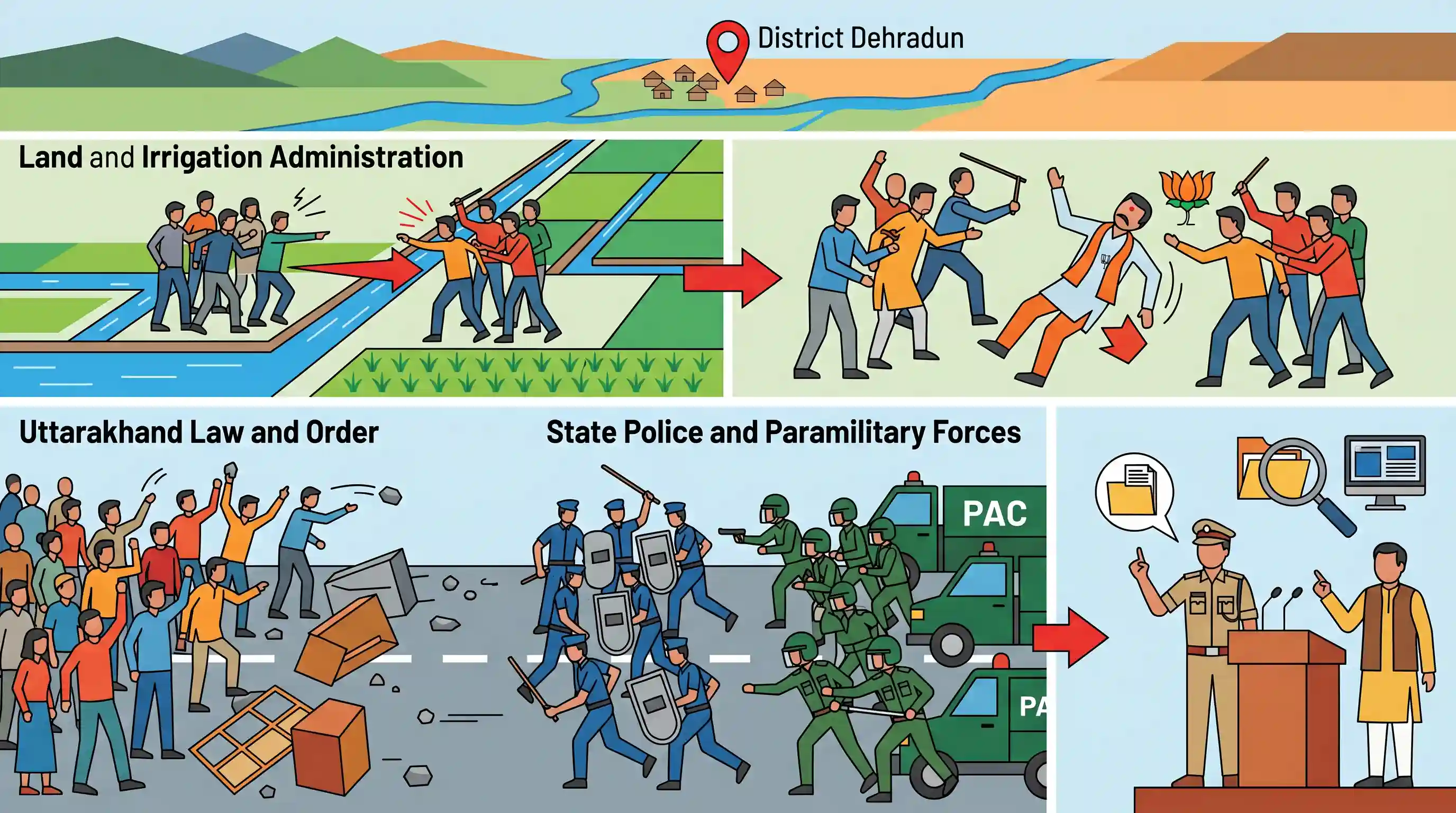
In Bairagiwala village of Dehradun, Uttarakhand, a violent clash over an irrigation/land dispute resulted in the death of 44-year-old BJP worker Vinod Kumar. The incident triggered protests, highway blockades, and stone-pelting, forcing police to use lathi-charge and deploy the Provincial Armed Constabulary (PAC) to maintain law and order. Local authorities, including SSP Pramendra Singh Dobal and MLA Munna Singh Chauhan, have assured strict action as police investigate the roots of the dispute.
Key Points
- Vinod Kumar, a 44-year-old local BJP worker and social media activist, was violently attacked and killed in Bairagiwala village, Dehradun district.
- While initial police reports attributed the clash to a dispute over irrigating agricultural fields, Bairagiwala village head Vicky Kashyap claimed the incident was a fallout of an ongoing land dispute that Vinod had raised earlier.
- The killing triggered widespread protests, national highway blockades, and stone-pelting, prompting the police to resort to a lathi-charge and deploy the Provincial Armed Constabulary (PAC) to restore order.
- An FIR was registered against 12 named suspects and several unidentified individuals, with Dehradun Senior Superintendent of Police (SSP) Pramendra Singh Dobal overseeing the probe and local MLA Munna Singh Chauhan visiting the bereaved family.
Important Terms
Provincial Armed Constabulary

An armed police reserve force in states like Uttar Pradesh and Uttarakhand, organized along military lines to maintain law and order, control riots, and assist local police.
UPSC context
GS Paper III (Internal Security). Tests knowledge of state-level security apparatus, mob control, and federal police divisions.
State Armed Police Forces
Specialized state-level armed police reserve units in India tasked with managing severe civil disturbances, counterinsurgency, and riots beyond civil police capabilities.
UPSC context
GS Paper III (Internal Security). Evaluates understanding of localized security management and police infrastructure.
Public Order
The preservation of peace, safety, and tranquility within society, classified as a State Subject under Entry 1 of the State List in India.
UPSC context
GS Paper II (Polity and Federalism). Tests understanding of the Seventh Schedule and Centre-State administrative divisions.
Seventh Schedule
The constitutional schedule under Article 246 of the Indian Constitution that allocates legislative powers across Union, State, and Concurrent Lists.
UPSC context
GS Paper II (Indian Constitution). Evaluates knowledge of federal structure, legislative competence, and separation of powers.
Prelims Trap
In Uttarakhand's land classification, 'Upraon' refers to fertile irrigated valley land while 'Talaon' represents dry terraced slopes.
It is the exact reverse. 'Talaon' (lowland/wet) is irrigated valley land, whereas 'Upraon' (upland/dry) refers to terraced hillside farming dependent on rainfall.
Static Concepts Connected
What are the traditional land classification terms 'Talaon' and 'Upraon' in Himalayan agriculture?
- Talaon Land: Refers to low-lying, perennially irrigated valley lands, highly fertile and used for intensive crops like paddy.
- Upraon Land: Refers to dry, unirrigated upland terrace farming on hillsides, heavily dependent on monsoon rainfall.
- Ijran/Khil Land: Represents poor-quality, stony, or intermittent agricultural land on steep forest fringes.
How do newly created states inherit and apply laws from their parent states?
- Adaptation of Laws: Under State Reorganisation Acts, parent state laws remain active in the new state 'mutatis mutandis' until repealed or modified.
- Legal Continuity: Prevents administrative vacuum during transition; exemplified by Uttarakhand still using the UP PAC Act of 1948.
Cross-Topic Patterns
Traditional land tenure and resource conflicts
Unequal distribution of fertile irrigated 'Talaon' land in hill states often drives localized agrarian violence and water disputes, linking land administration to internal security.
Federalism and legislative adaptation
The continued use of parent-state laws (like the UP PAC Act) by newly created states highlights administrative path dependency in India's federal structure.

Traditional Himalayan land terms (Talaon/Upraon) and regional research institutions are prime candidates for Geography matching questions.
Linked PYQs · 3
Linked PYQs · 3
- 2025UKPSC_PRELIMSGS1
Which of the following districts of Uttarakhand has the highest agricultural land ?
- 2025UKPSC_PRELIMSGS1
Which of the following is incorrectly matched about Central Government Institutes located in Uttarakhand?
- 2024UKPSC_PRELIMSGS1
What percentage (approximately) of Uttarakhand is plain area ?
