Bihar BJP Organizes Patna Event to Mobilize EBC Voter Base
Source:The Hindu ↗
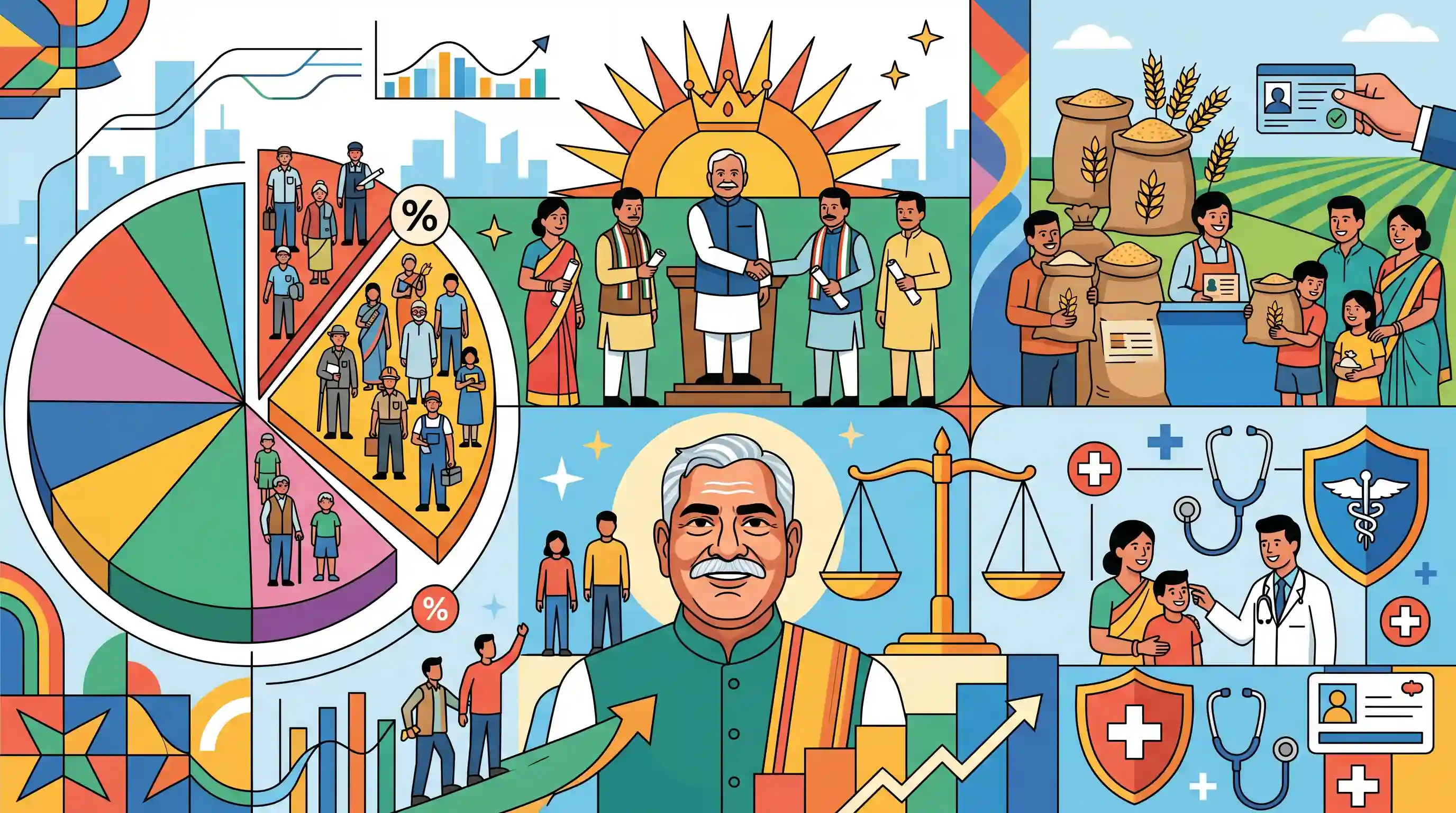
Why It Matters
This article is highly significant for understanding the political mobilization, demographic profile, and welfare interventions targetted at Extremely Backward Classes (EBCs), who make up 36% of Bihar's population. It also touches upon key historical landmarks like the Karpoori Thakur reservation model and major national welfare schemes (PMGKAY and Ayushman Bharat PM-JAY).
Summary
At the Ati Pichhda Samaj Felicitation Ceremony in Patna on June 22, 2026, Bihar Chief Minister Samrat Choudhary and other NDA leaders gathered to celebrate newly-elected BJP MLCs from the Extremely Backward Classes (EBC) community. Highlighting that EBCs make up 36% of Bihar's population, leadership highlighted key welfare accomplishments, including free grain distributions to 1.61 crore EBC ration card holders under PMGKAY, and health coverage for over 1 crore beneficiaries under Ayushman Bharat, while paying homage to the reservation legacy of social reformer Karpoori Thakur.
Key Points
- Ati Pichhda Samaj (Extremely Backward Community) Felicitation Ceremony was organized on June 22, 2026, at Patna's Sri Krishna Memorial Hall to honor newly-elected BJP MLCs.
- Extremely Backward Classes (EBCs) constitute 36% of Bihar's population, representing the largest social block in the state as verified by Bihar's demographic records.
- The event highlighted the administrative and social legacy of late former Bihar Chief Minister Karpoori Thakur, who pioneered the 'Karpoori Thakur Formula' in 1978 to create separate sub-quotas for EBCs and OBCs in government jobs.
- Under central welfare initiatives, 1.61 crore ration card holders from the EBC category in Bihar have received free food grains worth ₹6,024.45 crore through the Pradhan Mantri Garib Kalyan Anna Yojana.
- More than 1 crore people in Bihar have benefitted from free medical assistance of up to ₹5 lakh under the Ayushman Bharat (PM-JAY) scheme.
- BJP highlights EBC political representation, pointing out that they have 5 EBC MLCs in Bihar and that there are 27 OBC and EBC ministers in the Union Cabinet.
Important Terms
Extremely Backward Classes (EBCs)

A sub-category within the Other Backward Classes (OBCs) comprising the most socially and educationally marginalized communities, historically defined in Bihar based on the 1976 Mungeri Lal Commission recommendations.
UPSC context
GS Paper II (Social Justice, Vulnerable Sections); tests understanding of caste-based stratification, sub-categorization of OBCs, and reservation dynamics.
Karpoori Thakur Formula
A pioneering layered reservation model introduced in Bihar in 1978. It divided backward class quotas (26%) into sub-quotas for EBCs, OBCs, women, and economically weaker sections among upper castes.
UPSC context
GS Paper II (Social Justice, Affirmative Action); tests knowledge of historical reservation frameworks, sub-categorization, and pioneers of social empowerment.
Pradhan Mantri Garib Kalyan Anna Yojana (PMGKAY)
A major food security welfare scheme launched in 2020. Integrated with the NFSA, it provides free monthly foodgrains (5 kg per person) to eligible Priority Households and Antyodaya Anna Yojana beneficiaries.
UPSC context
GS Paper II (Welfare Schemes, Social Sector); tests understanding of food security, public distribution system (PDS) efficiency, and social safety nets.
Ayushman Bharat PM-JAY
A flagship central health assurance scheme launched in 2018. It provides cashless secondary and tertiary hospitalization coverage of up to ₹5 lakh per family annually to poor and vulnerable households.
UPSC context
GS Paper II (Social Sector/Health, Welfare Schemes); tests comprehension of universal health coverage (UHC) and efforts to reduce catastrophic out-of-pocket healthcare expenses.
Prelims Trap
State governments have the legislative competence to conduct a formal Census under the Census Act, 1948.
Only the Union can conduct a 'Census' (Union List, Entry 69). States conduct 'surveys' under Entry 45 of the Concurrent List (Inquiries and Statistics).
Static Concepts Connected
What is the constitutional basis of sub-categorisation of backward classes?
- Article 340: Empowers the President to appoint a commission to investigate and report on the conditions of backward classes.
- Indra Sawhney Judgement: The Supreme Court in 1992 ruled that there is no constitutional bar to sub-classifying backward classes into backward and more backward.
- Articles 15 and 16: Enable states to make special provisions and reservation policies for socially and educationally backward classes (SEBCs).
Cross-Topic Patterns
Demographics + Targeted Welfare Delivery
Caste-based demographic surveys are increasingly used by states to fine-tune beneficiary identification for major central schemes like PMGKAY and PM-JAY, bridging social justice with fiscal governance.
Caste Surveys + Reservation Limits
The push for sub-categorisation in Bihar mirrors the national legal battle over the 50% reservation limit established in the landmark Indra Sawhney judgment.

Sub-categorisation of backward classes under Articles 340 and 341, and its impact on the 50% reservation ceiling, is a high-yield 2026 topic.
Linked PYQs · 2
Linked PYQs · 2
- 2025BPSC_PRELIMSGS1
Consider the following statements: 1) The proportion of the young population (0-19 years) in Bihar is projected to decline significantly by 2041. 2) Bihar’s demographic dividend is expected to peak around 2041. 3) The elderly population (60+ years) in Bihar is expected to rise more sharply than in India. Select the correct answer using the codes given below:
- 2022BPSC_PRELIMSGS1
From which district of Bihar was the Garib Kalyan Rojgar Abhiyan launched by the Prime Minister in 2020?
