Akhilesh Yadav criticizes proposed BJP cash allowance for women
Source:The Hindu ↗
Why It Matters
Direct benefit transfers (DBT) and cash allowance schemes for women are central to modern electoral strategies and welfare governance in Indian states. Understanding the political discourse around these schemes highlights the dynamics of competitive populism and how regional parties frame welfare and corruption issues in state assembly elections.
Summary
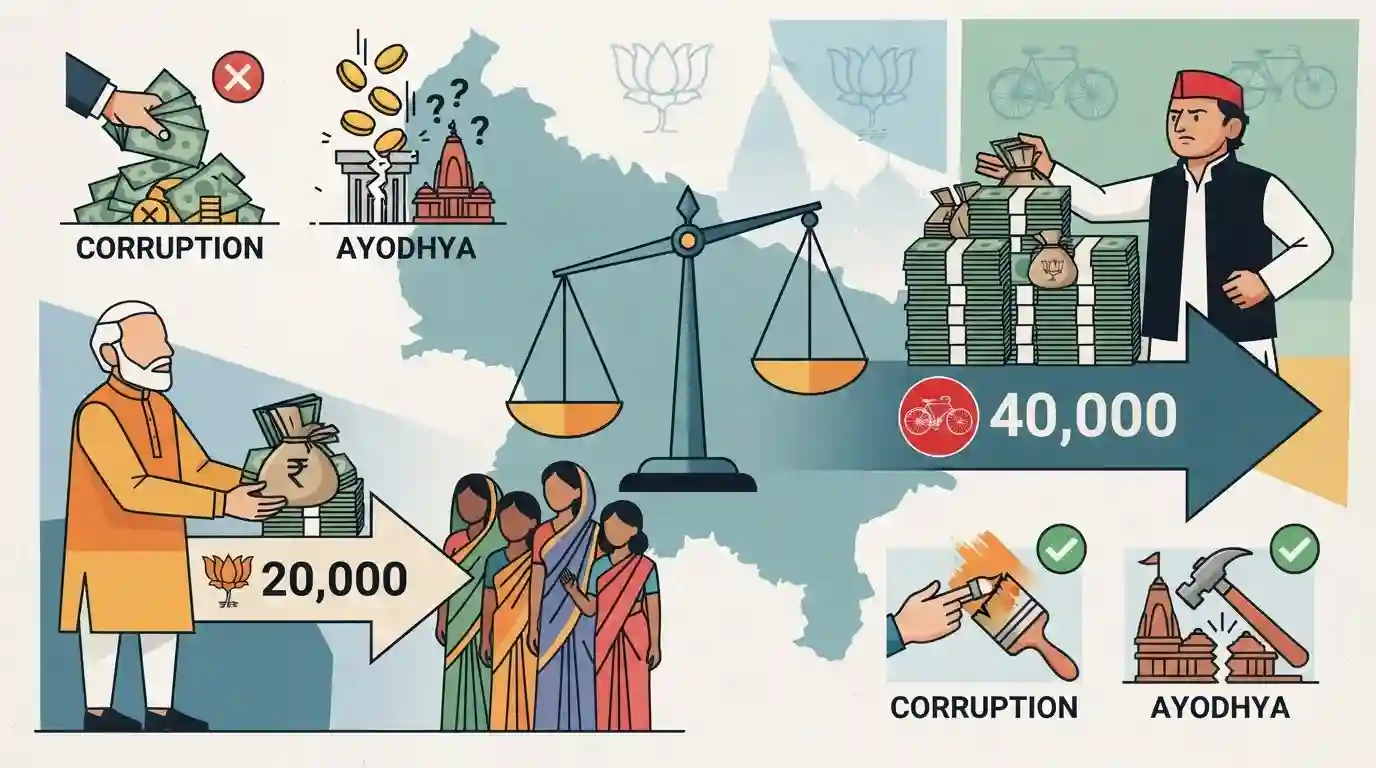
The article discusses a political clash in Uttar Pradesh regarding proposed direct cash transfers for women. Samajwadi Party chief Akhilesh Yadav attacked the BJP's reported plan to offer a ₹20,000 allowance to women, calling it "stolen money" used to mask a decade of corruption. In a display of competitive populism, Yadav countered the BJP's move by promising an annual allowance of ₹40,000 for women. He further criticized the BJP government for alleged financial irregularities in the Ram Temple project in Ayodhya.
Key Points
- Samajwadi Party president Akhilesh Yadav has criticized the BJP government's reported plan to introduce a cash grant of ₹20,000 for women in Uttar Pradesh, labeling it as a cover for corruption.
- Yadav alleged that funds meant for women over the past ten years were misappropriated and diverted to large capitalists, promising instead an annual allowance of ₹40,000 for women if his party is elected.
- He also accused the ruling party of large-scale corruption in the construction of the Ram Temple in Ayodhya, pointing to structural issues.
- The political discourse reflects a broader trend of competitive populism and direct benefit transfers (DBTs) targeted at women voters ahead of upcoming assembly elections.
Important Terms
Bharatiya Janata Party (BJP)

The dominant national political party currently ruling at the Centre and in Uttar Pradesh. It drives major welfare initiatives and infrastructure developments, significantly shaping state-level policy and electoral strategies.
UPSC context
GS Paper 2 (Political Parties). Tests the ideological and policy influence of the dominant national party on centre-state relations.
Samajwadi Party (SP)
A major regional political party based in Uttar Pradesh. It serves as the primary opposition, advocating for specific demographic bases and heavily influencing state-level electoral strategies through competitive policies.
UPSC context
GS Paper 2 (Regional Parties) & UPPSC GS 5 (UP Political System). Evaluates understanding of opposition roles and coalition politics.
Competitive Populism
An electoral trend where rival political parties attempt to outbid each other by promising increasingly generous welfare benefits, cash grants, or 'freebies' to attract voters, risking fiscal sustainability.
UPSC context
GS Paper 2 (Electoral Politics) & GS 3 (Economy). Tests the tension between necessary welfare schemes and state fiscal discipline.
Direct Benefit Transfer (DBT)
A governance mechanism that deposits welfare funds and subsidies directly into beneficiaries' bank accounts. It utilizes digital infrastructure to remove intermediaries, ensure accurate targeting, and minimize corruption in public spending.
UPSC context
GS Paper 2 (Welfare Schemes) & GS 3 (E-governance). Examines the role of technology in improving administrative transparency and efficiency.
Representation of the People Act, 1951
An Indian legislation governing the actual conduct of elections. It sets the rules for candidate qualifications, party registration, and strictly prohibits corrupt practices and undue inducements during political campaigns.
UPSC context
GS Paper 2 (Salient Features of the RPA). Tests the legal framework surrounding electoral promises, freebies, and campaign integrity.
Prelims Trap
Promises of freebies in election manifestos legally constitute a corrupt practice under the Representation of the People Act, 1951.
The Supreme Court ruled in the 2013 Balaji case that manifesto promises do not fall under Section 123 'corrupt practices' of the RPA.
Static Concepts Connected
What are the conditions for a political party to be recognized as a State Party?
- Vote & Seat: Secure at least 6% of valid votes in Assembly/Lok Sabha elections plus win 2 Assembly or 1 Lok Sabha seat.
- Seat Share: Win at least 3% of total Legislative Assembly seats or 3 seats, whichever is greater.
- Vote Alternative: Secure at least 8% of total valid votes polled in the State in a general election, without any seat requirement.
How does the Representation of the People Act, 1951 treat electoral freebies and corrupt practices?
- Section 123: Defines corrupt practices to include bribery, undue influence, and appealing to voters on the grounds of religion, race, or caste.
- Manifesto Exception: The Supreme Court clarified that manifesto promises of freebies do not legally constitute a 'corrupt practice' under this section.
- Disqualification: Candidates found guilty of corrupt practices can be disqualified from contesting elections for up to six years.
Cross-Topic Patterns
Competitive populism vs. State fiscal health
The debate over aggressive DBTs bridges GS-2 (welfare) and GS-3/6 (UP's fiscal health). High recurrent welfare spending challenges capital expenditure and tests state FRBM Act limits.
Women as a distinct electoral constituency
Proposed DBTs reflect a structural shift in UP politics where female voters are targeted independently of traditional caste blocks, driving a focus on state-level gender budgeting.

Expect questions probing the ethical/fiscal lines between 'welfare' and 'freebies', or prelims questions on state party criteria.
Linked PYQs · 3
Linked PYQs · 3
- 2025UPPSC_PRELIMSGS1
Consider the following and arrange them in correct chronological order. 1. Jawahar Rojgar Yojana 2. Development of women and children in Rural Areas 3. Integrated Rural Development Programme 4. National Rural Employment Programme Select the correct answer from the code given below :
- 2014UPPSC_PRELIMSGS1
A political party is recognized as a regional party, if
- 2022UPPSC_PRELIMSGS1
Consider the following statements about farm subsidies in India. 1. The input subsidies in India, such as on fertilizers fall under indirect farm subsidies. 2. Reduction in power and irrigation bills offered to farmers fall under direct farm subsidies. 3. The agricultural provisions of the World Trade Organization (WTO) though allow direct farm subsidies, prohibit indirect subsidies. 4. All subsidies provided by the governments in India fall under the indirect subsidies. Select the correct statements using the code given below.
