Legislative Defeat of Constitution Amendment on Delimitation
Source:The Hindu ↗
Why It Matters
The legislative standoff highlights the structural complexities of amending the Constitution and the friction between women's political empowerment and demographic-based delimitation, which directly impacts India's federal balance.
Summary
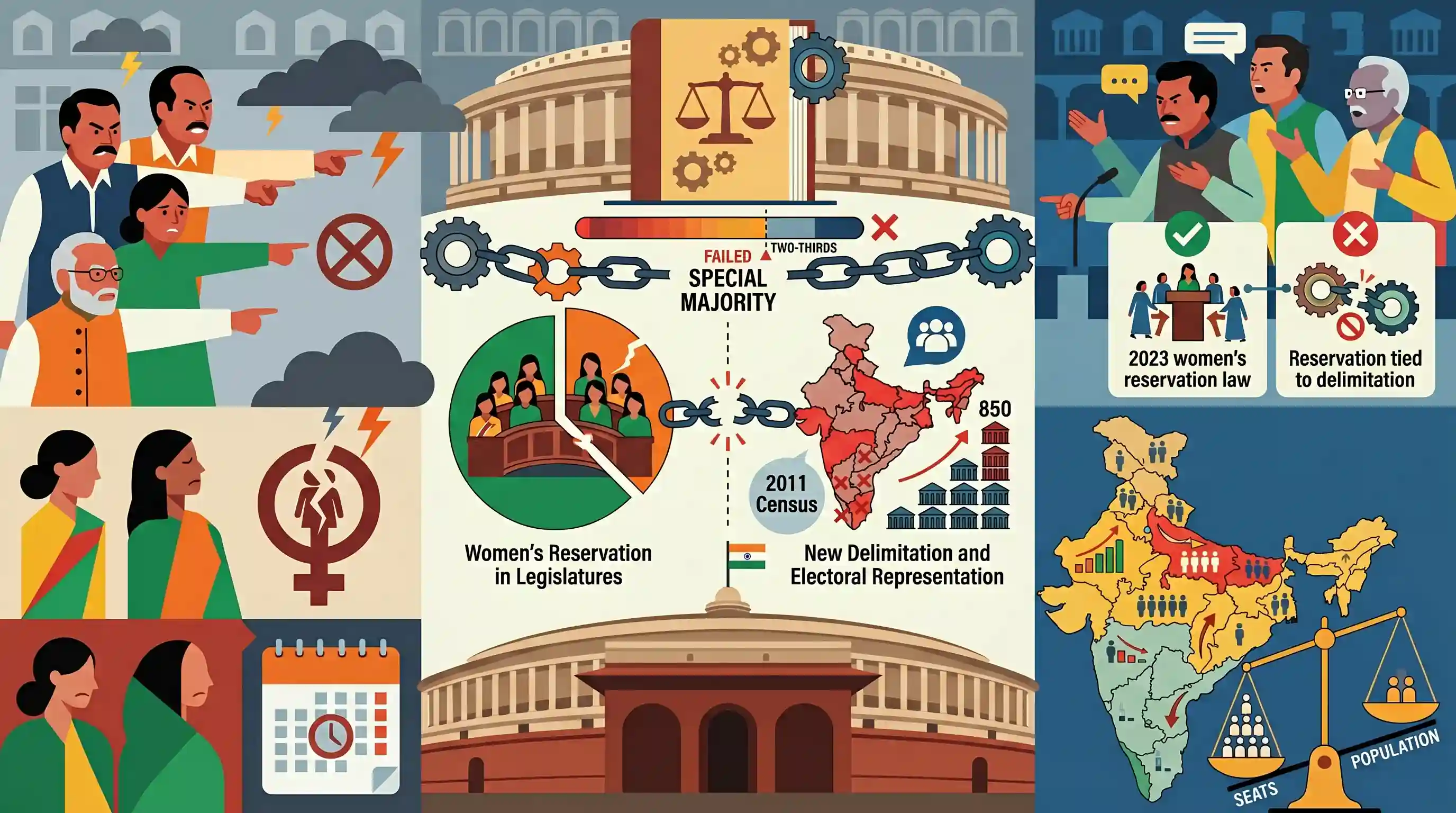
The Lok Sabha witnessed a bitter political fallout after a Constitution Amendment Bill, which sought to link women's reservation in legislatures with a new delimitation exercise, failed to secure the requisite two-thirds special majority. The legislation aimed to increase the Lok Sabha's maximum strength to 850 based on the 2011 Census and operationalise the gender quota ahead of the 2029 elections. While the BJP accused the Opposition of betraying women's empowerment and marking a 'black day' in Parliament, Congress and its INDIA bloc allies defended their stance. They argued that they support the 2023 women's reservation law but oppose its contentious linkage to delimitation, warning it could dilute the political representation of South Indian states and accusing the government of leveraging the issue for upcoming Assembly elections.
Key Points
- A Constitution Amendment Bill designed to operationalise women's reservation by 2029 and expand Lok Sabha seat strength to a maximum of 850 was defeated in the Lok Sabha.
- The Bill failed to secure the required Article 368 special majority (two-thirds of members present and voting), garnering 298 votes in favour and 230 against.
- Opposition parties reaffirmed their support for the 2023 women's quota law but opposed tying its implementation to fresh delimitation based on the 2011 Census.
- The opposition argued that the delimitation linkage was a political move that could adversely affect political representation for South Indian states.
- BJP leaders condemned the bill's defeat as a betrayal of women's empowerment, while the opposition demanded immediate implementation of the standalone 2023 reservation act.
Important Terms
Constitution Amendment Bill

A legislative proposal under Article 368 to modify the Constitution. It requires a special majority in both Houses and, for federal changes, ratification by at least half of the State Legislatures.
UPSC context
GS II (Polity); tests knowledge of parliamentary procedures, constitutional rigidity, and the balance between the Centre and States.
Women's Reservation Bill
Formally the 106th Amendment Act (Nari Shakti Vandan Adhiniyam), it reserves one-third of seats in the Lok Sabha and State Assemblies for women to address gender disparity in political representation.
UPSC context
GS I (Social Issues) & GS II (Governance); tests understanding of gender-based affirmative action and legislative reforms for empowerment.
Delimitation
The act of redrawing boundaries for Lok Sabha and State Assembly seats based on population (Articles 82 & 170) to ensure 'one person, one vote, one value.'
UPSC context
GS II (Polity); tests understanding of the Delimitation Commission, demographic representation, and the North-South federal divide.
Special Majority
A voting threshold for constitutional amendments requiring a majority of the House's total membership and a two-thirds majority of members present and voting.
UPSC context
GS II (Polity); tests technical knowledge of Article 368 and the procedural safeguards against arbitrary constitutional changes.
INDIA bloc
A multi-party coalition of opposition parties representing the shift toward consolidated coalition politics in India’s parliamentary democracy and its impact on the multi-party system.
UPSC context
GS II (Polity); tests understanding of coalition dynamics, the role of the Opposition, and the functioning of the multi-party system.
Federalism
A constitutional arrangement dividing power between the Centre and States. India is often described as 'quasi-federal' with a strong unitary tilt to ensure national integrity.
UPSC context
GS II (Polity); tests knowledge of Centre-State relations, the Seventh Schedule, and the protection of regional interests.
Prelims Trap
"A joint sitting of Parliament can be summoned to resolve a deadlock over a Constitution Amendment Bill."
Joint sittings (Article 108) only apply to ordinary and financial bills. Constitution Amendment Bills must be passed by each House separately; there is no joint sitting to resolve a deadlock.
Static Concepts Connected
What constitutes a "Special Majority" under Article 368?
- Absolute Majority: More than 50% of the total membership of the House must support the bill, regardless of vacancies or absentees.
- Present and Voting: At least two-thirds (2/3) of the members who are actually present and voting must vote in favour of the bill.
- State Ratification: For amendments affecting federal structures, the bill must also be ratified by the legislatures of half the States by a simple majority.
What is the constitutional freeze on Delimitation?
- 42nd Amendment (1976): Froze Lok Sabha seat allocation based on the 1971 Census until the year 2000 to encourage states to implement family planning without losing representation.
- 84th Amendment (2001): Extended the freeze on readjusting the total number of Lok Sabha and Assembly seats until the first census published after 2026.
- 87th Amendment (2003): Permitted territorial readjustment of constituencies (without altering the total seat count) based on the 2001 Census data.
Cross-Topic Patterns
Delimitation & Fiscal Federalism
The fear of Southern states losing Lok Sabha seats mirrors debates around the Finance Commission's use of 2011 census data, reflecting a broader demographic penalty for successful population control.
Intersectional Quotas & SC/ST Sub-categorisation
The 106th Amendment introduces a quota-within-quota for SC/ST women, directly intersecting with recent Supreme Court constitution bench rulings on the sub-classification of reserved categories.

Expect a 2026 multi-statement question linking Article 368 special majority, the 2026 delimitation freeze, and the 106th Amendment.
Linked PYQs · 4
Linked PYQs · 4
- 2023MainsGS2
Discuss the contribution of civil society groups for women's effective and meaningful participation and representation in state legislatures in India.
- 2022PrelimsGS1
Consider the following statements: 1. A bill amending the Constitution requires a prior recommendation of the President of India. 2. When a Constitution Amendment Bill is presented to the President of India, it is obligatory for the President of India to give his/her assent. 3. A Constitution Amendment Bill must be passed by both the Lok Sabha and the Rajya Sabha by a special majority and there is no provision for joint sitting. Which of the statements given above are correct?
- 2020PrelimsGS1
Rajya Sabha has equal powers with Lok Sabha in
- 2024PrelimsGS1
As per Article 368 of the Constitution of India, the Parliament may amend any provision of the Constitution by way of : 1. Addition 2. Variation 3. Repeal Select the correct answer using the code given below:
