Sixth Schedule Autonomy and Electoral Politics in Bodoland
Source:Indian Express ↗
Why It Matters
This issue illustrates the practical application of constitutional mechanisms like the Sixth Schedule and Delimitation in shaping electoral democracy. It provides a real-world example of how peace accords and regional autonomy frameworks can integrate ethnic movements into mainstream politics and governance in Northeast India.
Summary
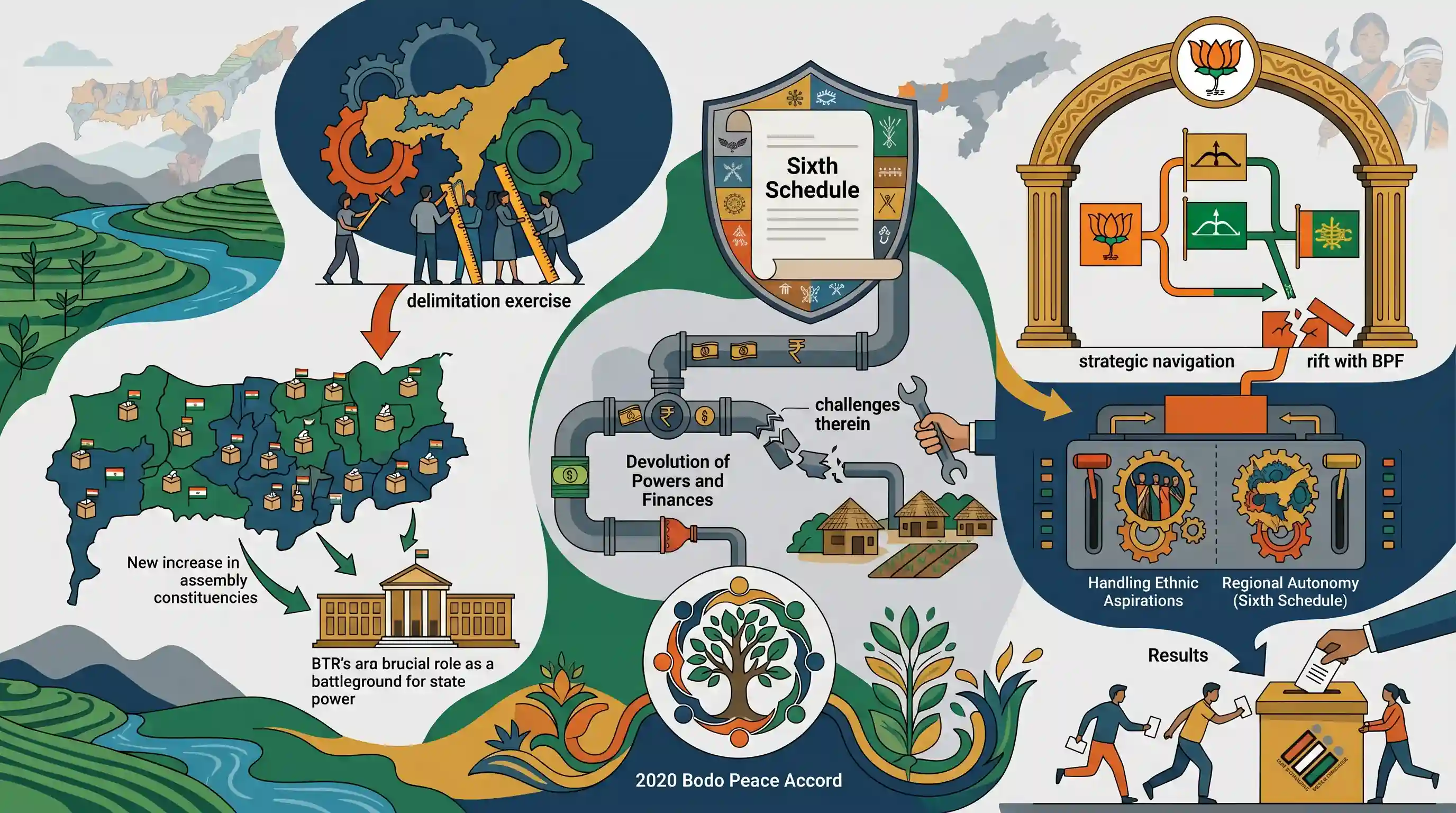
The article highlights the heightened political significance of the Bodoland Territorial Region (BTR) in the context of the upcoming Assam assembly elections. Following a recent delimitation exercise, the BTR has seen an increase in its assembly constituencies, making it a crucial battleground for state power. The ruling BJP is strategically navigating its alliance with the United People's Party Liberal (UPPL) while managing a rift with the Bodoland People's Front (BPF) within the broader NDA framework. The region's unique governance structure under the Sixth Schedule and the stabilizing impact of the 2020 Bodo Peace Accord continue to shape its identity politics, making the handling of regional autonomy and ethnic aspirations central to the BJP's electoral calculus in Assam.
Key Points
- The recent delimitation exercise in Assam has increased the number of assembly seats in the Bodoland Territorial Region (BTR), significantly boosting its electoral importance for the upcoming state elections.
- Bodoland operates under the Sixth Schedule of the Constitution via the Bodoland Territorial Council, which grants it substantial administrative and legislative autonomy.
- The 2020 Bodo Peace Accord successfully ended decades of armed insurgency, bringing regional outfits into the democratic mainstream and altering local political equations.
- The BJP faces a complex balancing act in managing its NDA alliances in the state, specifically navigating the rivalry between the UPPL (its current ally in the BTC) and the BPF (a former ally).
- Ethnic identity, tribal land rights, and the execution of the peace accord's developmental promises remain the primary drivers of voter behavior in the region.
Important Terms
Sixth Schedule of the Constitution

Provision under Articles 244(2) and 275(1) providing special administrative autonomy to tribal areas in Assam, Meghalaya, Tripura, and Mizoram through Autonomous District Councils (ADCs) with legislative and judicial powers.
UPSC context
GS Paper II: Indian Polity; tests understanding of federalism and tribal administration in the North-East.
Bodo Peace Accord (2020)
A tripartite agreement signed in January 2020 between the Centre, Assam Government, and Bodo groups to end decades of insurgency, renaming the region BTR and increasing its administrative powers.
UPSC context
GS Paper III: Internal Security/Insurgency; relevant for questions on peace-building and regional autonomy.
Bodoland Territorial Council (BTC)
An autonomous body formed under the Sixth Schedule in 2003 to govern the Bodoland Territorial Region (BTR), managing local subjects like land, forests, and primary education.
UPSC context
GS Paper II: Governance; examines the devolution of powers and local self-governance in tribal regions.
Delimitation Act
Legislation enacted under Article 82 of the Constitution that mandates redrawing the boundaries of Lok Sabha and State Assembly constituencies based on the latest census to ensure equitable representation.
UPSC context
GS Paper II: Elections; tests knowledge of the Representation of People’s Act and electoral reforms.
Bodoland People’s Front (BPF)
A major regional political party in Assam, led by Hagrama Mohilary, which formerly governed the BTC and currently plays a key role in Bodoland’s ethnic identity politics.
UPSC context
GS Paper II: Political Parties/Pressure Groups; illustrates regionalism and coalition dynamics in Indian politics.
United People’s Party Liberal (UPPL)
A regional political party in Bodoland led by Pramod Boro, which came to power in the BTC after the 2020 Accord and currently aligns with the BJP.
UPSC context
GS Paper II: Governance; demonstrates how regional parties influence state-level electoral outcomes and tribal policy.
Prelims Trap
Laws passed by Autonomous District Councils under the Sixth Schedule do not require the Governor's assent.
While Autonomous District Councils possess distinct legislative powers over specific subjects (like land and forests), all laws passed by them legally require the assent of the State Governor to take effect.
Static Concepts Connected
How does the Sixth Schedule differ fundamentally from the Fifth Schedule?
- Geographical scope: The Sixth Schedule applies exclusively to Assam, Meghalaya, Tripura, and Mizoram (AMTM), whereas the Fifth Schedule applies to Scheduled Areas in any other state.
- Degree of autonomy: The Sixth grants legislative and judicial powers via Autonomous District Councils (ADCs), while the Fifth relies on Tribes Advisory Councils which are strictly advisory.
- Governor's role: Under the Sixth Schedule, the Governor has special discretionary powers to organize, reorganize, or alter the boundaries of autonomous districts.
What are the constitutional powers and immunities of the Delimitation Commission?
- Judicial immunity: Its orders have the force of law and cannot be challenged in any court.
- Legislative standing: Orders are laid before the Lok Sabha and State Legislative Assembly, but these legislatures cannot effect any modifications to the orders.
- Appointment: It is appointed by the President of India and works in direct collaboration with the Election Commission of India.
Cross-Topic Patterns
Internal Security Accords & Asymmetric Federalism
The 2020 Bodo Peace Accord mirrors a recurring GS2/GS3 pattern where internal conflict resolution (insurgency) is achieved by deepening asymmetric federalism and expanding autonomous governance structures.
Delimitation altering ethnic representation math
The redrawing of BTR constituencies highlights the tension between standard proportional representation and ethnic minority safeguards, acting as a micro-case study for India's upcoming post-2026 national delimitation debate.

Expect a 2026 Prelims multi-statement question testing the exact limits of an Autonomous District Council's powers vs. the State Governor.
Linked PYQs · 4
Linked PYQs · 4
- 2024MainsGS2
Analyse the role of local bodies in providing good governance at local level and bring out the pros and cons merging the rural local bodies with the urban local bodies.
- 2024PrelimsGS1
How many Delimitation Commissions have been constituted by the Government of India till December 2023?
- 2023PrelimsGS1
With reference to 'Scheduled Areas' in India, consider the following statements: 1. Within a State, the notification of an area as Scheduled Area takes place through an Order of the President. 2. The largest administrative unit forming the Scheduled Area is the District and the lowest is the cluster of villages in the Block. 3. The Chief Ministers of the concerned States are required to submit annual reports to the Union Home Ministry on the administration of Scheduled Areas in the States. How many of the above statements are correct?
- 2022MainsGS2
Discuss the role of the Election Commission of India in the light of the evolution of the Model Code of Conduct.
