Gender Justice Realities Versus Nari Shakti Rhetoric in India
Source:Indian Express ↗
Why It Matters
Provides a critical analysis of the disparity between legislative rhetoric on women's empowerment and the practical implementation of gender justice in India. It is highly relevant for GS1 (Role of Women, Social Issues) and GS2 (Welfare schemes for vulnerable sections, justice delivery mechanisms, and gender justice).
Summary
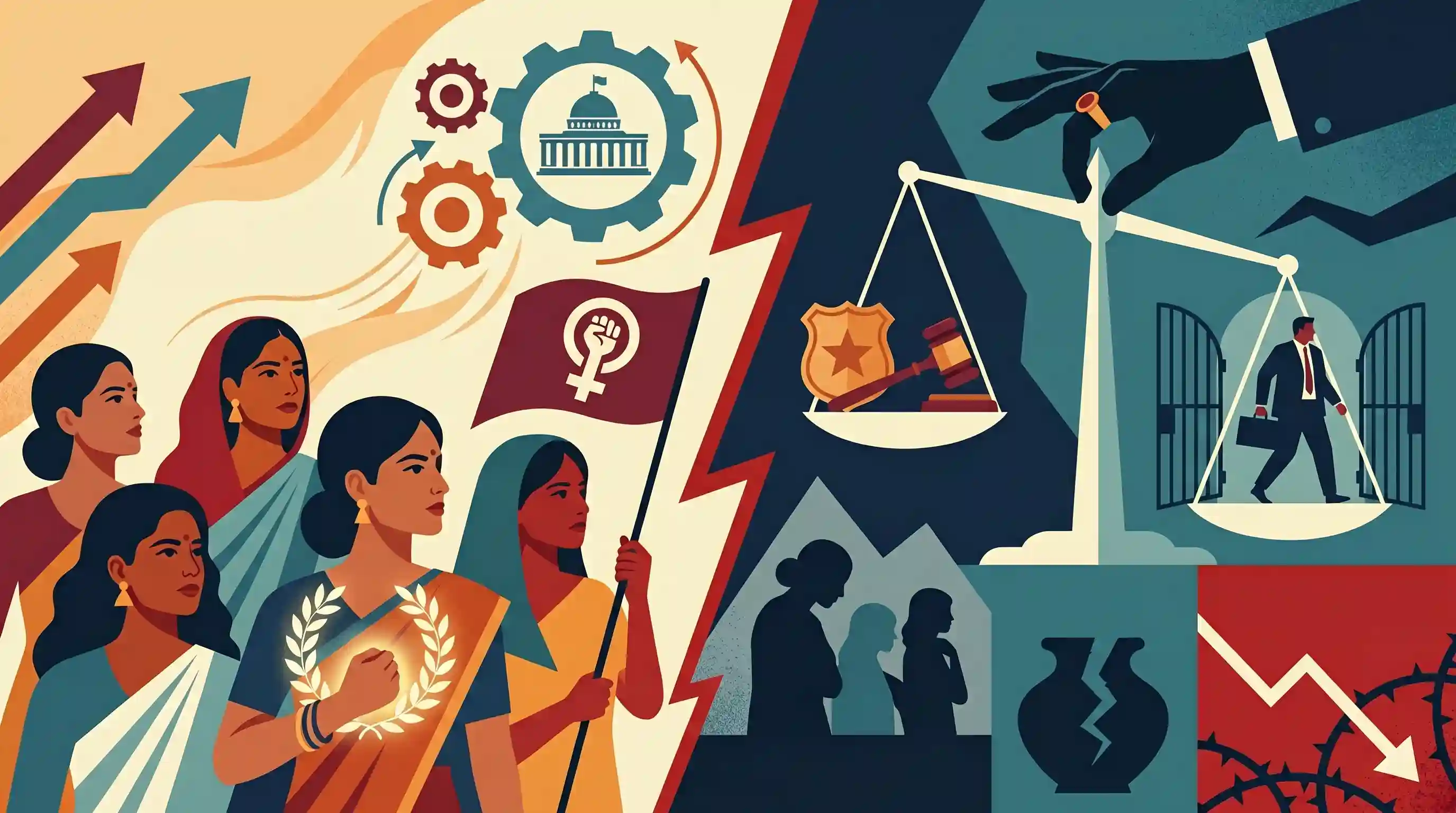
The article critically contrasts the political rhetoric surrounding 'Nari Shakti' (women empowerment) with the stark reality of women's safety and gender justice in India. It highlights how the criminal justice system is frequently manipulated—through parole, remission, or political shielding—to protect powerful individuals accused or convicted of crimes against women. By citing alarming NCRB statistics on dowry deaths and India's poor performance on the global Women, Peace and Security Index, the piece argues that substantive protection for women remains fundamentally inadequate despite legislative maneuvers like the Women's Reservation Bill.
Key Points
- Despite the introduction of the Nari Shakti Vandan Adhiniyam, systemic barriers continue to impede substantive gender justice and women's safety in India.
- National Crime Records Bureau (NCRB) data reveals an alarming rise in crimes against women, including a 14% increase in dowry deaths.
- India ranks 131 out of 177 in the Women, Peace and Security Index 2023, reflecting a deep gap in institutional protection and societal security for women.
- Cases involving the granting of parole, remission, and political protection to individuals convicted or accused of heinous crimes against women expose significant flaws and biases in the criminal justice system.
Important Terms
Nari Shakti Vandan Adhiniyam

The 106th Constitutional Amendment Act, 2023, reserving one-third (33%) of seats for women in the Lok Sabha, State Legislative Assemblies, and the Delhi Assembly for a 15-year period.
UPSC context
GS II: Indian Constitution/Governance. Tests knowledge of electoral reforms and legislative measures for women's political empowerment.
National Crime Records Bureau (NCRB)
A central agency under the Ministry of Home Affairs responsible for collecting and analyzing crime data, most notably through its annual 'Crime in India' report.
UPSC context
GS II/III: Governance and Internal Security. Essential for citing official data in answers regarding crime rates and public safety.
Women, Peace and Security (WPS) Index
A global index by Georgetown Institute and PRIO measuring women's wellbeing across three dimensions: inclusion, justice, and security. India was ranked 131st out of 177 in 2023.
UPSC context
GS II: Social Justice/International Reports. Used for comparative analysis of India's performance on global gender parity benchmarks.
Remission of Sentence
The executive power (Articles 72/161) to reduce the duration of a convict's sentence without changing its nature. Often debated in the context of high-profile crimes against women.
UPSC context
GS II: Judiciary/Executive Powers. Tests understanding of the separation of powers and ethical dimensions of criminal justice.
Gender Justice
The legal and social principle ensuring women have equal rights, opportunities, and protection from violence, as guaranteed under Articles 14, 15, and 21 of the Constitution.
UPSC context
GS I/II: Society and Social Justice. A core theme for essays and answers on vulnerable sections and human rights.
Parole
A temporary, conditional release of a prisoner for a specific purpose (e.g., family emergency). Unlike remission, it does not reduce the actual period of the sentence.
UPSC context
GS II: Criminal Justice System. Relevant for discussions on prison reforms and the balance between convict rights and victim justice.
Prelims Trap
The Nari Shakti Vandan Adhiniyam mandates immediate 33% reservation for women across the Lok Sabha, Rajya Sabha, and State Legislative Assemblies.
It does not apply to the Rajya Sabha or State Legislative Councils. Furthermore, implementation is contingent on a post-delimitation census, not immediate.
Static Concepts Connected
What constitutional amendments were introduced by the 106th CAA for women's reservation?
- Article 330A: Mandates 33% reservation for women in the Lok Sabha, including seats reserved for SCs and STs.
- Article 332A: Mandates 33% reservation for women in all State Legislative Assemblies.
- Article 334A: Makes implementation contingent upon a delimitation exercise following the first census published post-enactment.
How does the Governor's pardoning power (Art 161) differ from the President's (Art 72)?
- Death Sentences: Only the President can pardon a death sentence; the Governor cannot, though they can suspend, remit, or commute it.
- Court Martial: The President has the power to pardon sentences by Court Martial, whereas the Governor holds no such power.
- Jurisdictional Scope: The President's power applies to offenses against Union laws, while the Governor's power applies to offenses against State laws.
Cross-Topic Patterns
Executive Remission vs. Rule of Law
The political use of parole/remission links GS2 executive powers (Article 161) with judicial review, highlighting how discretionary state actions can undermine constitutional gender justice.
Statutory Rights vs. Societal Capital
GS1/GS2 essays often explore how formal protections (106th CAA, Dowry Prohibition Act) fail to translate into substantive empowerment without underlying shifts in patriarchal social capital.

The 106th CAA's exclusion of Rajya Sabha and its strict dependence on post-Act delimitation is highly probable in the 2026 Prelims.
Linked PYQs · 4
Linked PYQs · 4
- 2023MainsGS2
Explain the constitutional perspectives of Gender Justice with the help of relevant Constitutional Provisions and case laws.
- 2023MainsGS2
Discuss the contribution of civil society groups for women's effective and meaningful participation and representation in state legislatures in India.
- 2020MainsGS2
Which steps are required for constitutionalization of a Commission ? Do you think imparting constitutionality to the National Commission for Women would ensure greater gender justice and empowerment in India? Give reasons.
- 2019MainsGS1
“Empowering women is the key to control population growth.” Discuss.
