Legislator Disqualification and Representation of People Act Rules
Source:times-of-india ↗
Why It Matters
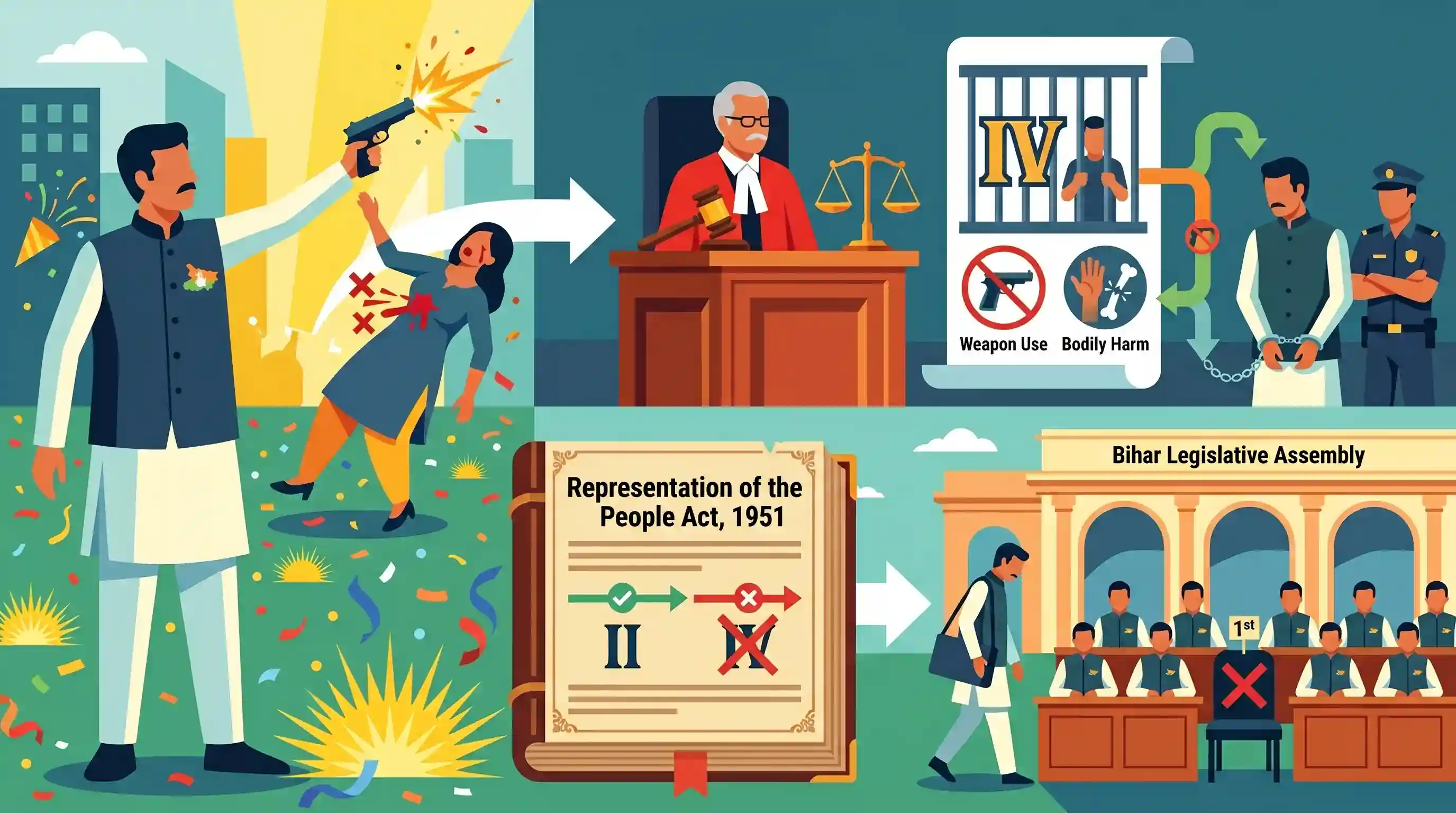
This development highlights the constitutional and legal mechanisms governing the disqualification of state legislators in India, specifically through Section 8(3) of the Representation of the People Act, 1951, and showcases judicial accountability regarding gun-related offences like celebratory firing.
Summary
A Delhi court sentenced Bihar BJP MLA Raju Kumar Singh from Sahebganj to four years of imprisonment for a 2018 celebratory firing incident that killed a woman in South Delhi. Convicted under IPC Section 304 Part II and the Arms Act, Singh's sentence exceeds the two-year threshold, triggering his automatic disqualification from the Bihar Legislative Assembly under the Representation of the People Act, 1951. This makes him the first member of the current Bihar Assembly to lose his legislative seat due to a criminal conviction.
Key Points
- BJP MLA Raju Kumar Singh (from Sahebganj, Muzaffarpur) was sentenced to four years of simple imprisonment by a Delhi special court.
- The sentencing relates to a 2018 celebratory firing incident during a New Year's Eve party in South Delhi that resulted in the death of 45-year-old architect Archana Gupta.
- The court convicted Singh under IPC Section 304 Part II (culpable homicide not amounting to murder with knowledge) and the Arms Act, and imposed a fine of Rs 25 lakh to be paid as compensation to the victim's husband.
- This four-year sentence triggers immediate disqualification of Singh's membership in the Bihar Legislative Assembly under Section 8(3) of the Representation of the People Act, 1951.
- He will become the first MLA of the current Bihar Assembly to lose his seat following a conviction in a serious criminal case.
- The Rouse Avenue Court rejected his plea for release on probation, describing celebratory firing as a 'scourge' in India.
Important Terms
Representation of the People Act, 1951

An act of the Parliament of India that regulates the conduct of elections, qualifications and disqualifications of legislators, electoral offenses, and the resolution of election disputes.
UPSC context
GS Paper II: Polity; tests key provisions of election laws, legislative accountability, and democratic reforms.
Section 8(3) of RPA, 1951
A statutory provision in the Representation of the People Act that mandates the immediate disqualification of legislators convicted of an offense and sentenced to prison for two years or more.
UPSC context
GS Paper II: Polity; tests awareness of disqualification criteria and checks on criminal elements in legislatures.
Lily Thomas v. Union of India (2013)
A landmark Supreme Court judgment that struck down Section 8(4) of the RPA, ending the three-month protection from immediate disqualification for convicted sitting legislators.
UPSC context
GS Paper II: Judiciary; tests knowledge of landmark judgments shaping electoral hygiene and accountability.
Criminalisation of Politics
The entry of individuals with criminal backgrounds, pending charges, or convictions into political processes, electoral contests, and legislative bodies.
UPSC context
GS Paper II: Governance; tests critical analysis of electoral corruption and reform-oriented solutions.
Arms Act, 1959
Indian legislation that regulates the acquisition, possession, manufacture, and sale of firearms and ammunition to control gun violence and ensure public safety.
UPSC context
GS Paper III: Internal Security; tests weapon licensing policies, security frameworks, and public safety laws.
Indian Penal Code
The official criminal code of India, drafted in 1860, which defined crimes and prescribed punishments before being replaced by the Bharatiya Nyaya Sanhita in 2024.
UPSC context
GS Paper II: Judiciary; tests understanding of the criminal justice system and judicial codifications.
Prelims Trap
An appellate court's suspension of a legislator's prison sentence automatically restores their membership in the Legislative Assembly.
Under the Lok Prahari (2018) ruling, a mere suspension of the 'sentence' under CrPC does not restore the seat; there must be an express stay on the 'conviction' itself.
Static Concepts Connected
What are the procedural mechanisms of legislator disqualification under the RPA 1951?
- Triggering Threshold: Under Section 8(3), conviction for any offense with a prison term of two years or more triggers instant disqualification.
- Instant Effect: The 2013 Lily Thomas ruling struck down Section 8(4), removing the three-month grace period to appeal before disqualification takes effect.
- Constitutional Decider: For non-defection disqualifications, Article 192 mandates the Governor must act according to the binding advice of the Election Commission of India.
What is the structural difference between the RPA 1950 and the RPA 1951?
- RPA 1950 Scope: Focuses on pre-election machinery, including delimitation of constituencies, voter registration eligibility, and the preparation of electoral rolls.
- RPA 1951 Scope: Governs the actual conduct of elections, qualifications/disqualifications of MPs/MLAs, corrupt practices, and the trial of election disputes.
Cross-Topic Patterns
Judicial Activism + Legislative Independence
The judiciary's strict execution of Lily Thomas rulings directly alters legislative majorities, showcasing how judicial anti-corruption measures intersect with legislative composition.
Fundamental Rights + Statutory Disqualifications
The statutory right to contest elections under the RPA 1951 is balanced against the state's interest in maintaining the integrity of democratic institutions.

RPA Section 8(3) operational mechanics and the distinction between staying a sentence vs conviction will be a key GS-2 focus in 2026.
Linked PYQs · 2
Linked PYQs · 2
- 2024-EBPSC_PRELIMSGS1
Who decides the disqualification of members of State Legislative Assembly, for matters other than those in the tenth schedule of the Constitution?
- 2023BPSC_PRELIMSGS1
Consider the following statements regarding the 42nd Amendment to the Constitution of India: 1. It added three words to the Preamble—‘Socialist’, ‘Secular’ and ‘Integrity’. 2. It added eight Fundamental Duties to the Constitution. 3. It added new Directive Principles, i.e., Article 39A, Article 43A and Article 47. 4. It granted power to the President, in consultation with the Election Commission, to disqualify members of the State Legislatures. Which of the above statements is/are incorrect?
