Ganesh Gaonkar Elected as Goa Legislative Assembly Speaker
Source:The Hindu ↗
Why It Matters
The election and role of the Speaker are central to the functioning of the State Legislature, an important topic in GS2 (Polity and Governance). The mention of the Mhadei river diversion dispute also touches on inter-state relations and water disputes, which are recurring themes in UPSC Prelims and Mains.
Summary
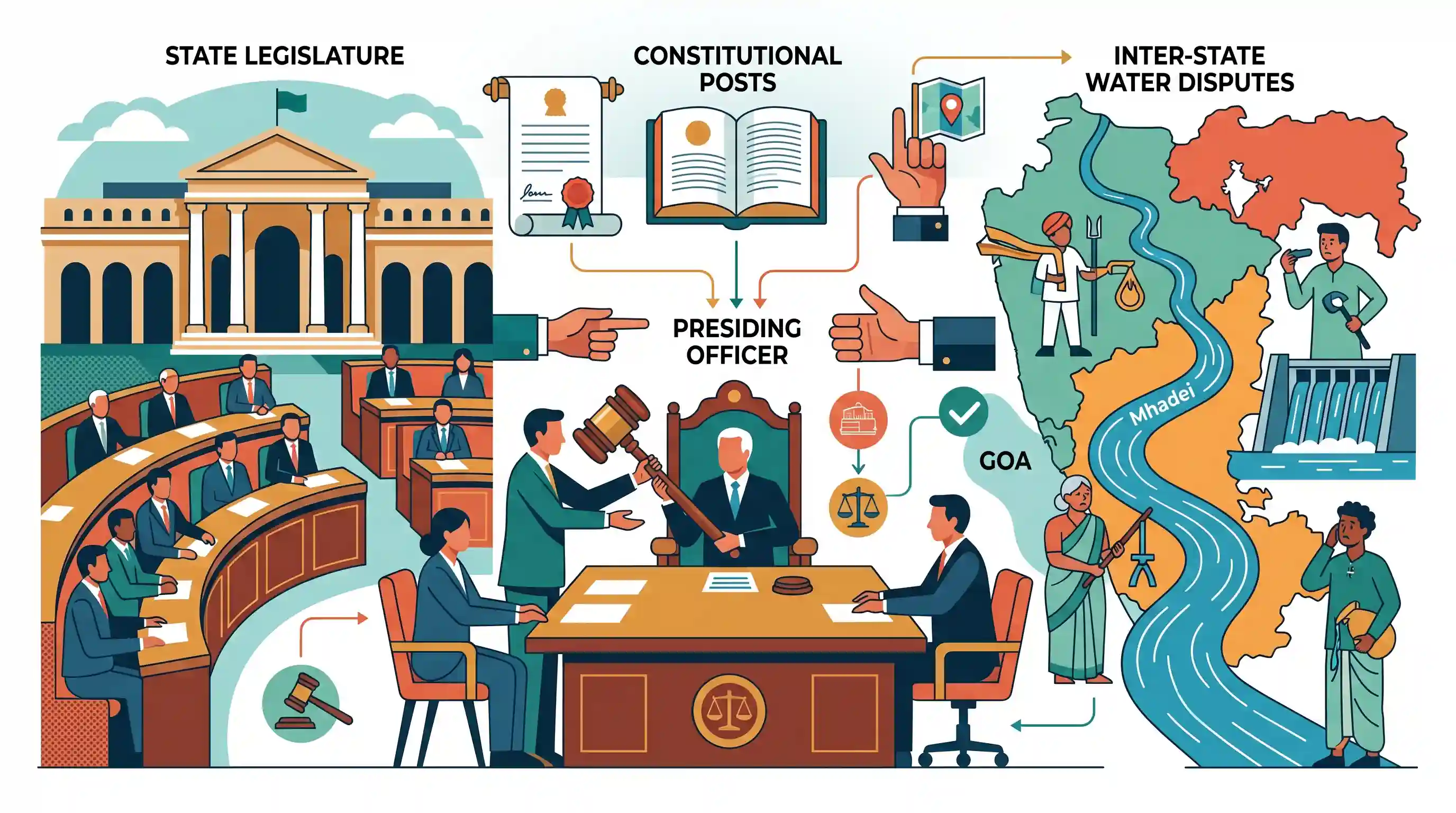
BJP MLA Ganesh Gaonkar has been elected as the Speaker of the Goa Legislative Assembly in a special session. The election was necessitated by the resignation of the previous Speaker, Ramesh Tawadkar, who was inducted into the state cabinet. The article highlights the constitutional process of electing a presiding officer and briefly mentions Gaonkar's involvement in the committee addressing the Mhadei inter-state river water dispute.
Key Points
- BJP MLA Ganesh Gaonkar was elected as the new Speaker of the Goa Legislative Assembly, securing 32 votes against Congress candidate Altone D'Costa's 7 votes.
- The Speaker's post became vacant after Ramesh Tawadkar resigned to join Chief Minister Pramod Sawant's cabinet.
- Governor P Ashok Gajapathi Raju summoned a special session of the assembly to conduct the election.
- Gaonkar, who also served as pro-tem speaker after the 2022 polls, is part of a House committee studying the Mhadei river diversion issue with Karnataka.
Important Terms
Speaker of the Legislative Assembly

The constitutional presiding officer of a State's lower house, elected by members to conduct proceedings, maintain order, and impartially interpret assembly rules.
UPSC context
GS Paper II: State Legislature; tests knowledge of constitutional roles, powers, and neutrality in a parliamentary democracy.
Article 178
A constitutional provision mandating every State Legislative Assembly to elect two members as Speaker and Deputy Speaker to ensure the house's self-regulation and continuity.
UPSC context
GS Paper II: Constitution; relevant for understanding structural requirements and mandatory offices within state legislative bodies.
Mhadei Inter-State River Water Dispute
A water-sharing conflict between Goa, Karnataka, and Maharashtra regarding the diversion of the Mahadayi river's water to the Malaprabha basin for drinking and irrigation.
UPSC context
GS Paper II: Inter-state Relations; tests understanding of federalism, water governance, and the role of tribunals.
Legislative Assembly (Vidhan Sabha)
The lower (or sole) house of a state legislature, composed of representatives directly elected by the people to exercise legislative and oversight functions.
UPSC context
GS Paper II: State Legislature; core topic regarding the structure and functioning of sub-national representative governance.
Casting Vote
The decisive vote exercised by the Speaker only during a tie to resolve legislative deadlocks, symbolizing the office's neutrality during normal proceedings.
UPSC context
GS Paper II: Powers of Speaker; tests knowledge of procedural authority and the convention of impartiality.
Inter-State River Water Disputes Act, 1956
Parliamentary legislation enacted under Article 262 to provide for the adjudication of disputes relating to waters of inter-state rivers and river valleys.
UPSC context
GS Paper II: Statutory Bodies; essential for topics on federalism and mechanisms for resolving inter-state conflicts.
Prelims Trap
"The Speaker of the State Legislative Assembly submits his resignation letter to the Governor."
According to Article 179 of the Constitution, the Speaker must address their resignation exclusively to the Deputy Speaker, not to the Governor or the President.
Static Concepts Connected
What governs the election and resignation of State Assembly Speakers?
- Article 178: Mandates every State Legislative Assembly to choose two members as its Speaker and Deputy Speaker as soon as may be.
- Article 179: Specifies that the Speaker vacates office by writing to the Deputy Speaker, or via a resolution passed by a majority of all the Assembly members.
- Pro-tem Speaker: A temporary presiding officer appointed by the Governor to administer oaths to new MLAs; the office ceases automatically once a regular Speaker is elected.
What are the geographical and legal contours of the Mhadei river dispute?
- Geography: The Mhadei (Mandovi) originates in Bhimgad WLS (Karnataka) and is a west-flowing river that empties into the Arabian Sea through Goa.
- Kalasa-Banduri Project: Karnataka's project aims to divert water from Mhadei tributaries into the east-flowing Malaprabha river, a tributary of the Krishna river.
- Article 262: Empowers Parliament to provide for the adjudication of inter-state river disputes and allows it to explicitly bar Supreme Court jurisdiction over such matters.
Cross-Topic Patterns
Mhadei River + Inter-State Tribunals
The Kalasa-Banduri Nala project bridges static physical geography (west-vs-east flowing basin transfers) with dynamic constitutional frameworks under the Inter-State River Water Disputes Act.
Legislative Presiding Officers + Executive Cabinet
A Speaker resigning to join the state cabinet highlights the fluid boundaries between legislative presiding officers and the executive branch in India's parliamentary democracy.

Expect a multi-statement question combining Article 262 tribunal jurisdiction with the geography of the west-flowing Mhadei river.
Linked PYQs · 3
Linked PYQs · 3
- 2024PrelimsGS1
With reference to the Speaker of the Lok Sabha, consider the following statements : While any resolution for the removal of the Speaker of the Lok Sabha is under consideration 1. He/She shall not preside. 2. He/She shall not have the right to speak. 3. He/She shall not be entitled to vote on the resolution in the first instance. Which of the statements given above is/are correct?
- 2022PrelimsGS1
With reference to Deputy Speaker of Lok Sabha, consider the following statements: 1. As per the Rules of Procedure and Conduct of Business in Lok Sabha, the election of Deputy Speaker shall be held on such date as the Speaker may fix. 2. There is a mandatory provision that the election of a candidate as Deputy Speaker of Lok Sabha shall be from either the principal opposition party or the ruling party. 3. The Deputy Speaker has the same power as of the Speaker when presiding over the sitting of the House and no appeal lies against his rulings. 4. The well established parliamentary practice regarding the appointment of Deputy Speaker is that the motion is moved by the Speaker and duly seconded by the Prime Minister. Which of the statements given above are correct?
- 2023MainsGS2
Discuss the role of Presiding Officers of state legislatures in maintaining order and impartiality in conducting legislative work and in facilitating best democratic practices.
