End of President Rule in Manipur and New Government Formation
Source:The Hindu ↗
Why It Matters
The event highlights the constitutional mechanisms governing President's Rule (Article 356) and the one-year cap necessitating either an election/government formation or a constitutional amendment. It also brings focus to internal security challenges, ethnic faultlines, and power-sharing as tools for conflict resolution in India's Northeast, highly relevant for both GS2 (Polity & Governance) and GS3 (Internal Security).
Summary
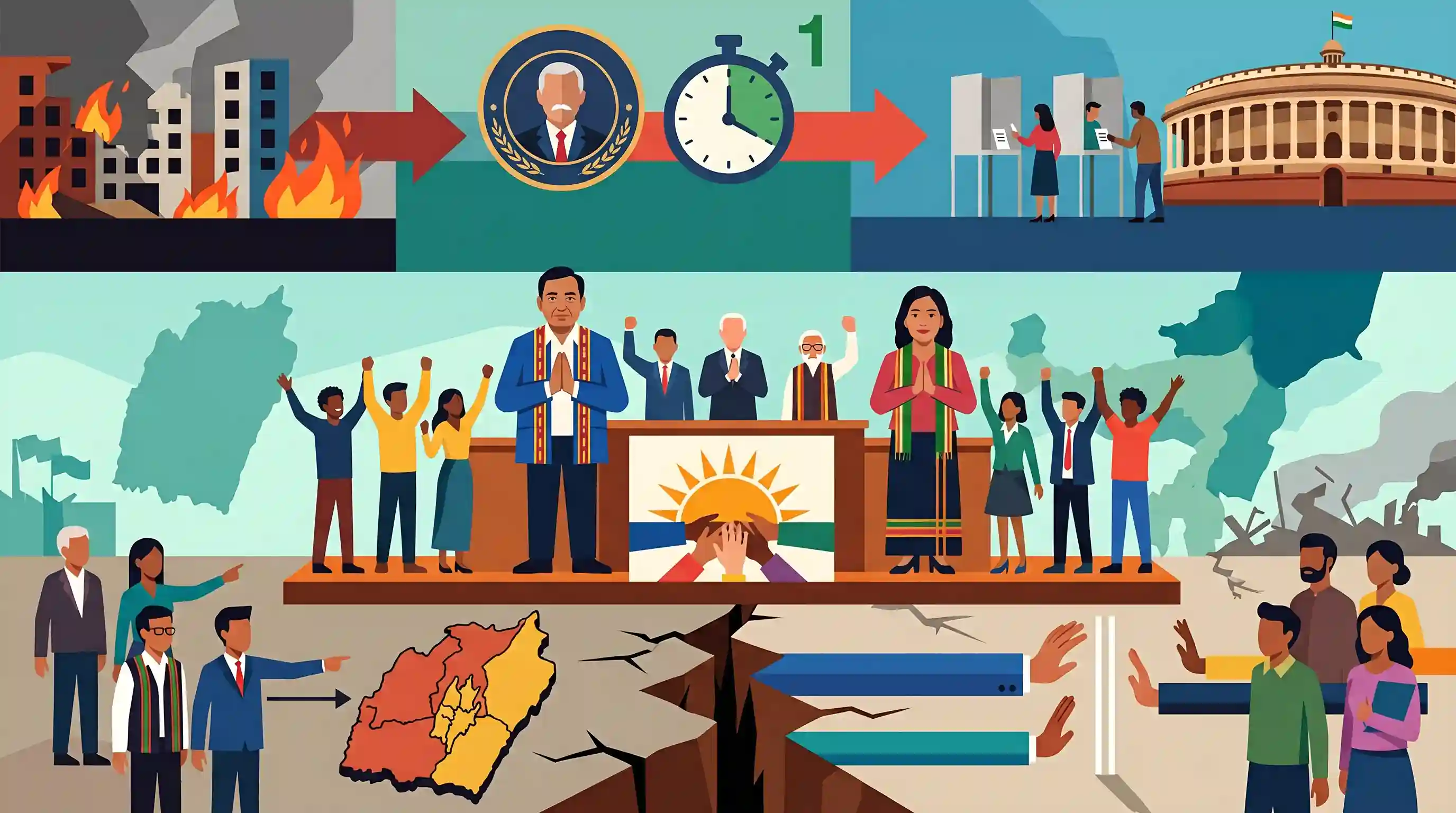
Manipur is set to see the restoration of an elected government, ending the President's Rule imposed on February 13, 2025. Yumnam Khemchand Singh has been elected as the BJP Legislature Party Leader and will be the next Chief Minister. The new government aims to represent diverse communities, with Nemcha Kipgen likely to be appointed as the state's first woman and Kuki-Zo Deputy Chief Minister. This development prevents a constitutional crisis, as extending President's Rule beyond one year requires a constitutional amendment. However, challenges persist as some Kuki-Zo legislators demand a separate administration and political resolution before fully integrating into the government, reflecting the deep-seated ethnic divisions since the violence erupted in May 2023.
Key Points
- Yumnam Khemchand Singh, a Meitei leader, has been elected as the BJP Legislature Party Leader and is set to become Manipur's Chief Minister, ending President's Rule.
- Nemcha Kipgen is expected to become the first woman and first Kuki-Zo Deputy Chief Minister of Manipur, as part of a power-sharing arrangement.
- Manipur was placed under President's Rule on February 13, 2025; the move to restore an elected government avoids the need for a Constitutional amendment, which is required to extend President's Rule beyond one year.
- The state has experienced severe ethnic violence between the Meitei and Kuki-Zo communities since May 3, 2023, displacing over 60,000 people.
- Some Kuki-Zo legislators remain hesitant to join the government, as Kuki-Zo groups and insurgent groups under the Suspension of Operations (SoO) pact continue to demand a separate Union Territory with a Legislative Assembly.
Important Terms
President's Rule (Article 356)

A constitutional provision allowing the Union government to assume direct control of a State's administration upon the failure of constitutional machinery.
UPSC context
GS Paper II (Polity); tests federalism, 44th Amendment limits (1-year rule), and SR Bommai judgment.
Suspension of Operations (SoO) pact
A tripartite ceasefire agreement signed in 2008 between the Centre, Manipur, and Kuki-Zo insurgent groups to halt hostilities and initiate political dialogue.
UPSC context
GS Paper III (Internal Security); relevant for Northeast insurgency and conflict resolution strategies.
National People's Party (NPP)
The first political party from Northeast India to achieve 'National Party' status, focusing on tribal-centric issues and regional aspirations.
UPSC context
GS Paper II (Polity); tests ECI criteria for national status and the role of regional parties.
Naga People's Front (NPF)
A major regional party in Nagaland and Manipur advocating for Naga identity, cultural nationalism, and the integration of Naga-inhabited areas.
UPSC context
GS Paper II (Governance); illustrates identity-based politics and coalition dynamics in border states.
Separate Administration
The political demand by the Kuki-Zo community for a distinct administrative setup, independent of the Manipur state government, due to ethnic polarization.
UPSC context
GS Paper I/III; deals with social fragmentation, internal security, and demands for autonomy.
Article 355
Constitutional mandate requiring the Union to protect states against external aggression and internal disturbance, often a precursor to Article 356.
UPSC context
GS Paper II (Polity); tests the Union's responsibility in maintaining state security and order.
Prelims Trap
Parliament can extend President's Rule up to 3 years by simply passing a resolution every six months.
The 44th Amendment restricted extension beyond one year. It requires an active National Emergency or an Election Commission certification that elections cannot be held. It is not an unconditional 3-year maximum.
Static Concepts Connected
What are the conditions to extend President's Rule beyond one year?
- 44th Amendment Check: The 44th Constitutional Amendment (1978) restricts the duration of Article 356 to one year under normal circumstances to prevent misuse.
- National Emergency: To extend beyond one year, a Proclamation of National Emergency (Article 352) must be in operation in the whole of India, or in the whole or any part of the state.
- EC Certification: The Election Commission must certify that general elections to the state's legislative assembly cannot be held due to difficulties.
What is the constitutional status of a Deputy Chief Minister?
- No Constitutional Backing: The post is not mentioned in the Constitution (Articles 163 or 164). It is purely a political designation meant to accommodate coalition or power-sharing demands.
- Oath of Office: A Deputy CM takes the oath of office and secrecy as a regular Cabinet Minister, not specifically as a 'Deputy Chief Minister'.
- Pay and Powers: They hold the rank and draw the salary of a Cabinet Minister, with no superior executive or financial powers over other ministers.
Cross-Topic Patterns
Article 371C vs. Sixth Schedule
The Kuki-Zo demand for a separate Union Territory exposes the limitations of Article 371C's 'Hill Areas Committee' in Manipur, contrasting sharply with the robust autonomy granted under the Sixth Schedule.
SoO pacts and GS3 Security
The Suspension of Operations (SoO) agreement connects to GS3 internal security, echoing similar tripartite ceasefire models used to neutralize armed insurgent groups in Nagaland and Assam.

Expect a Prelims question testing the 44th CAA conditions for extending Article 356 beyond one year, framed around the Manipur timeline.
Linked PYQs · 5
Linked PYQs · 5
- 2023MainsGS2
Account for the legal and political factors responsible for the reduced frequency of using Article 356 by the Union Governments since mid 1990s.
- 2019MainsGS2
“Parliament's power to amend the Constitution is a limited power and it cannot be enlarged into absolute power." In the light of this statement explain whether Parliament under Article 368 of the Constitution can destroy the Basic Structure of the Constitution by expanding its amending power?
- 2025MainsGS3
What are the major challenges to internal security and peace process in the North-Eastern States? Map the various peace accords and agreements initiated by the government in the past decade.
- 2017MainsGS3
The North-East region of India has been infested with insurgency for a very long time. Analyze the major reasons for the survival of armed insurgency in this region.
- 2019MainsGS3
Cross-border movement of insurgents is only one of the several security challenges facing the policing of the border in North-East India. Examine the various challenges currently emanating across the India-Myanmar border. Also, discuss the steps to counter the challenges.
