Uniform Civil Code Implementation Plans Across NDA States
Source:The Hindu ↗
આ શા માટે મહત્વનું છે
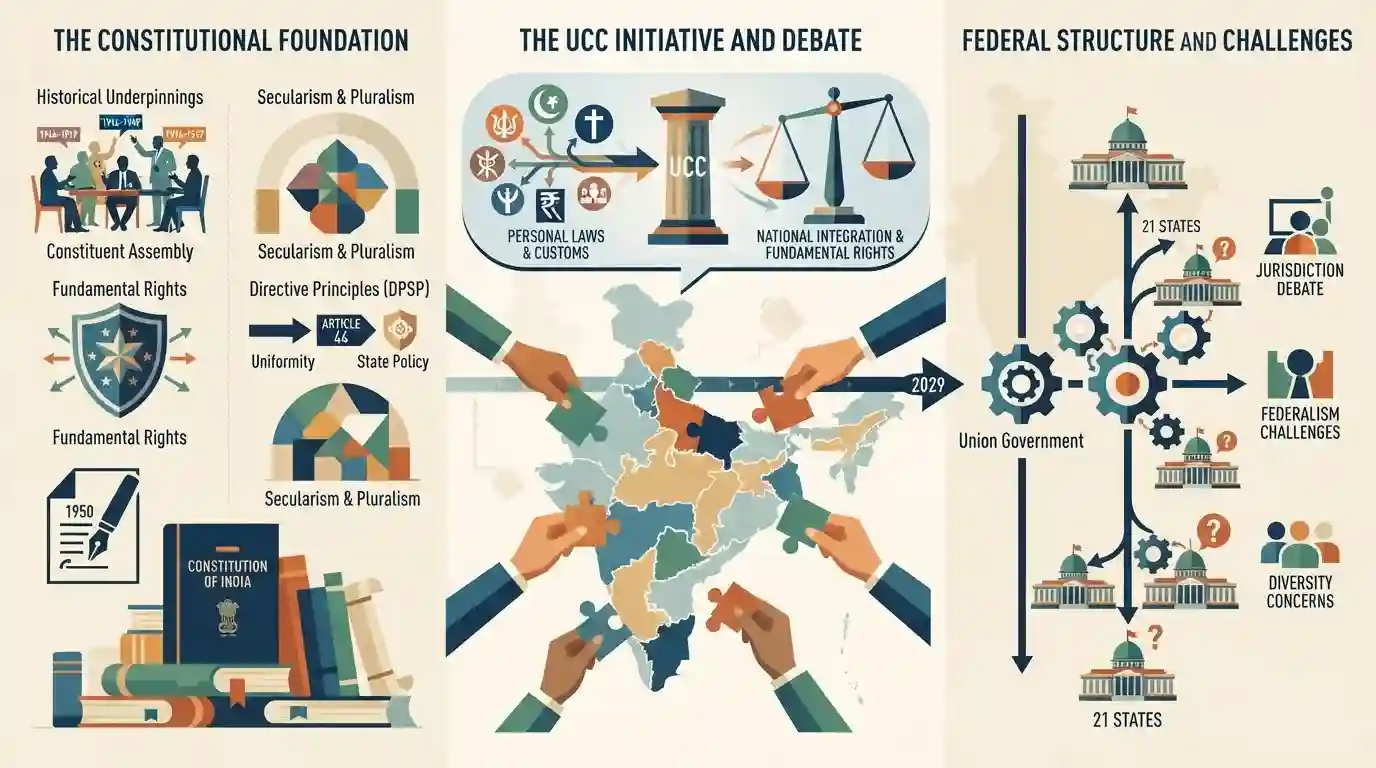
The push for a Uniform Civil Code (UCC) across multiple States by 2029 touches upon core constitutional principles, including federal dynamics, Centre-State legislative competence under the Concurrent list, Directive Principles of State Policy (Article 44), and the broader socio-political debate on balancing secularism with religious and cultural pluralism.
સારાંશ
Union Home Minister Amit Shah stated that BJP-led NDA governments across 21 States intend to introduce the Uniform Civil Code (UCC) prior to 2029. This initiative brings the debate over Article 44 of the Constitution (Directive Principles of State Policy), national integration, federal jurisdiction, and the interplay between personal laws and fundamental rights into sharp focus.
મુખ્ય મુદ્દા
- Union Home Minister Amit Shah announced that BJP-led NDA governments in 21 States will introduce and implement the Uniform Civil Code (UCC) before 2029.
- UCC falls under Article 44 of the Constitution of India as part of the Directive Principles of State Policy, which directs the state to secure a uniform civil code throughout the territory of India.
- The implementation across states highlights debates around federalism, cooperative/coercive federalism, and legislative competence under the Concurrent List of the Seventh Schedule.
- Brings forth discussions on balancing secularism, cultural pluralism, and uniform rights for citizens in personal law matters like marriage, divorce, and inheritance.
મહત્વપૂર્ણ શબ્દો
Uniform Civil Code (UCC)

A proposal to formulate and implement a single set of personal laws governing marriage, divorce, inheritance, and adoption for all citizens irrespective of religion.
UPSC context
GS Paper II (Indian Constitution - Significant Provisions, Secularism). Tests understanding of fundamental rights vs. Directive Principles and legal pluralism.
Article 44
A provision under Part IV of the Indian Constitution (Directive Principles of State Policy) stating that the State shall endeavor to secure for citizens a Uniform Civil Code throughout India.
UPSC context
GS Paper II (DPSPs). Tests non-justiciable constitutional directives, cooperative federalism, and the interface between state policy and personal laws.
સંલગ્ન સ્થિર ખ્યાલો
What is the constitutional basis and legislative competence for a Uniform Civil Code in India?
- Article 44: Constitutional mandate enshrined in Article 44 under Part IV (Directive Principles of State Policy) of the Constitution.
- Concurrent List Entry: Enumerated under Entry 5 (Marriage and divorce; infants and minors; adoption; wills, intestacy and succession) of the Concurrent List (List III) of the Seventh Schedule.
- Legislative Power: Both Parliament and State Legislatures possess legislative competence to enact laws on subjects in the Concurrent List, subject to Article 254 regarding repugnancy.
આંતર-વિષય પેટર્ન
UCC vs Concurrent List Federal Dynamics
UCC implementation by individual states tests the limits of Concurrent List legislative competence and cooperative federalism, contrasting with Centre-led uniform codes like the Bharatiya Nyaya Sanhita.
DPSP vs Fundamental Rights Jurisprudence
The interplay between Article 44 (DPSP) and Article 25 (Religious Freedom) forms the core jurisprudential debate balancing state-led social reform with minority rights.

UCC legislative competence (Concurrent List, Entry 5) and its interplay with DPSP vs Fundamental Rights will likely feature in Mains GS2.
સંલગ્ન PYQ · 3
સંલગ્ન PYQ · 3
- 2024MainsGS2
Discuss India as a secular state and compare with the secular principles of the US constitution.
- 2014MainsGS2
Though the federal principle is dominant in our Constitution and that principle is one of its basic features, but it is equally true that federalism under the Indian Constitution leans in favour of a strong Centre, a feature that militates against the concept of strong federalism. Discuss.
- 2020PrelimsGS1
Which part of the Constitution of India declares the ideal of Welfare State?
