Karnataka Opposition Protests Against Proposed Minority Quotas
Source:Indian Express ↗
Why It Matters
The article provides a practical case study of the ongoing debate over the constitutionality of religion-based reservations in public procurement, intersecting with core GS2 themes of equality and affirmative action. It also highlights the macroeconomic impact of state revenue generation (tax/tariff hikes) on inflation, as well as the role of the political opposition in ensuring executive accountability and probity in governance.
Summary
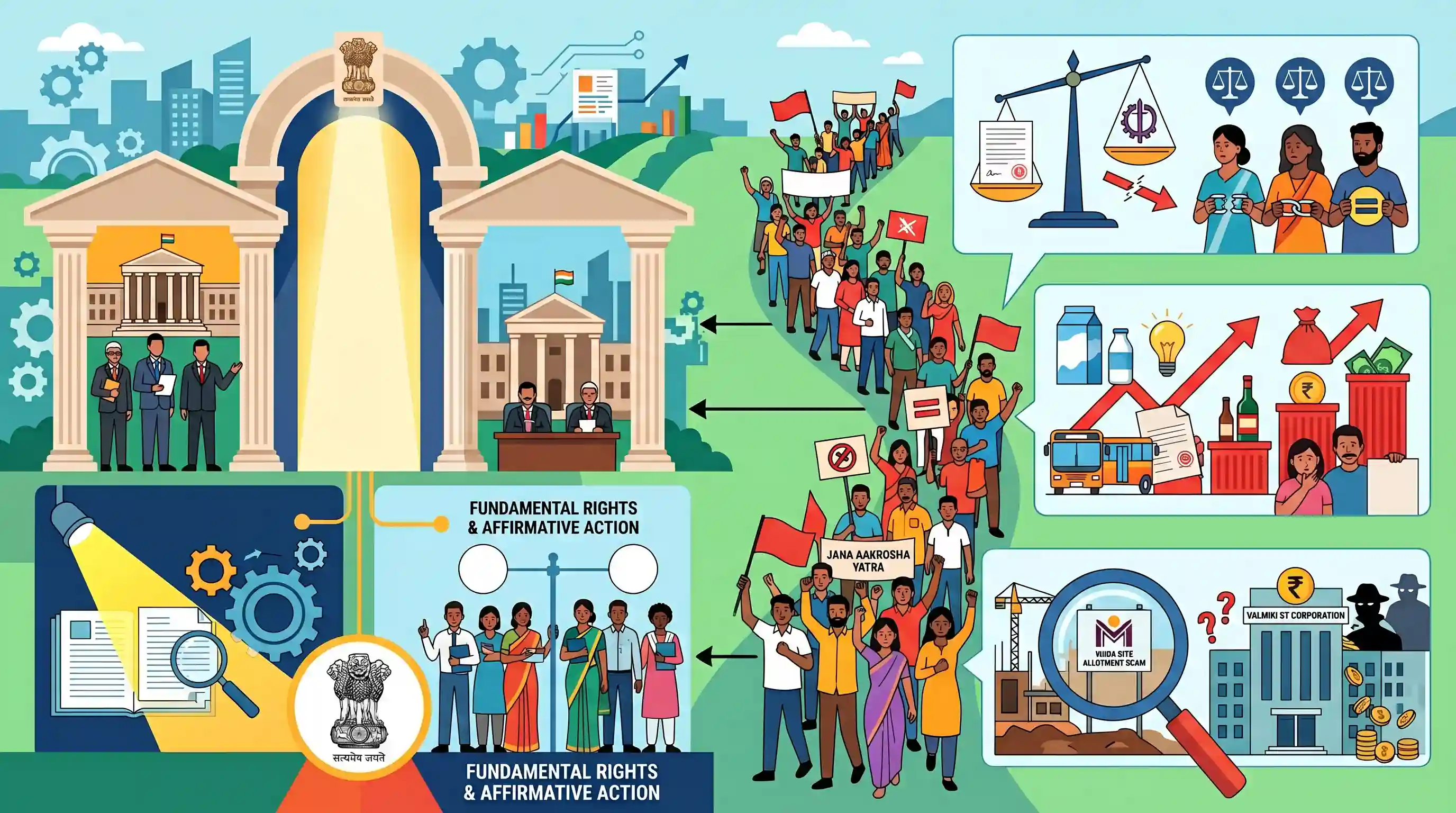
The Karnataka unit of the BJP has initiated a 16-day statewide protest campaign, the "Jana Aakrosha Yatra," targeting the Congress-led state government over alleged misgovernance, corruption, and controversial policy proposals. A primary grievance is the state's reported move to introduce a reservation quota for Muslims in civil contract tenders up to Rs 2 crore. The opposition has condemned this as "anti-Constitutional" appeasement that undermines the affirmative action rights of SC, ST, and OBC communities. Additionally, the protests focus on the economic burden placed on citizens through steep hikes in the prices of essentials—including milk, electricity, bus fares, stamp duties, and liquor. The yatra also demands accountability for major administrative controversies, such as the MUDA site allotment scam and financial irregularities in the Valmiki ST Development Corporation. For UPSC aspirants, this issue intersects with the constitutional debates surrounding religion-based reservations versus the rights of backward classes (Articles 15 and 16), the doctrine of constitutional morality, the impact of state taxation on inflation, and the imperative for probity and transparency in public procurement and administration.
Key Points
- The Karnataka BJP launched a 16-day statewide "Jana Aakrosha Yatra" to protest alleged misgovernance and corruption by the Congress-led state government.
- A major focal point of the protest is the state government's reported plan to introduce religion-based reservation for Muslims in government civil contract tenders up to Rs 2 crore, which the BJP terms "anti-Constitutional".
- The opposition argues that introducing minority quotas in public procurement encroaches upon the affirmative action benefits meant for SC, ST, and OBC contractors.
- The campaign also highlights the steep increase in the cost of living, pointing to state-mandated hikes in the prices of milk, electricity, stamp duties, bus fares, and liquor.
- The protests demand accountability over recent corruption scandals, specifically citing the MUDA site allotment scam and the Valmiki ST Development Corporation financial irregularities.
Important Terms
Mysuru Urban Development Authority (MUDA)

A statutory body in Karnataka responsible for urban planning and site allotment in Mysuru; currently under investigation by the Enforcement Directorate for alleged illegal compensatory site allocations.
UPSC context
GS-II: Governance. Tests awareness of administrative accountability, statutory bodies, and transparency in land-allotment processes.
Valmiki ST Development Corporation
A Karnataka state-run entity tasked with Scheduled Tribe welfare; recently at the center of a major financial embezzlement case involving the diversion of welfare funds.
UPSC context
GS-II: Welfare schemes for vulnerable sections. Tests knowledge of institutional safeguards for STs and financial probity in public administration.
Religion-based Reservation
Quotas specifically granted to religious groups; a contentious legal issue as Indian affirmative action (Articles 15 & 16) is typically based on social and educational backwardness.
UPSC context
GS-II: Indian Constitution. Tests understanding of secularism, Fundamental Rights, and the legal limits of reservation policy.
Public Procurement
The process where government bodies acquire goods or services from the private sector; often used as a tool for social justice through affirmative action quotas.
UPSC context
GS-II/III: Governance and Economy. Tests knowledge of the 'Level Playing Field' principle and transparency in government spending.
Constitutional Morality
A judicial doctrine emphasizing adherence to the spirit and core values of the Constitution—such as equality and justice—beyond its literal text.
UPSC context
GS-IV: Ethics/GS-II: Judiciary. Essential for analyzing conflicts between societal norms, legislative actions, and constitutional principles.
Prelims Trap
The Indian Constitution absolutely prohibits any form of reservation for religious minorities in the state.
Articles 15(1) and 16(2) prohibit discrimination solely on religion. However, religious minorities can legally be granted quotas if classified as Socially and Educationally Backward Classes (SEBCs).
Static Concepts Connected
How does the Constitution enable affirmative action in public procurement contracts?
- Article 46 (DPSP): Mandates the State to promote the educational and economic interests of weaker sections (like SC/STs).
- Not Article 16: Article 16 strictly governs "public employment" or appointments, not the allocation of civil contract tenders.
- Executive Policy: States formulate specific procurement policies (e.g., reserving sub-crore contracts for specific contractors) under their executive powers to fulfill social justice mandates.
Which major items remain under exclusive State taxation power outside the GST regime?
- Alcoholic Liquor: State excise duties on alcoholic liquors for human consumption fall under Entry 8 and 51 of the State List.
- Stamp Duties: Rates of stamp duty on properties and various documents remain under state purview, serving as a key revenue source.
- Petroleum Products: Motor spirit (petrol), high-speed diesel, natural gas, and aviation turbine fuel are currently excluded from the GST framework.
Cross-Topic Patterns
Quotas in public procurement
Reserving sub-crore civil tenders for marginalized groups connects Article 46 (economic interests of weaker sections) with the need for transparent, competitive bidding in public finance.
State taxes and cost-push inflation
State-mandated hikes in non-GST items (liquor excise, stamp duties, utility tariffs) directly drive cost-push inflation, often complicating the RBI's monetary policy targeting.

Expect a Prelims question distinguishing between Constitutional protections for 'public employment' (Art 16) vs 'public procurement' policies.
Linked PYQs · 5
Linked PYQs · 5
- 2025MainsGS4
"Constitutional morality is not a natural sentiment but a product of civil education and adherance of the rule of law." Examine the significance of constitutional morality for public servant highlighting the role in promoting good governance and ensuring accountability in public administration.
- 2021MainsGS2
‘Constitutional Morality’ is rooted in the Constitution itself and is founded on its essential facets. Explain the doctrine of ‘Constitutional Morality’ with the help of relevant judicial decisions.
- 2018MainsGS2
Whether National Commission for Scheduled Castes (NCSC) can enforce the implementation of constitutional reservation for the Scheduled Castes in the religious minority institutions? Examine.
- 2024MainsGS3
What are the causes of persistent high food inflation in India? Comment on the effectiveness of the monetary policy of the RBI to control this type of inflation.
- 2021PrelimsGS1
Which one of the following is likely to be the most inflationary in its effects?
