Akhilesh Yadav criticizes BJP over reported cash aid for women
Source:kashmirreader ↗
Why It Matters
The article highlights the growing trend of political parties proposing direct cash transfers/welfare schemes for women ahead of elections, raising questions about the fiscal sustainability of such populist measures versus genuine economic development. This is relevant to GS Paper 2 (Government Policies, Welfare Schemes, and Elections) and GS Paper 3 (State Economy and Public Finance). It also touches upon UP state-specific political dynamics.
Summary
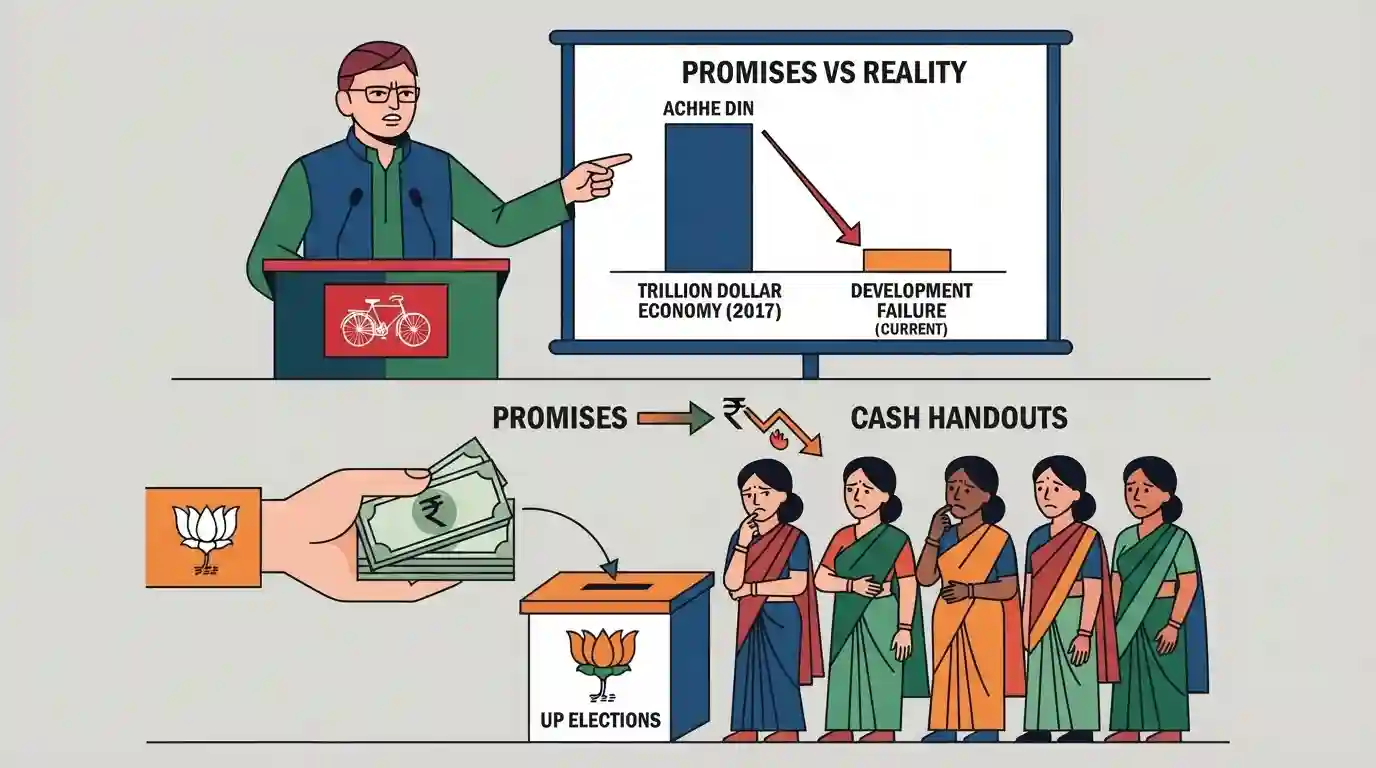
Samajwadi Party leader Akhilesh Yadav has strongly criticised the BJP government in Uttar Pradesh over reports that it plans to launch a ₹20,000 cash assistance scheme for women. Yadav argued that the introduction of such a direct benefit transfer scheme indicates the BJP's failure on the economic front and its reliance on money distribution to win the upcoming state assembly elections. He highlighted the contrast between the BJP's earlier promises of a 'trillion-dollar economy' and 'Achhe Din' and their current strategy of offering cash handouts, framing it as an admission of developmental failure.
Key Points
- Samajwadi Party chief Akhilesh Yadav criticised the BJP government in Uttar Pradesh following reports of a proposed ₹20,000 cash assistance scheme for women.
- Yadav alleged the scheme proves the BJP has no developmental achievements to showcase ahead of the assembly elections and is resorting to cash handouts to win votes.
- He claimed the BJP previously promised an 'Achhe Din' (good days) economy and a one trillion dollar economy for UP, but these promises have failed.
- The proposed scheme aims to provide direct financial assistance to women in the state.
- The political debate highlights the increasing use of Direct Benefit Transfer (DBT) and cash assistance schemes as electoral strategies in Indian state politics.
Important Terms
Direct Benefit Transfer (DBT)

A government initiative to transfer subsidies, pensions, and welfare payments directly into beneficiaries' Aadhaar-linked bank accounts. It relies on the JAM trinity to eliminate intermediaries and prevent fund leakages.
UPSC context
GS-2 (Welfare Schemes) & GS-3 (Economy); crucial for understanding transparent governance, digital inclusion, and subsidy rationalization.
Freebie Politics (Revadi Culture)
Unviable goods, services, or cash transfers promised by political parties to secure votes. It is frequently criticized for straining state exchequers and shifting focus away from long-term capital investments.
UPSC context
GS-2 (Elections); highlights the ongoing judicial and political debate between genuine welfare economics and unsustainable electoral populism.
Trillion-Dollar Economy Target
A strategic policy goal set by the Uttar Pradesh government to expand its Gross State Domestic Product (GSDP) to $1 trillion, intending to significantly boost India's overarching national economic ambitions.
UPSC context
GS-3 (Economic Growth); relevant to state-level economic planning, decentralized growth models, and structural transformation challenges.
Bharatiya Janata Party (BJP)
India's current ruling national political party. Founded in 1980, it is characterized by its right-wing ideological stance, cultural nationalism, and a focus on both centralized welfare and economic growth models.
UPSC context
GS-2 (Indian Constitution); relevant to understanding India's multi-party system and the contemporary shift toward a dominant-party framework.
Samajwadi Party (SP)
A recognized state political party based primarily in Uttar Pradesh. Founded in 1992, it is ideologically rooted in democratic socialism, historically focusing on the representation of marginalized and agrarian communities.
UPSC context
GS-2 (State Politics); illustrates the critical role of regional political parties and regionalism in India's federal democratic structure.
Prelims Trap
Promising cash schemes in election manifestos is considered a 'corrupt practice' under the Representation of the People Act, 1951.
Under the Balaji vs State of TN (2013) ruling, the Supreme Court clarified that manifesto promises of public welfare do not constitute corrupt practices under Section 123.
Static Concepts Connected
How are "corrupt practices" defined during elections under the RPA, 1951?
- Statutory Definition: Section 123 defines bribery, undue influence, and appealing to religion/caste as corrupt practices.
- Manifesto Exemption: The Supreme Court ruled that making promises in election manifestos does not amount to a corrupt practice, as they are broad public policy declarations.
What is the JAM Trinity and how does it plug fiscal leakages?
- Jan Dhan: Provides universal banking access to the unbanked, creating the endpoint for Direct Benefit Transfers (DBT).
- Aadhaar: Serves as a unique biometric identifier to weed out ghost beneficiaries and eliminate duplication in welfare rolls.
- Mobile Connectivity: Allows beneficiaries to receive real-time alerts and access digital financial services without relying on middlemen.
Cross-Topic Patterns
Freebies vs Fiscal Consolidation
Cash transfer schemes trigger debates linking DPSP welfare obligations (GS2) with state fiscal health, debt sustainability, and FRBM Act limits (GS3).
Feminization of State Welfare
Unconditional cash transfers targeted exclusively at women reflect a policy shift towards improving female household bargaining power and financial inclusion.

Mains 2026 will likely test the 'Freebies vs Welfare' debate, asking candidates to weigh targeted DBTs against state capital expenditure.
Linked PYQs · 4
Linked PYQs · 4
- 2022UPPSC_PRELIMSGS1
Consider the following statements about farm subsidies in India. 1. The input subsidies in India, such as on fertilizers fall under indirect farm subsidies. 2. Reduction in power and irrigation bills offered to farmers fall under direct farm subsidies. 3. The agricultural provisions of the World Trade Organization (WTO) though allow direct farm subsidies, prohibit indirect subsidies. 4. All subsidies provided by the governments in India fall under the indirect subsidies. Select the correct statements using the code given below.
- 2013UPPSC_PRELIMSGS1
The total number of members of Uttar Pradesh Legislative Council is
- 2022UPPSC_PRELIMSGS1
Which one of the following pairs (State : Members in the Legislative Assembly) is NOT correctly matched?
- 2023UPPSC_PRELIMSGS1
With reference to the representation of Uttar Pradesh in Parliament, which of the following statement/s is/are correct? (1) Uttar Pradesh has 31 seats allotted for Rajya Sabha. (2) 80 members of Lok Sabha are elected from Uttar Pradesh. Select the correct answer using the code given below – Code -
