Assam Sixth Schedule Autonomy and Tribal Council Governance
Source:The Hindu ↗
Why It Matters
This issue highlights the practical challenges in implementing the Sixth Schedule and the tension between state-level political centralization and constitutional provisions designed to protect tribal self-governance. It is highly relevant for GS Paper 2 (Polity and Governance) concerning the functioning of local self-government and the protection of tribal rights.
Summary
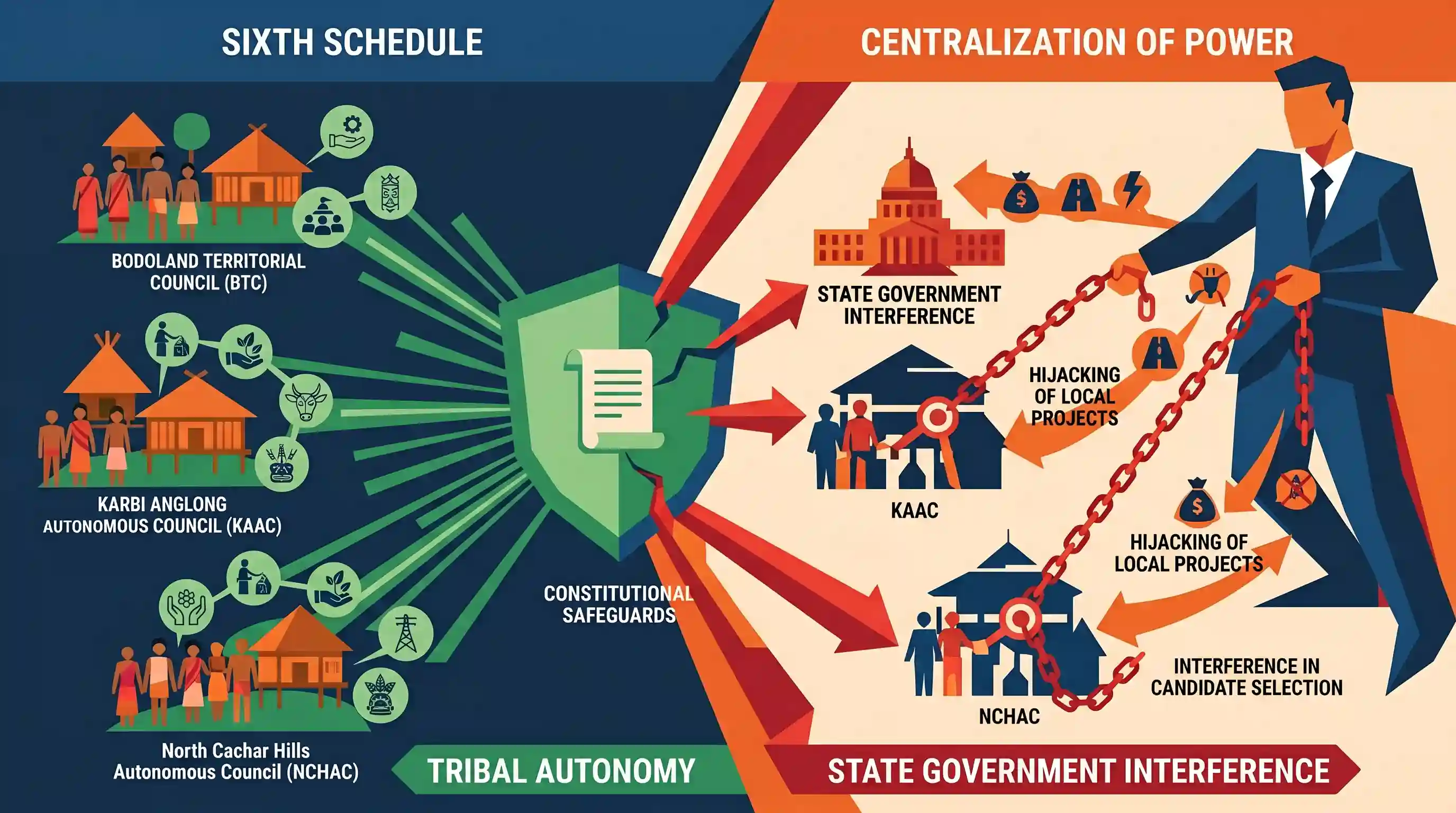
Congress MP Gaurav Gogoi has criticized the BJP government in Assam, alleging that it is eroding the autonomy of the state's tribal councils governed under the Sixth Schedule of the Constitution. Gogoi asserted that Chief Minister Himanta Biswa Sarma is centralizing authority, systematically stripping the Bodoland Territorial Council (BTC), Karbi Anglong Autonomous Council (KAAC), and North Cachar Hills Autonomous Council (NCHAC) of their functional independence. By interfering in candidate selection and hijacking localized development projects, the state government is bypassing constitutional safeguards meant for tribal self-governance. Gogoi warns that this centralization undermines tribal identity and democratic decentralization in the region.
Key Points
- Congress MP Gaurav Gogoi accused the BJP-led Assam government of systematically undermining the autonomy of tribal councils established under the Sixth Schedule.
- He alleged that the state government is centralizing power by dictating the functioning of the Bodoland Territorial Council (BTC), Karbi Anglong Autonomous Council (KAAC), and North Cachar Hills Autonomous Council (NCHAC).
- The centralization includes controlling project allocations (such as infrastructure developments like hospitals) and interfering in local administrative decisions, thereby bypassing the councils' constitutional autonomy.
- Gogoi linked this erosion of tribal self-governance to the BJP’s broader national narrative of centralization, warning that it threatens tribal identity and local democracy in Assam.
Important Terms
Sixth Schedule of the Constitution

A constitutional provision under Articles 244(2) and 275(1) providing for the administration of tribal areas in Assam, Meghalaya, Tripura, and Mizoram through Autonomous District Councils (ADCs) to protect tribal culture and land.
UPSC context
GS Paper II: Indian Polity. Tests understanding of federalism, tribal governance, and the 'Bordoloi Committee' recommendations.
Bodoland Territorial Council (BTC)
An autonomous body established in 2003 under the Sixth Schedule to govern the Bodoland Territorial Region (BTR) in Assam, following a peace accord to address Bodo community aspirations.
UPSC context
GS Paper II: Local Governance; GS Paper III: Internal Security. Relates to peace accords and ethnic self-governance.
Karbi Anglong Autonomous Council (KAAC)
A self-governing body in Diphu, Assam, established in 1952 under the Sixth Schedule to administer Karbi Anglong districts and safeguard the rights of indigenous Karbi and other tribal groups.
UPSC context
GS Paper II: State Governance. Tests knowledge of specific autonomous regions and their legislative/financial powers.
North Cachar Hills Autonomous Council (NCHAC)
Also known as the Dima Hasao Autonomous Council, this body administers the Dima Hasao district of Assam, possessing legislative and executive powers to develop hill tribes and manage local resources.
UPSC context
GS Paper II: Federal Structure. Important for understanding the evolution of tribal districts and ethnic identity politics.
Autonomous District Council (ADC)
The fundamental administrative unit under the Sixth Schedule, typically consisting of 30 members (26 elected, 4 nominated by the Governor) with powers over land, forests, and customary laws.
UPSC context
GS Paper II: Decentralization. A key contrast to the PRIs (Panchayati Raj Institutions) under the 73rd Amendment.
Democratic Decentralization
The process of devolving decision-making power from a central authority to local levels, intended in the Sixth Schedule to empower tribal communities to manage their own socio-economic development.
UPSC context
GS Paper II: Governance. Core concept for questions on federalism and grassroots democracy.
Prelims Trap
"Autonomous District Councils under the Sixth Schedule are entirely outside the executive authority of the State government."
While ADCs possess legislative and judicial powers, the State's executive authority still extends to them, and the Governor plays a direct, supreme supervisory role. They are not independent sovereign entities.
Static Concepts Connected
What is the exact role of the Governor in Sixth Schedule areas?
- Boundary Alteration: The Governor can organize, reorganize, alter boundaries, or change the names of autonomous districts and regions.
- Assent to Laws: All laws and regulations passed by the Autonomous District Councils require the Governor's assent to become valid.
- Commission of Inquiry: The Governor can appoint a commission to examine and report on any matter relating to the administration of autonomous districts.
How does the Sixth Schedule differ from the Fifth Schedule in governance?
- Geographical Scope: The 6th Schedule applies only to Assam, Meghalaya, Tripura, and Mizoram (AMTM). The 5th Schedule applies to Scheduled Areas in any other state.
- Degree of Autonomy: The 6th Schedule creates ADCs with actual legislative, executive, and judicial powers. The 5th Schedule creates Tribal Advisory Councils, which only have advisory roles to the Governor.
Cross-Topic Patterns
Overlapping Safeguards: 6th Schedule, ILP & Art 371
UPSC often tests the geographical overlaps and legal distinctions between states under the Sixth Schedule, states requiring an Inner Line Permit (ILP), and special provisions under Article 371 (e.g., 371B, 371C).
Panchayati Raj vs Autonomous District Councils
The 73rd Amendment (Panchayati Raj) does not apply to Sixth Schedule areas. Comparing PRI dependency on State Finance Commissions with the independent revenue models of ADCs is a recurring Mains theme.

Expect a Prelims question contrasting the Governor's discretionary powers in 5th vs 6th Schedules, alongside ADC funding mechanisms.
Linked PYQs · 5
Linked PYQs · 5
- 2019PrelimsGS1
Under which Schedule of the Constitution of India can the transfer of tribal land to private parties for mining be declared null and void?
- 2022PrelimsGS1
If a particular area is brought under the Fifth Schedule of the Constitution of India, which one of the following statements best reflects the consequence of it ?
- 2023PrelimsGS1
With reference to 'Scheduled Areas' in India, consider the following statements: 1. Within a State, the notification of an area as Scheduled Area takes place through an Order of the President. 2. The largest administrative unit forming the Scheduled Area is the District and the lowest is the cluster of villages in the Block. 3. The Chief Ministers of the concerned States are required to submit annual reports to the Union Home Ministry on the administration of Scheduled Areas in the States. How many of the above statements are correct?
- 2025PrelimsGS1
Consider the following statements : With reference to the Constitution of India, if an area in a State is declared as Scheduled Area under the Fifth Schedule I. the State Government loses its executive power in such areas and a local body assumes total administration II. the Union Government can take over the total administration of such areas under certain circumstances on the recommendations of the Governor Which of the statements given above is/are correct?
- 2017MainsGS2
The local self-government system in India has not proved to be effective instrument of governance." Critically examine the statement and give your views to improve the situation.
