Madhya Pradesh Chief Minister Land Acquisition Controversy and Defense
Source:outlookindia ↗
Why It Matters
This article touches upon key administrative, ethical, and legal aspects relevant to State Exams, including the constitutional functioning of the Chief Minister's office, the statutory regulation of urban master plans under the MP Town and Country Planning Act, and asset disclosure mandates for election candidates under the Representation of the People Act, 1951.
Summary
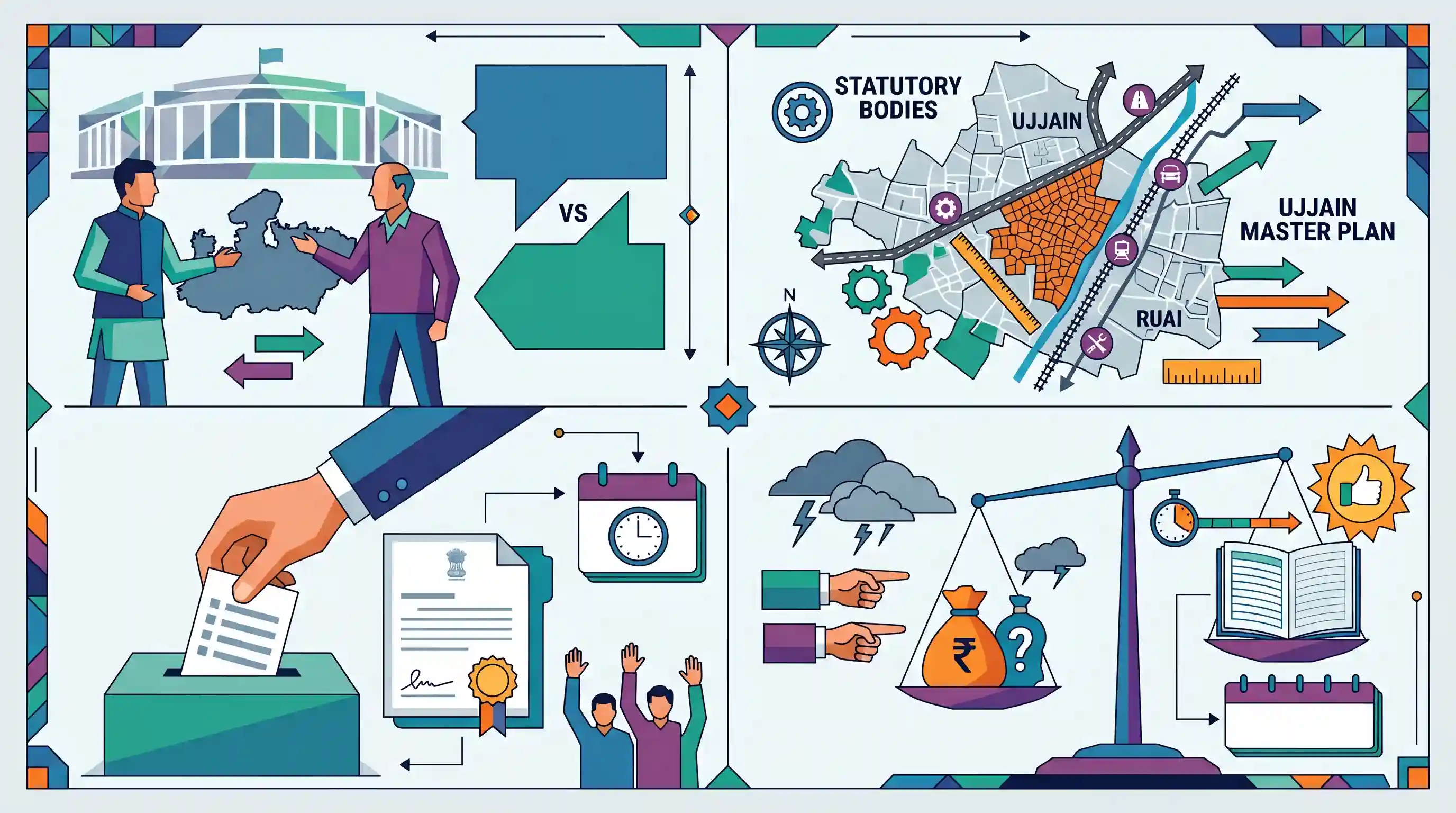
The article details a political controversy in Madhya Pradesh where the opposition Congress has accused Chief Minister Mohan Yadav's family of accumulating 335 acres of land in Ujjain, specifically near key infrastructure corridors and zones affected by the Ujjain Master Plan 2035. The ruling BJP strongly defended the Chief Minister, clarifying that the land acquisitions span decades, were transparently declared in his 2023 election affidavit, and that no new land was purchased after he assumed the office of Chief Minister in December 2023.
Key Points
- The opposition Congress in Madhya Pradesh has accused Chief Minister Mohan Yadav of utilizing official influence to expand his family's land holdings in Ujjain to 335 acres.
- The allegations center around land acquisitions near proposed highway links, road projects, and zones demarcated under the upcoming Ujjain Master Plan 2035, raising questions of conflict of interest.
- The BJP defended the Chief Minister, stating that the land in question was acquired over several decades, was legally declared in his 2023 Assembly election affidavit, and that no new land has been purchased by the CM or his immediate family since he assumed office.
- The controversy brings focus to the legal frameworks governing urban planning in Madhya Pradesh (the MP Town and Country Planning Act, 1973) and election disclosure laws under the Representation of the People Act, 1951.
Important Terms
Representation of the People Act, 1951

A parliamentary act regulating the conduct of elections in India, detailing candidate qualifications and disqualifications, registration of political parties, electoral offenses, and resolution of election disputes.
UPSC context
GS Paper II: Salient features of the RPA, 1951, electoral reforms, and transparency in public life.
Conduct of Elections Rules, 1961
Rules governing electoral procedures in India, mandating the filing of Form 26 affidavits for candidates to disclose their assets, liabilities, education, and criminal antecedents.
UPSC context
GS Paper II: Electoral rules ensuring candidate accountability, transparency, and public right to information.
Madhya Pradesh Nagar Tatha Gram Nivesh Adhiniyam, 1973
A Madhya Pradesh state law providing for the planning, development, and control of land use, including the preparation of regional and town zoning development plans.
UPSC context
GS Paper III: Urban planning, land-use zoning, and regional spatial development strategies.
Ujjain Master Plan 2035
A localized urban planning blueprint released in May 2023 to guide infrastructure, road alignments, and land-use transformations in Ujjain ahead of upcoming growth demands.
UPSC context
GS Paper III: Urbanization; GS Paper IV: Conflict of interest in administrative decision-making.
Prelims Trap
In the absence of the Chief Minister, the senior-most Cabinet Minister automatically presides over the State Council of Ministers.
The state's Rules of Business (framed under Article 166) govern executive proceedings. There is no constitutional default of seniority; the CM must nominate a specific minister to preside over Cabinet meetings in their absence.
Static Concepts Connected
What is the legal basis and scope of Form 26 disclosures under the RPA?
- Statutory basis: Prescribed under Rule 4A of the Conduct of Elections Rules, 1961, framed under the Representation of the People Act, 1951.
- Mandatory declarations: Candidates must declare criminal antecedents, assets (movable and immovable), liabilities, and educational qualifications.
- Concealment consequence: Filing a false affidavit constitutes an electoral offence and can lead to rejection of nomination or election invalidation.
How is state cabinet executive business regulated under Article 166?
- Formal execution: All executive actions of a State Government are taken in the name of the Governor.
- Rules of Business: The Governor allocates business and frames transaction rules on the advice of the State Cabinet.
- Absence of CM: The Rules of Business dictate who presides over Cabinet meetings, typically a minister nominated specifically by the CM.
Cross-Topic Patterns
Infrastructure zoning + Conflict of Interest
Intersects GS-4 Ethics and GS-3 Urban Planning, highlighting how administrative insider knowledge of city Master Plans challenges local conflict-of-interest frameworks.
Land pooling laws + Article 300A
Connects GS-2 Town Planning Acts with constitutional property rights under Article 300A, highlighting how public-purpose land acquisitions balance farmer protests and state requirements.

Form 26 asset disclosures and Article 166 Rules of Business will likely be framed as a multi-statement GS-2 Polity question in 2026.
Linked PYQs · 1
Linked PYQs · 1
- 2022MPPSC_PRELIMSGS1
Who among the following shall preside the meeting of Council of Ministers in Madhya Pradesh in the absence of the Chief Minister?
