Opposition Blames Ruling Party for Defeat of Women Quota Bill
Source:The Hindu ↗
Why It Matters
The controversy over linking women's reservation to delimitation highlights a core tension in Indian federalism: the friction between purely demographic representation and protecting the political weight of states that have successfully controlled their population. This intersection of gender justice and Centre-State relations is highly relevant for GS-2 Polity questions on representation and federal equity.
Summary
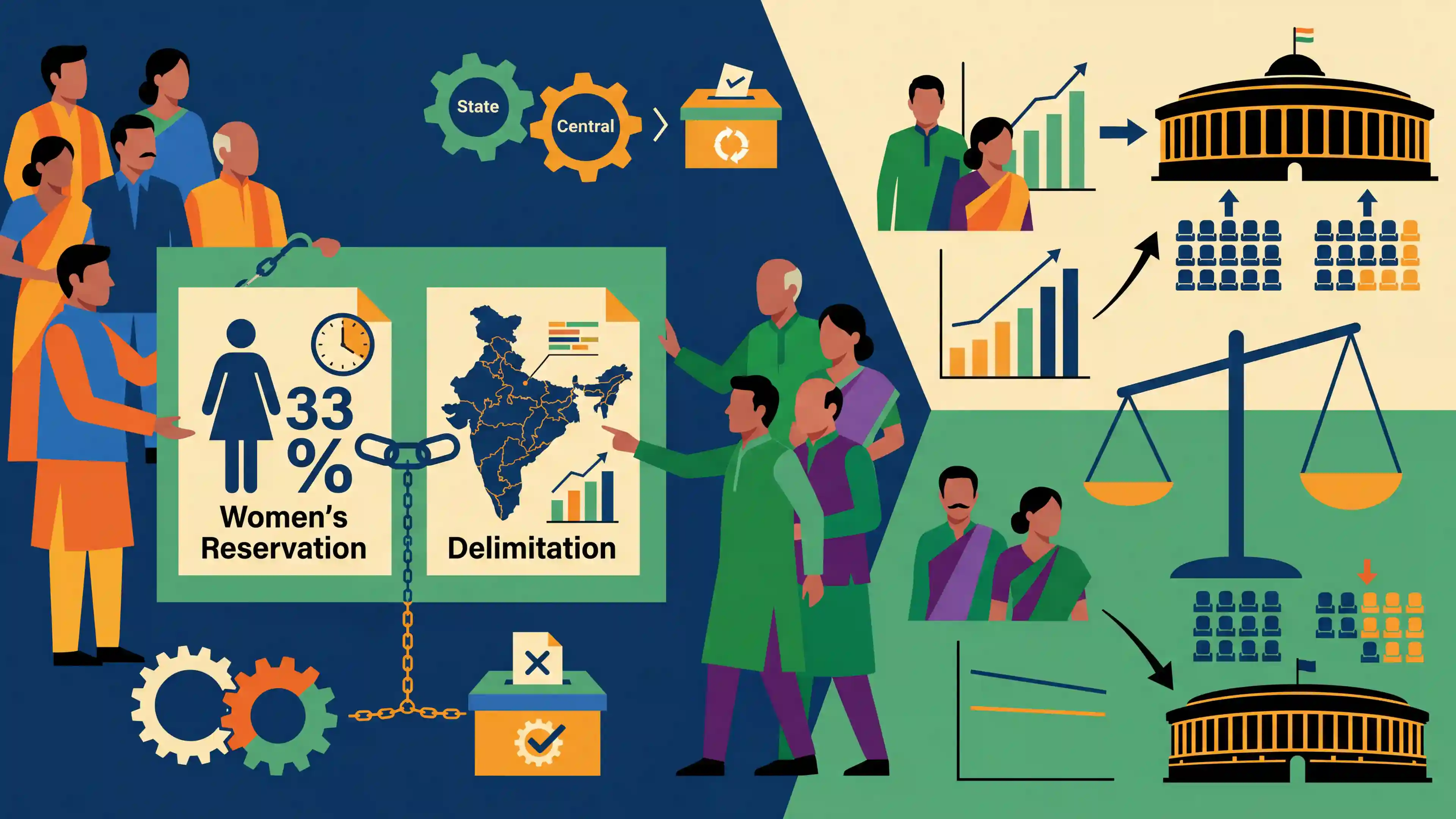
Congress leader K.C. Venugopal asserted that the BJP deliberately delayed the implementation of the 33% women's legislative reservation by introducing the Constitution (131st Amendment) Bill, 2026. This bill contentiously tied the women's quota to a nationwide delimitation exercise. The Opposition blocked the legislation primarily because the delimitation clause threatened to reduce the parliamentary representation of Southern and Eastern states, imposing a 'demographic penalty' on regions that successfully managed their population growth. Congress argues this legislative packaging was a strategic move to undermine federal equity while shifting the blame for the delayed women's reservation onto the Opposition.
Key Points
- Congress leader K.C. Venugopal accused the BJP of derailing the 33% women's reservation by linking it with the contentious delimitation exercise.
- The Constitution (131st Amendment) Bill, 2026, sought to package women's reservation with delimitation, raising concerns over a potential reduction in parliamentary seats for Southern and Eastern states.
- The Opposition blocked the bill to prevent states like Tamil Nadu and Kerala from facing a demographic penalty for their successful population control measures.
- Congress demands the immediate and unconditional implementation of women's legislative quotas without tying them to future delimitation processes.
Important Terms
Constitution (131st Amendment) Bill, 2026

A 2026 legislative proposal aiming to fast-track women's reservation by decoupling it from the post-2026 Census, enabling delimitation based on 2011 data and expanding Lok Sabha seats to 850.
UPSC context
GS Paper II (Polity); tests understanding of constitutional amendments, seat expansion, and the intersection of gender quotas with delimitation.
Nari Shakti Vandan Adhiniyam
The 106th Constitutional Amendment Act (2023) providing 33% reservation for women in Lok Sabha and State Assemblies, historically contingent upon a fresh Census and delimitation exercise.
UPSC context
GS Paper II (Social Justice/Governance); vital for questions on women’s political empowerment and legislative reforms.
Delimitation
The statutory process of redrawing electoral constituency boundaries and reallocating seats based on population data (Articles 82/170) to ensure "one person, one vote, one value."
UPSC context
GS Paper II (Elections); critical for understanding representation dynamics and the constitutional freeze on seat allocation.
Demographic Penalty
The potential loss of parliamentary seats and political influence for states that successfully implemented population control, relative to states with higher fertility rates.
UPSC context
GS Paper I & II (Population/Federalism); explores the North-South divide and fairness in representative democracy.
Federal Equity
The principle ensuring that the distribution of political power and resources does not unfairly disadvantage states based on their developmental or demographic performance.
UPSC context
GS Paper II (Federalism); tests the balance between central authority and state rights in large-scale electoral restructuring.
Prelims Trap
The state-wise allocation of Lok Sabha seats automatically unfreezes in the year 2026.
The 84th Amendment does not trigger an automatic unfreezing in 2026. The freeze applies until the relevant figures for the "first census taken after the year 2026" are published.
Static Concepts Connected
What is the Constitutional framework governing Delimitation in India?
- Article 82: Under Article 82, Parliament enacts a Delimitation Act to readjust seat allocation after every Census.
- Seat Freeze: The 42nd (1976) and 84th (2001) Amendments froze state-wise Lok Sabha seat allocation based on 1971 Census data until the first census post-2026.
- Judicial Immunity: Orders issued by the Delimitation Commission have the force of law and cannot be questioned in any court, preventing electoral delays.
How is Women's Reservation structured under the 106th Amendment Act?
- 33% Quota: Mandates 33% of seats for women in the Lok Sabha, State Legislative Assemblies, and the NCT of Delhi.
- Sub-reservation: Includes a mandated 33% reservation for women within the existing constitutional quotas for SCs and STs.
- Sunset Clause: The quota will be effective for 15 years, though Parliament can extend it by law.
- Contingency: Implementation is explicitly contingent upon a delimitation exercise based on the first census taken after the Act's commencement.
Cross-Topic Patterns
Finance Commission vs. Delimitation penalty
Southern states' falling fertility previously caused friction over Finance Commission tax devolutions. Delimitation threatens to extend this 'demographic penalty' from financial resource sharing to core political representation.
Local vs. National quota implementation
While local governance women's quotas (73rd/74th Amendments) were implemented quickly via state mandates, national quotas face structural delays due to their entanglement with the delicate federal balance.

Expect a GS-2 Mains question linking the 'demographic penalty' of Delimitation to asymmetrical federalism and the delayed Women's Quota.
Linked PYQs · 3
Linked PYQs · 3
- 2023MainsGS2
Discuss the contribution of civil society groups for women's effective and meaningful participation and representation in state legislatures in India.
- 2019MainsGS2
“The reservation of seats for women in the institutions of local self-government has had a limited impact on the patriarchal character of the Indian Political Process.” Comment.
- 2024MainsGS2
What changes has the Union Government recently introduced in the domain of Centre-State relations ? Suggest measures to be adopted to build the trust between the Centre and the States and for strengthening federalism.
