Parliamentary Debate on Fuel Prices and Fiscal Deficit
Source:The Hindu ↗
Why It Matters
The debate highlights core macroeconomic issues relevant to UPSC, including direct tax disparities, fiscal deficit management under the FRBM Act, the impact of Free Trade Agreements (FTAs) on domestic manufacturing (MSMEs), and strategies for maintaining energy security amidst global geopolitical disruptions.
Summary
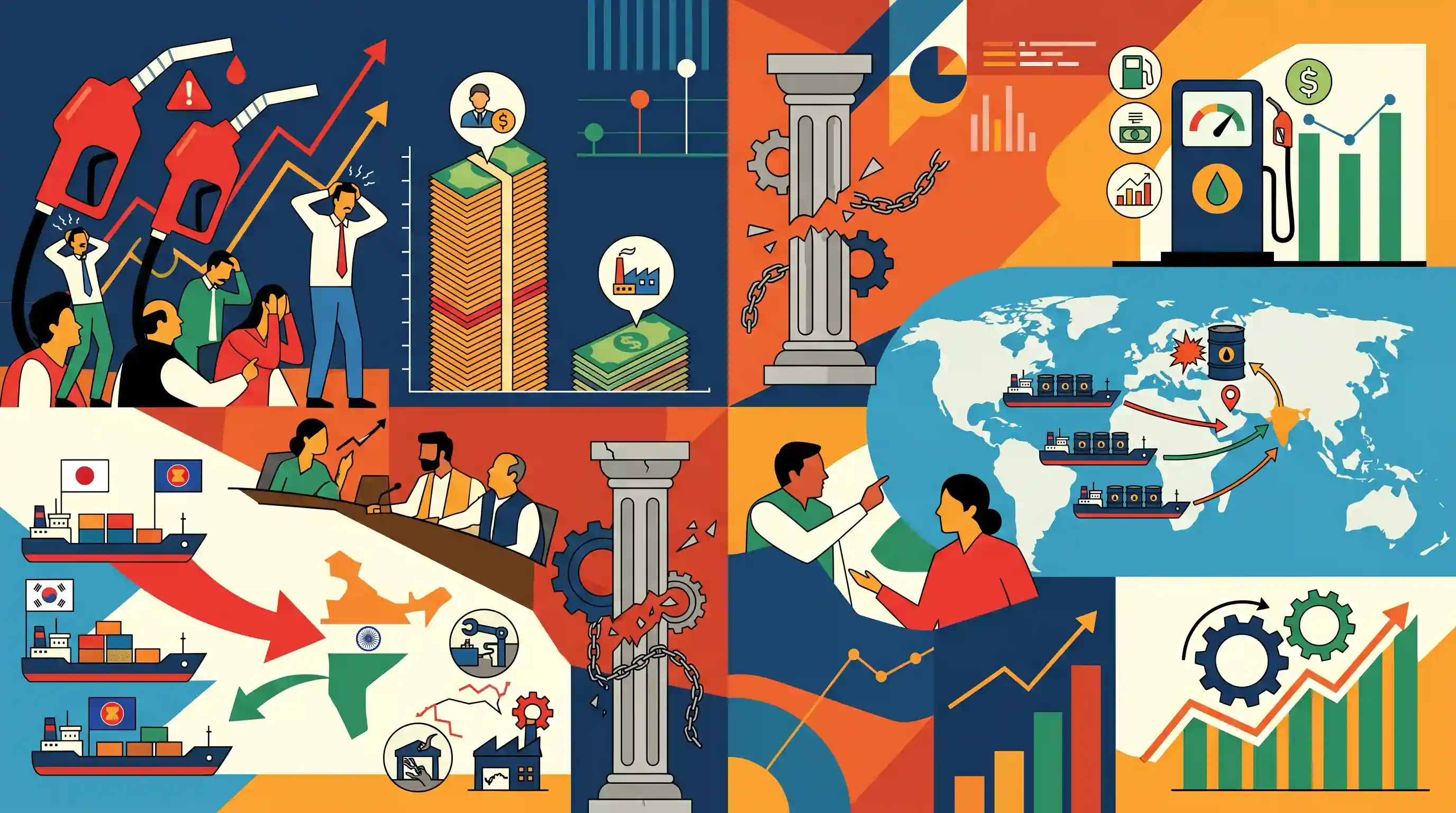
During the Lok Sabha debate on the Finance Bill, the opposition and the ruling party sparred over fuel prices, tax disparities, and macroeconomic policies. Congress highlighted the skew between corporate and income tax collections, while the BJP defended its handling of fuel prices and energy security, citing the diversification of crude oil imports amid the West Asia conflict. Opposition MPs also criticized the Centre's non-adherence to the FRBM Act and raised alarms over widening trade deficits caused by Free Trade Agreements (FTAs) with countries like Japan, South Korea, and ASEAN, which are impacting domestic MSMEs.
Key Points
- Opposition members in the Lok Sabha highlighted the growing disparity between corporate tax and income tax collections, criticizing the reduction in corporate tax rates while high-net-worth individuals move abroad.
- The government's reluctance to raise fuel prices despite a spike in global crude oil prices due to the West Asia conflict was alleged to be driven by electoral considerations.
- The BJP defended its policies, noting that the government shielded consumers from inflation and enhanced energy security by diversifying crude oil imports from 27 to 41 countries.
- Concerns were raised regarding the Centre's failure to adhere to the Fiscal Responsibility and Budget Management (FRBM) Act, contrasting it with the fiscal discipline demanded from states.
- India's rising trade deficit stemming from Free Trade Agreements (FTAs) with ASEAN, UAE, Japan, and South Korea was flagged as detrimental to domestic MSMEs.
Important Terms
Finance Bill

A legislative proposal presented with the Union Budget to give legal effect to the government's tax proposals and financial changes for the upcoming fiscal year.
UPSC context
GS Paper 2 & 3: Tests understanding of the legislative process, parliamentary control over finances, and fiscal policy implementation.
Fiscal Responsibility and Budget Management (FRBM) Act
A 2003 law mandating fiscal discipline by setting targets for reducing fiscal deficits and government debt to ensure long-term macroeconomic stability and transparency.
UPSC context
GS Paper 3: Core topic for fiscal policy, government budgeting, and issues related to resource mobilization.
MSMEs
Small-scale businesses classified by investment and turnover that serve as India's economic backbone, contributing roughly 30% to GDP and 45% to total exports.
UPSC context
GS Paper 3: Crucial for topics on industrial growth, employment generation, and impact of international trade policies.
ASEAN
A regional intergovernmental organization comprising ten Southeast Asian nations, serving as a critical economic and strategic partner under India's 'Act East Policy'.
UPSC context
GS Paper 2: Significant for international relations, regional groupings, and India’s strategic interests in the Indo-Pacific.
Free Trade Agreements (FTAs)
International treaties that reduce or eliminate tariffs and non-tariff barriers on trade between member nations to promote economic integration and market access.
UPSC context
GS Paper 3: Tests impact of globalization and trade policy on domestic manufacturing and the trade balance.
Trade Deficit
An economic situation where the value of a country's imports exceeds its exports; a key concern for India regarding its trade with FTA partners.
UPSC context
GS Paper 3: Important for balance of payments, export-led growth strategies, and evaluating trade treaty outcomes.
Prelims Trap
"Corporate tax remains the highest contributor to direct tax revenues for the Union Government."
Following the 2019 corporate tax rate cuts and improved individual filing compliance, personal income tax collections have actually surpassed corporate tax collections in recent Union Budgets.
Static Concepts Connected
What are the key targets and escape clauses under the FRBM Act?
- Original Targets: Aimed to eliminate the revenue deficit and bring the fiscal deficit down to 3% of GDP to ensure long-term macroeconomic stability.
- N.K. Singh Committee: Recommended capping the general government debt-to-GDP ratio at 60% (40% for the Centre and 20% for the States).
- Escape Clause: Allows the Centre to deviate from the fiscal deficit target by 0.5% of GDP during national security crises, structural reforms, or severe economic shocks.
How does the Annual Finance Bill relate to Money Bills under the Constitution?
- Article 110 limits: A Money Bill strictly contains provisions listed in Article 110 (e.g., taxation, borrowing). The Speaker’s certification is final.
- Budget implementation: The annual Finance Bill giving effect to the Union Budget is usually introduced and passed as a Money Bill.
- Rajya Sabha powers: Unlike ordinary Finance Bills (Article 117), the Rajya Sabha cannot amend or reject a Money Bill; it can only recommend changes within 14 days.
Cross-Topic Patterns
FTA design vs. MSME protection
The structural widening of trade deficits with ASEAN and Japan highlights the 'inverted duty structure,' where raw materials face higher import duties than finished goods, disproportionately hurting domestic MSMEs.
West Asia crisis and crude diversification
India's expansion from 27 to 41 crude oil sourcing countries demonstrates a strategic shift toward Russia and Latin America to buffer against ongoing West Asian geopolitical shocks and secure price stability.

Income > Corporate tax trends, FRBM escape clauses, and FTA-driven trade deficits are high-probability multi-statement Prelims Qs for 2026.
Linked PYQs · 3
Linked PYQs · 3
- 2013MainsGS3
What were the reasons for the introduction of Fiscal Responsibility and Budget Management (FRBM) Act, 2003 ? Discuss critically its salient features and their effectiveness.
- 2025MainsGS3
Explain how the Fiscal Health Index (FHI) can be used as a tool for assessing the fiscal performance of states in India. In what way would it encourage the states to adopt prudent and sustainable fiscal policies?
- 2011MainsGS2
Compared to the South Asian Free Trade Area (SAFTA), the Bay of Bengal Initiative for Multisectoral Technical and Economic Cooperation Free Trade Area (BIMSTEC FTA) seems to be more promising." Critically evaluate.
