Constitutional Mandate and Resignation of Union Minister George Kurian
Source:Indian Express ↗
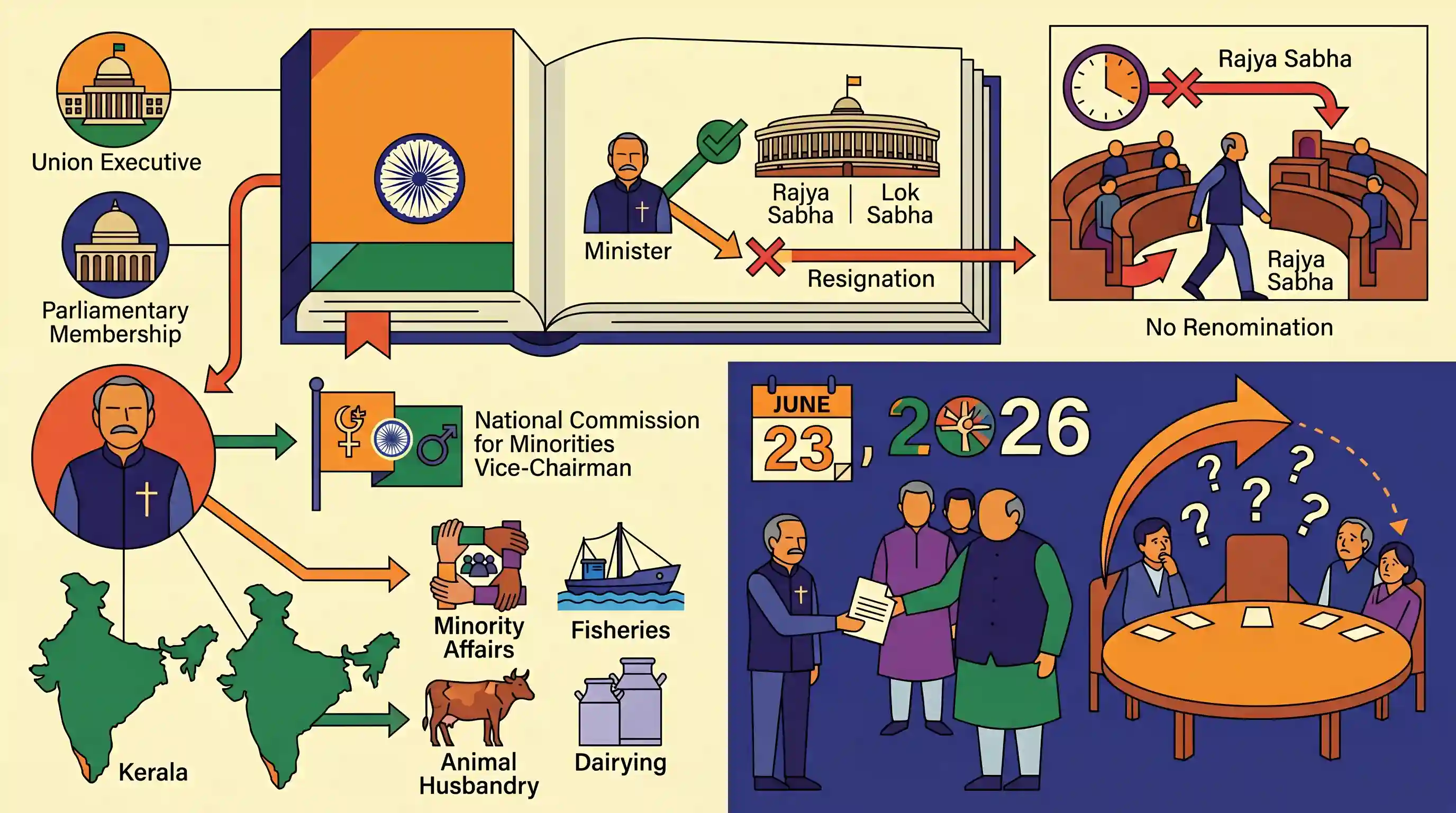
Why It Matters
The event underscores the practical application of Article 75 of the Constitution, which mandates that a minister must be a member of Parliament. It also provides a contextual backdrop for studying the composition of the Union Council of Ministers and the roles of statutory bodies like the National Commission for Minorities.
Summary
George Kurian, the BJP's lone Christian face in the Union Council of Ministers, resigned from his post on June 23, 2026, following the expiry of his Rajya Sabha term and the party's decision not to renominate him. Kurian, who served as Minister of State for Minority Affairs, Fisheries, Animal Husbandry, and Dairying, stepped down in accordance with constitutional requirements regarding parliamentary membership for ministers. His departure has triggered speculation of an imminent reshuffle in the Union Cabinet. Kurian previously served as the vice-chairman of the National Commission for Minorities and was seen as a key figure in the BJP's outreach to the Christian community in Kerala.
Key Points
- George Kurian, the sole Christian minister in the Union Council of Ministers, resigned after the BJP chose not to renominate him to the Rajya Sabha upon the expiry of his term.
- Under Article 75 of the Indian Constitution, a minister who ceases to be a Member of Parliament for six consecutive months cannot remain in the Council of Ministers.
- Kurian previously served as a Minister of State for Minority Affairs, Fisheries, Animal Husbandry and Dairying.
- His resignation has fueled speculations about a potential reshuffle of the Union Council of Ministers.
- Before becoming a Union Minister, Kurian served as vice-chairman of the National Commission for Minorities, a statutory body.
Important Terms
Union Council of Ministers

The highest executive body of the Indian government, headed by the Prime Minister. It aids and advises the President under Articles 74 and 75 of the Constitution.
UPSC context
GS Paper II: Executive and Parliamentary systems. Tests knowledge of ministerial appointments, hierarchy, and collective responsibility.
Article 75
A key constitutional provision governing the appointment, tenure, and responsibilities of ministers. It mandates that a minister must join either House of Parliament within six months.
UPSC context
GS Paper II: Indian Constitution. Tests understanding of the executive's accountability and the 'six-month rule' for parliamentary membership.
Rajya Sabha
The 'Council of States' or Upper House of India's Parliament. It is a permanent body where members serve six-year terms, representing States and Union Territories.
UPSC context
GS Paper II: Parliament. Tests knowledge of the composition, powers, and the role of the Upper House in the executive.
National Commission for Minorities
A statutory body established under the 1992 Act to safeguard the rights of notified minority communities (Muslims, Christians, Sikhs, Buddhists, Parsis, and Jains).
UPSC context
GS Paper II: Statutory bodies and welfare of vulnerable sections. Tests knowledge of minority rights and institutional safeguards.
Statutory Body
An organization created by an Act of Parliament to perform specific functions. Unlike constitutional bodies, their powers and structure are derived from legislation.
UPSC context
GS Paper II: Governance. Tests the ability to distinguish between constitutional, statutory, and quasi-judicial institutions.
Sangh Parivar
The collective of Hindu nationalist organizations, including the RSS and BJP. It focuses on cultural and political outreach based on the ideology of Hindutva.
UPSC context
GS Paper I/II: Political parties and social movements. Relevant for understanding ideological foundations in Indian politics.
Prelims Trap
"The Constitution explicitly categorizes the Council of Ministers into Cabinet Ministers, Ministers of State, and Deputy Ministers."
The Constitution only refers to a "Council of Ministers" under Article 74/75. Rank classifications stem from parliamentary conventions and Rules of Business.
Static Concepts Connected
What are the constitutional rules for parliamentary membership of Union Ministers?
- Article 75(5): A Minister who is not a member of either House for six consecutive months automatically ceases to be a Minister at the expiration of that period.
- Initial appointment: A non-MP can be appointed as a Minister, provided they secure a seat in either the Lok Sabha or Rajya Sabha within the six-month window.
- Voting restrictions: Ministers have the right to speak and take part in the proceedings of both Houses, but can only vote in the House of which they are a member.
How is the National Commission for Minorities (NCM) legally structured?
- Statutory backing: Established under the National Commission for Minorities Act, 1992. Unlike the NCST or NCBC, it is a statutory body, not a constitutional one.
- Exclusive composition: The NCM Act mandates that the Chairperson, Vice-Chairperson, and five Members must all belong to notified minority communities.
- Six communities: The Central Government currently notifies six religious communities as national minorities: Muslims, Christians, Sikhs, Buddhists, Parsis, and Jains (added in 2014).
Cross-Topic Patterns
NCM vs. Constitutional bodies
UPSC frequently pairs the statutory NCM with constitutional commissions (like NCBC or NCST) in Prelims to test aspirants on structural, legal, and appointment differences.
State vs. National minority status
The Central notification of six minorities under the NCM Act links directly to ongoing judicial debates over identifying linguistic and religious minorities at the State level (e.g., TMA Pai case).

Expect a mixed-statement Prelims question in 2026 merging Article 75 rules for ministers with the statutory composition rules of the NCM.
Linked PYQs · 2
Linked PYQs · 2
- 2022PrelimsGS1
Consider the following statements: 1. The Constitution of India classifies the ministers into four ranks viz. Cabinet Minister, Minister of State with Independent Charge, Minister of State and Deputy Minister. 2. The total number of ministers in the Union Government, including the Prime Minister, shall not exceed 15 percent of the total number of members in the Lok Sabha. Which of the statements given above is/are correct?
- 2022MainsGS2
Discuss the role of the National Commission for Backward Classes in the wake of its transformation from a statutory body to a constitutional body.
