Political Campaign Dynamics and Economic Decline in Regional States
Source:The Hindu ↗
Why It Matters
This article provides real-world context for GS2 topics related to state elections, federal dynamics between national and regional political parties, and law and order issues (crimes against women). It also touches upon GS1 economic geography regarding the decline of traditional resource-based industries like jute and steel in West Bengal.
Summary
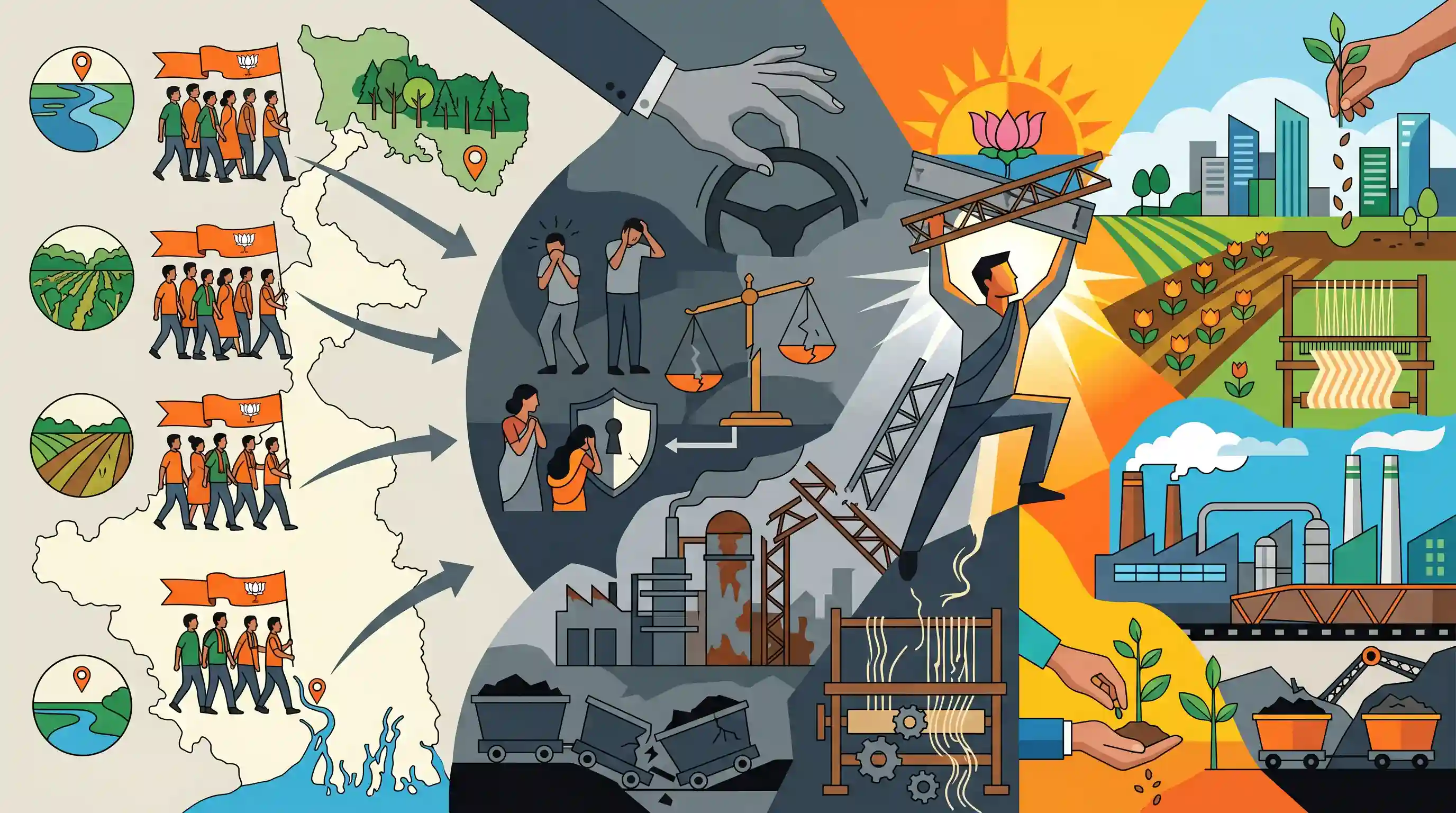
The Bharatiya Janata Party (BJP) has formally launched its campaign for the 2026 West Bengal Assembly elections through four 'Parivartan Yatras' starting from Mathurapur, Cooch Behar, Krishnanagar, and Asansol. Senior party leaders highlighted widespread corruption, alleged atrocities against women—specifically recalling the R.G. Kar Medical College tragedy—and a general breakdown of law and order under the ruling Trinamool Congress (TMC). The campaign also draws attention to the industrial and economic decline of the state, focusing on the deterioration of its historic coal, steel, and jute sectors, as the BJP positions itself as the vehicle for regional development and governance change.
Key Points
- The BJP initiated its 2026 West Bengal Assembly election campaign with four 'Parivartan Yatras' (Marches for Change) launched from different corners of the state.
- Campaign narratives strongly focus on allegations of corruption and deteriorating law and order under the TMC government.
- The R.G. Kar Medical College rape and murder incident was heavily highlighted to underscore issues of women's safety and gender justice.
- BJP leaders pointed to the state's economic stagnation, specifically noting the decline of the traditional coal, steel, and jute industries in West Bengal.
- The yatras frame the upcoming election as a choice between the incumbent regional party and the national party's promise of a 'double engine' development model.
Important Terms
Parivartan Yatra

A mass political outreach campaign used for voter mobilization and anti-incumbency consolidation. It involves large-scale travels across constituencies to highlight governance failures and connect with the grassroots.
UPSC context
GS Paper II: Electoral Processes. Tests understanding of political mobilization strategies and their impact on state-level democratic competition.
R.G. Kar Medical College Case
Refers to the 2024 rape and murder case of a trainee doctor in Kolkata, which sparked nationwide protests. It symbolizes critical gaps in workplace safety, institutional accountability, and law and order.
UPSC context
GS Paper II: Social Justice/Women’s Safety. Tests knowledge of institutional failures, safety protocols, and judicial activism (suo-motu cognizance).
Jute Industry
A labor-intensive sector historically concentrated along West Bengal’s Hooghly River. Known as the 'Golden Fiber,' it faces competition from synthetic alternatives, outdated machinery, and international producers like Bangladesh.
UPSC context
GS Paper I/III: Location of Industries. Relevant for understanding resource-based clusters, economic geography, and challenges to traditional manufacturing.
Iron and Steel Industry
Heavy industry concentrated in the Chota Nagpur plateau (including West Bengal). It depends on raw materials like iron ore and coking coal, facing challenges like technological obsolescence and resource depletion.
UPSC context
GS Paper I: Industrial Location Factors. Tests knowledge of primary sector distribution and factors influencing the growth of heavy industries.
Electoral Mobilization
The process by which political parties activate and engage voters through rallies, door-to-door visits, and digital outreach to influence election outcomes and highlight regional governance issues.
UPSC context
GS Paper II: Representation of People’s Act. Tests understanding of voter outreach mechanisms and the functioning of a multi-party democracy.
Prelims Trap
"India is both the largest producer and the largest exporter of jute globally."
While India is the undisputed largest producer of raw jute, Bangladesh consistently ranks as the world's largest exporter due to better quality and export-focused policies.
Static Concepts Connected
Why is the jute industry historically concentrated in the Hooghly basin?
- Water availability: Abundant freshwater from the Hooghly river is essential for the processing and retting of raw jute.
- Transport network: Inexpensive water transport, heavily supported by a dense network of railways and roadways for raw material movement.
- Labor & Capital: Availability of cheap labor from adjoining states (Bihar, UP, Odisha) and banking/insurance facilities in Kolkata.
What are the core mandates of the POSH Act, 2013?
- ICC mandate: Every employer with 10 or more employees must legally constitute an Internal Complaints Committee (ICC).
- Unorganized sector: State governments are required to set up Local Complaints Committees (LCC) at the district level for the unorganized sector.
- Civil Court powers: The ICC/LCC enjoys the powers of a civil court for summoning witnesses and gathering evidence.
Cross-Topic Patterns
Coastal shift of Steel Plants
Historic steel plants (like Asansol) relied heavily on proximate Raniganj coalfields. Modern plants increasingly shift to coastal regions to leverage imported coking coal and export markets.
Protectionism vs. Right to Work
State directives restricting night shifts for women following severe crimes are frequently criticized for violating Article 19(1)(g) and gender justice under the guise of protectionism.
Fiscal Federalism dynamics
Political narratives of 'double-engine' growth are often tested against the constitutional role of the Finance Commission (Article 280), which mandates objective resource allocation regardless of party alignment.

Mains 2026 is likely to test the constitutional friction between women's workplace safety (POSH Act) and state limits on the Right to Work.
Linked PYQs · 4
Linked PYQs · 4
- 2022MainsGS2
“While the national political parties in India favour centralisation, the regional parties are in favour of State autonomy.” Comment.
- 2023MainsGS2
Explain the constitutional perspectives of Gender Justice with the help of relevant Constitutional Provisions and case laws.
- 2020MainsGS1
Account for the present location of iron and steel industries away from the source of raw material, by giving examples.
- 2019MainsGS1
Can the strategy of regional resource-based manufacturing help in promoting employment in India?
