Electoral reforms debate in Lok Sabha and democratic accountability
Source:Indian Express ↗
Why It Matters
Electoral reforms and parliamentary debates are core components of the UPSC GS-II syllabus. Understanding the political discourse surrounding reforms like simultaneous elections, EVMs, and electoral funding is crucial for analyzing the evolution of India's democratic institutions and the mechanisms of accountability.
Summary
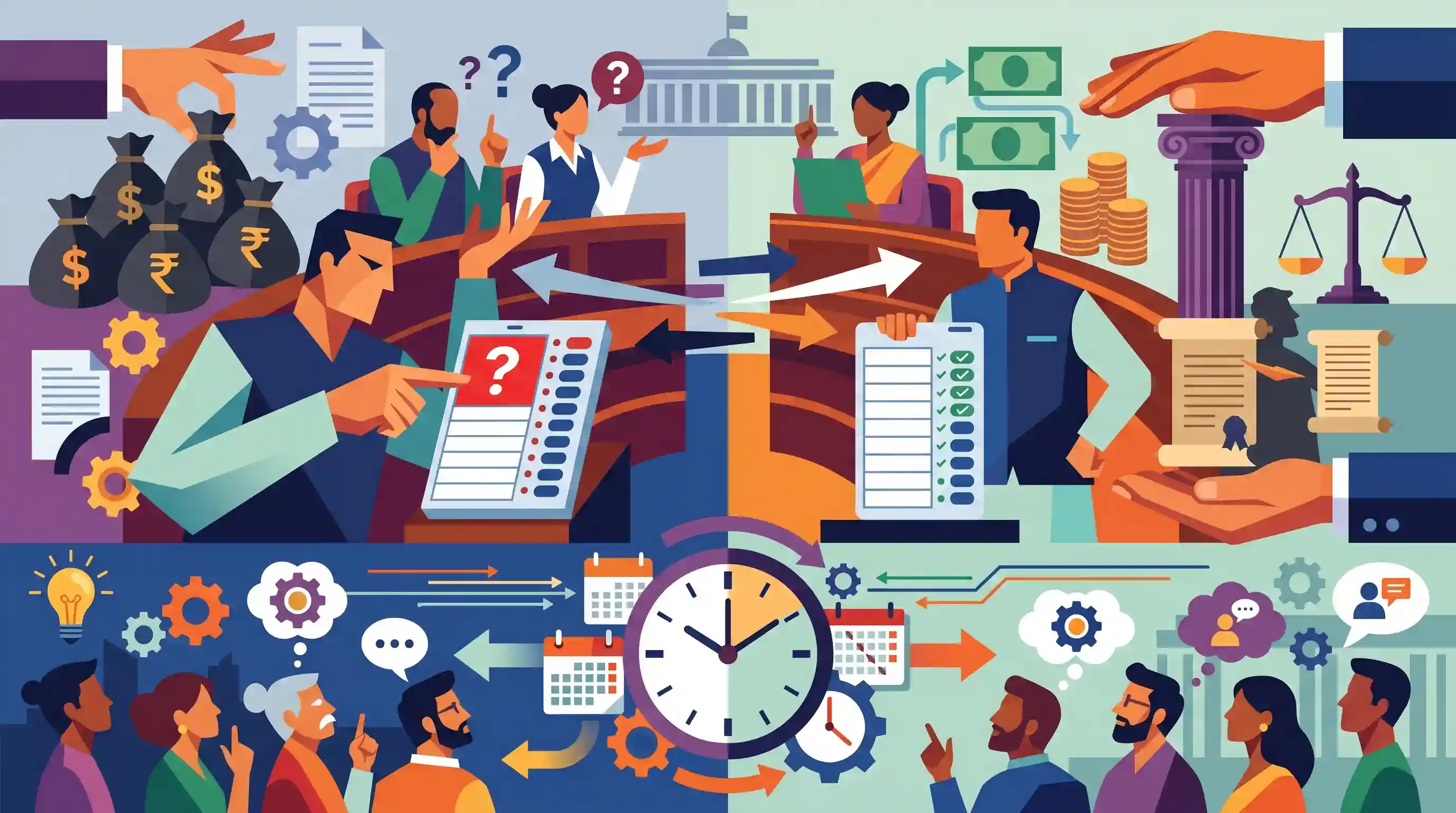
A recent Lok Sabha debate on electoral reforms saw the ruling BJP and its allies successfully counter the Congress party by building a strong political narrative. While the Opposition has frequently raised concerns regarding electoral processes, such as EVM reliability and electoral funding, the ruling coalition utilized the parliamentary platform to defend the integrity of India's democratic institutions and highlight past political precedents. The debate underscores the ongoing national discourse on key electoral reforms, including the proposed 'One Nation, One Election' framework, and highlights the role of Parliament as the primary arena for contesting ideas on democratic governance.
Key Points
- The Lok Sabha recently hosted a significant debate focusing on electoral reforms in India, reflecting ongoing political and systemic priorities.
- The ruling BJP and its allies successfully built a counter-narrative against the Congress party, emphasizing their track record and defending the current electoral framework.
- Debates on poll reforms typically encompass contentious issues such as the reliability of Electronic Voting Machines (EVMs), electoral funding transparency, and the feasibility of 'One Nation, One Election'.
- The proceedings highlight the critical role of Parliamentary debates in shaping public perception and deliberating on foundational democratic processes.
Important Terms
Representation of the People Act (RPA)

Primary legislations (1950 & 1951) governing Indian elections; 1950 focuses on seat allocation and electoral rolls, while 1951 details election conduct, candidate qualifications, and disqualifications.
UPSC context
GS Paper II: Salient features of the RPA; essential for understanding the legal framework of Indian democracy.
Election Commission of India (ECI)
An autonomous constitutional authority (Article 324) responsible for administering election processes in India for Parliament, State Legislatures, and the offices of President and Vice-President.
UPSC context
GS Paper II: Constitutional Bodies; tests knowledge of election management, independence, and Art. 324-329.
One Nation, One Election (ONOE)
A proposal to synchronize the election cycles of the Lok Sabha and all State Legislative Assemblies to hold them simultaneously, aiming to reduce costs and governance disruptions.
UPSC context
GS Paper II: Electoral Reforms; a high-priority topic regarding federalism and legislative efficiency.
Lok Sabha
The lower house of India's bicameral Parliament, composed of representatives directly elected by the people on the basis of universal adult suffrage.
UPSC context
GS Paper II: Parliament and State Legislatures; focuses on structure, functions, and democratic representation.
Electoral Reforms
Systematic changes to rules and processes—such as funding transparency and criminalization curbs—aimed at ensuring elections remain free, fair, and representative.
UPSC context
GS Paper II: Governance; tests critical analysis of democratic integrity and committee recommendations.
Electronic Voting Machine (EVM)
Electronic devices used to record votes, replacing paper ballots to modernize the electoral process and minimize malpractices like booth capturing.
UPSC context
GS Paper II: Issues in Elections; pertains to technological transparency and public trust in democratic institutions.
Prelims Trap
"The Right to Vote in India is a Fundamental Right protected under Part III of the Constitution."
The Right to Vote is a Constitutional Right derived from Article 326 (Universal Adult Suffrage), not a Fundamental Right. It is operationalized as a statutory right under the RPA.
Static Concepts Connected
Which Constitutional Articles must be amended to implement 'One Nation, One Election'?
- Arts 83 & 172: Governs the standard five-year duration of the Houses of Parliament and State Legislative Assemblies, respectively.
- Arts 85 & 174: Deals with the President's and Governor's powers to prorogue and dissolve the Lok Sabha and State Assemblies.
- Article 356: Relates to the imposition of President's Rule, which requires new frameworks to prevent mid-cycle Assembly dissolutions from breaking the synchronized schedule.
How is rule-making power for elections divided under the Constitution?
- Article 327 (Parliament): Parliament has overarching power to legislate on elections to both Parliament and State legislatures, including electoral rolls and delimitation.
- Article 328 (States): State legislatures can only legislate on matters relating to their own state elections if Parliament has not already made a provision.
- Article 329 (Courts): Bars judicial interference in electoral matters, establishing that elections can only be challenged via an election petition to an authorized authority.
Cross-Topic Patterns
Electoral Bonds + RTI + Corporate Ethics
Striking down anonymous electoral bonds connects democratic transparency (Art 19(1)(a)) directly with corporate governance, specifically rolling back Companies Act amendments regarding unlimited corporate political contributions.
Executive Panels vs Standing Committees
The Kovind Committee on simultaneous elections highlights the increasing use of executive-appointed high-level panels for major systemic overhauls, contrasting with the traditional scrutiny role of Parliamentary Standing Committees.

Constitutional amendments needed for 'One Nation, One Election' (Arts 83, 172) & state ratification rules are highly probable for 2026.
Linked PYQs · 3
Linked PYQs · 3
- 2024MainsGS2
Examine the need for electoral reforms as suggested by various committees with particular reference to "one nation one election" principle.
- 2017MainsGS2
Simultaneous election to the Lok Sabha and the State Assemblies will limit the amount of time and money spent in electioneering but it will reduce the government's accountability to the people." Discuss.
- 2017PrelimsGS1
Right to vote and to be elected in India is a
