Constitution Amendments and Delimitation Dynamics in Parliament
Source:Indian Express ↗
Why It Matters
It covers crucial themes in Indian polity like constitutional amendments, disqualification norms for arrested ministers, delimitation, and women's reservation, which directly relate to GS Paper II syllabi on governance and the Parliament.
Summary
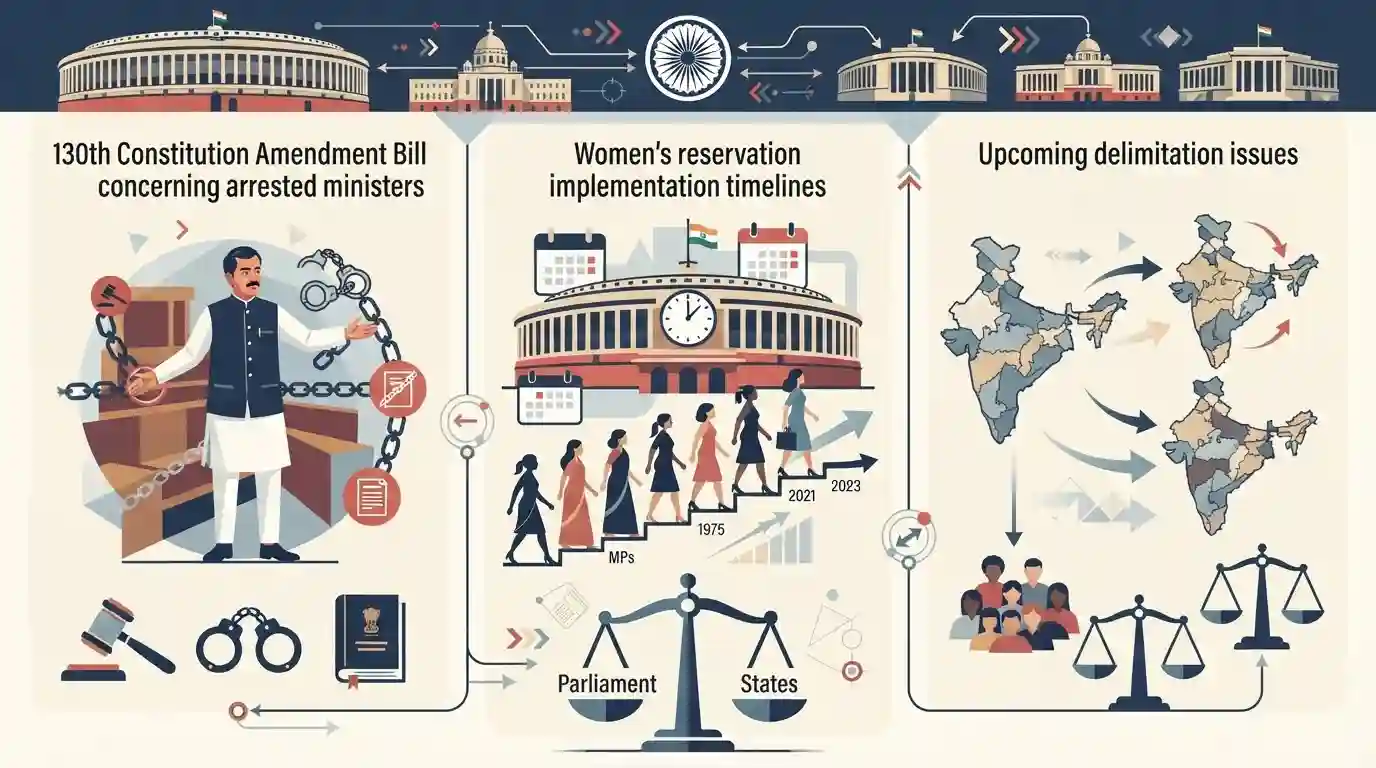
The article highlights major legislative proposals and parliamentary developments, including the 130th Constitution Amendment Bill concerning arrested ministers, women's reservation implementation timelines, and upcoming delimitation issues, which have significant implications for Indian federalism and parliamentary democracy.
Key Points
- The article discusses key legislative and political updates, including the proposed 130th Constitution Amendment Bill regarding arrested ministers, debates surrounding women's reservation, and delimitation.
- Constitutional amendments require rigorous checks under Article 368, maintaining the balance of powers and federal principles.
- Delimitation and women's reservation represent major structural reforms impacting representation and federal balance in Parliament.
Important Terms
130th Constitution Amendment Bill

A legislative proposal to amend Articles 75, 164, and 239AA of the Constitution to mandate the removal of arrested ministers and Chief Ministers detained for 30 consecutive days on serious charges.
UPSC context
Important for GS Paper II under Indian Polity (Parliament and State Legislatures, Constitutional Amendments, and Executive Accountability).
Women Reservation Act
Formally the 106th Constitution Amendment Act, 2023, it mandates a one-third reservation of seats for women in the Lok Sabha, state legislative assemblies, and the Delhi assembly.
UPSC context
Crucial for GS Paper II (Social Justice, Governance, and Women Empowerment initiatives).
Delimitation
The process of redrawing boundaries of parliamentary and assembly constituencies based on changing population figures to ensure equitable representation across states.
UPSC context
Relevant for GS Paper II (Indian Federalism, Representation of People Act, and Legislative Structure).
Prelims Trap
Constitutional amendment bills invariably lapse upon the dissolution of the Lok Sabha irrespective of the House in which they originated.
Aspirants often assume constitutional amendment bills automatically lapse upon the dissolution of the Lok Sabha. However, under Article 368 read with parliamentary rules, ordinary bills lapse upon Lok Sabha dissolution, but Constitution Amendment Bills do not lapse if they originate and pend in the Rajya Sabha, though Lok Sabha-origin bills do lapse when the Lok Sabha dissolves.
Static Concepts Connected
What is the procedural scope and limitation of the amending power under Article 368?
- Majorities Required: Two types of majorities are required: special majority under Article 368 (2/3rd present and voting + absolute majority) and ratification by half the state legislatures for federal provisions.
- Basic Structure Doctrine: Established by the Kesavananda Bharati case (1973), Parliament cannot alter the 'basic structure' of the Constitution even via a unanimous Article 368 amendment.
How does the constitutional mechanism of Delimitation operate in India?
- Statutory Commission: Carried out by an independent Delimitation Commission appointed under an Act of Parliament after every Census, though post-2001 allocation was frozen until 2026.
- Finality of Orders: Orders of the Delimitation Commission have the force of law and cannot be called in question in any court under Article 329.
Cross-Topic Patterns
Delimitation versus Southern Fiscal Federalism
Delimitation ties population-based seat allocation directly to fiscal federalism metrics like the Finance Commission's devolution criteria, creating a double penalty for performing states.
Women's Reservation meets Census Bottlenecks
The operational delay of the Nari Shakti Vandan Adhiniyam exposes the friction between progressive socio-political reforms and administrative prerequisite bottlenecks like census collection.

Delimitation + federal representation balance + Article 368 amending power will likely feature in a multi-statement Mains Q.
Linked PYQs · 3
Linked PYQs · 3
- 2025MainsGS2
Indian Constitution has conferred the amending power on the ordinary legislative institutions with a few procedural hurdles. In view of this statement, examine the procedural and substantive limitations on the amending power of the Parliament to change the Constitution.
- 2022MainsGS2
Discuss the procedures to decide the disputes arising out of the election of a Member of the Parliament or State Legislature under The Representation of the People Act, 1951. What are the grounds on which the election of any returned candidate may be declared void ? What remedy is available to the aggrieved party against the decision ? Refer to the case laws.
- 2024MainsGS2
What changes has the Union Government recently introduced in the domain of Centre-State relations ? Suggest measures to be adopted to build the trust between the Centre and the States and for strengthening federalism.
