Constitutional Amendment Bill on Arrested Ministers and Quotas
Source:Indian Express ↗
हे का महत्त्वाचे आहे
Understanding constitutional amendment bills, ethics of arrested ministers in office, women's reservation execution, and delimitation are central to Indian Polity and Governance (GS2).
सारांश
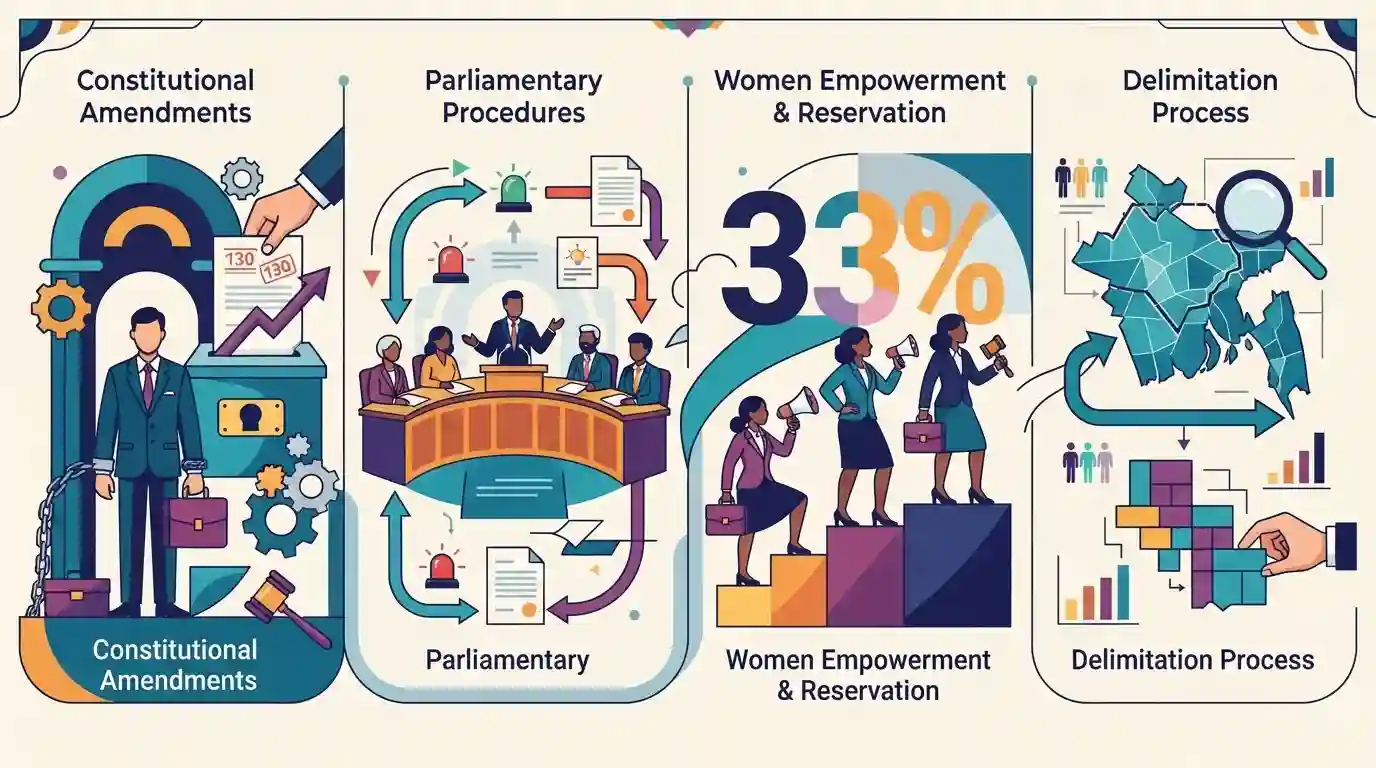
This article outlines major proposed or discussed parliamentary measures, such as the 130th Constitution Amendment Bill regarding arrested ministers, and touches upon critical governance themes including women's reservation and delimitation.
मुख्य मुद्दे
- The article discusses key legislative and political developments concerning constitutional amendments, including the 130th Constitution Amendment Bill proposal.
- It touches upon issues regarding arrested ministers holding office, the implementation timeline of the Women's Reservation Act, and upcoming delimitation exercises in Parliament.
- These legislative measures highlight ongoing debates on parliamentary democracy, ethics in governance, gender representation, and federal constituency restructuring in India.
महत्त्वाच्या संज्ञा
130th Constitution Amendment Bill

A proposed constitutional reform bill aiming to mandate the automatic removal or resignation of ministers and chief ministers if detained for 30 consecutive days under serious criminal charges.
UPSC context
GS Paper II: Polity & Governance – Constitutional amendments, executive accountability, and criminalization of politics.
Women's Reservation Act
A landmark constitutional amendment (106th Act) reserving one-third of seats for women in the Lok Sabha and State Legislative Assemblies, tied to future delimitation.
UPSC context
GS Paper I/II: Women empowerment, affirmative action, and inclusive legislative representation.
संबंधित स्थिर संकल्पना
What are the distinct procedures and majorities required for amending the Indian Constitution under Article 368?
- Special Majority: Special majority of total membership and a two-thirds majority of members present and voting is required in both Lok Sabha and Rajya Sabha independently.
- No Joint Sitting: No joint sitting is permitted under Article 368 if there is a deadlock between the two Houses of Parliament over a constitutional amendment bill.
- State Ratification: Ratification by at least half of the state legislatures by a simple majority is additionally required for specific federal provisions listed in the proviso to Article 368.
आंतर-विषय नमुने
Delimitation freezes vs. Nari Shakti Vandan implementation
The implementation of the Women's Reservation Act depends on the next Census and delimitation, directly tying federal seat adjustments to gender representation and inter-state power distribution.

Expect a multi-statement Prelims question on Article 368 procedures combined with the pre-conditions of the 106th Amendment Act.
संबंधित PYQ · 2
संबंधित PYQ · 2
- 2025MainsGS2
Indian Constitution has conferred the amending power on the ordinary legislative institutions with a few procedural hurdles. In view of this statement, examine the procedural and substantive limitations on the amending power of the Parliament to change the Constitution.
- 2020MainsGS2
Which steps are required for constitutionalization of a Commission ? Do you think imparting constitutionality to the National Commission for Women would ensure greater gender justice and empowerment in India? Give reasons.
