Constitution 130th Amendment Bill Shelved Amid Federalism Concerns
Source:Indian Express ↗
কেন এটি গুরুত্বপূর্ণ
This development highlights the ongoing legislative efforts and constitutional debates surrounding the criminalisation of politics and the principles of natural justice. It is highly relevant for GS2 (Polity and Governance) as it touches upon the disqualification of public representatives, the functioning of Joint Parliamentary Committees, federalism concerns raised by states, and upcoming major reforms like women's reservation and electoral delimitation.
সারসংক্ষেপ
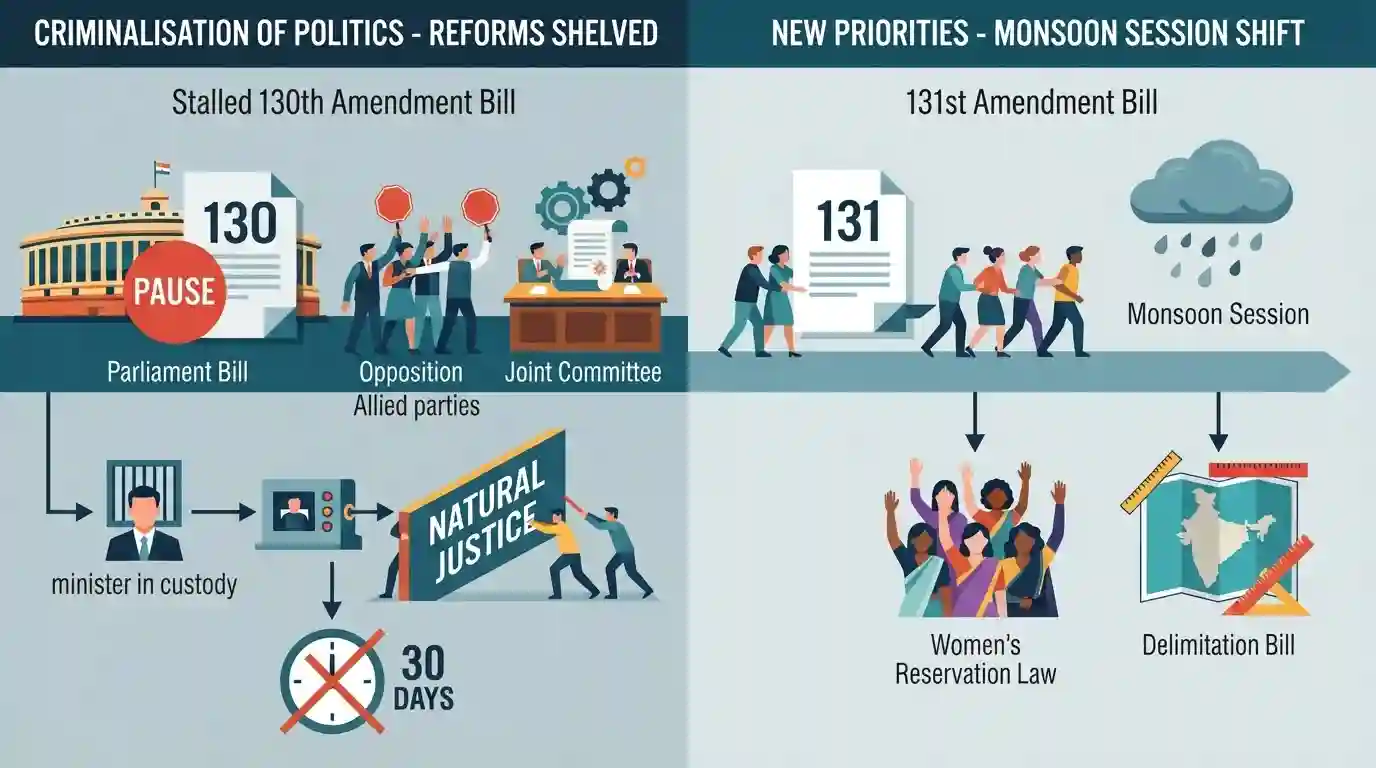
The Union government has temporarily shelved the Constitution (130th Amendment) Bill, 2025, which aimed to enforce the automatic removal of ministers placed in judicial custody for 30 consecutive days. The Joint Committee of Parliament examining the draft law deferred its report after facing significant pushback from Opposition parties and allies who argued the legislation violates natural justice by punishing representatives prior to conviction. The government has shifted its focus to prioritizing the Constitution (131st Amendment) Bill in the upcoming Monsoon Session to enact the Women’s Reservation law and the Delimitation Bill.
মূল বিষয়
- The government has put the Constitution (130th Amendment) Bill, 2025, which seeks to remove 'tainted' ministers, on the backburner.
- The proposed 130th Amendment mandates that a Union or State minister detained in custody for serious offences for 30 consecutive days would be automatically removed on the 31st day.
- The Joint Committee of Parliament deferred adopting its report on the Bill to allow for wider consultation following concerns from Opposition parties and NDA allies.
- Critics argue the 130th Amendment is anti-federal, undemocratic, and violates natural justice by penalizing public representatives based on custody rather than a legal conviction.
- The government's immediate legislative priority is securing a two-thirds majority in the Monsoon Session for the Constitution (131st Amendment) Bill, which covers Women's Reservation and Delimitation.
গুরুত্বপূর্ণ শব্দ
Constitution (130th Amendment) Bill, 2025

A legislative proposal seeking the mandatory removal or resignation of Ministers, Chief Ministers, and the Prime Minister if they are held in custody for 30 consecutive days for serious offences.
UPSC context
GS Paper II (Polity); tests executive accountability, separation of powers, and criminalisation of politics.
Constitution (131st Amendment) Bill
A proposed constitutional amendment seeking to expand Lok Sabha seats, lift frozen delimitation parameters, and fast-track women's legislative reservation by using the 2011 Census.
UPSC context
GS Paper II (Elections & Representation); tests federal balance, delimitation processes, and seat reallocation.
Women's Reservation law
Formally enacted as the Constitution (106th Amendment) Act, 2023, it mandates reserving one-third of all seats in the Lok Sabha and State Assemblies for women.
UPSC context
GS Paper I & II (Social Justice & Polity); tests political empowerment and inclusive governance.
Delimitation Bill
A legislative bill introduced alongside constitutional changes to restructure constituency boundaries, reallocate parliamentary seats proportionally, and determine the census framework for representation.
UPSC context
GS Paper II (Elections & Federalism); tests voter representation and federal-state dynamics.
প্রিলিমস ফাঁদ
An MP or MLA stands automatically disqualified from the legislature upon being remanded to judicial custody for more than 30 days.
Under Section 8 of the RPA 1951, disqualification is triggered only by final conviction (typically with a minimum 2-year sentence), not by mere arrest, judicial custody, or framing of charges.
সংযুক্ত স্থির ধারণা
What are the key grounds for disqualifying legislators under Indian law?
- Constitutional provisions: Articles 102(1) and 191(1) disqualify MPs and MLAs for holding offices of profit, unsound mind, insolvency, or acquiring foreign citizenship.
- Statutory framework: Section 8 of the Representation of the People Act, 1951 disqualifies representatives only upon conviction, requiring at least a two-year prison sentence.
- Custody exception: Neither the Constitution nor the RPA mandates disqualification based on arrest, judicial custody, or the framing of criminal charges alone.
What is a Joint Parliamentary Committee and how is it formed?
- Ad-hoc character: A JPC is an ad-hoc, temporary committee set up for a specific bill or inquiry, dissolving after presenting its report.
- Membership ratio: It comprises members from both Houses of Parliament, maintaining a 2:1 ratio of Lok Sabha to Rajya Sabha representation.
- Establishment process: Created through a motion passed in one House and concurred by the other, or jointly by the Presiding Officers of both Houses.
আন্তঃবিষয় প্যাটার্ন
Separation of powers and judicial restraint
In Public Interest Foundation (2018), the Supreme Court refused to disqualify charge-sheeted politicians, preserving Parliament's exclusive domain to amend candidate qualifications under the separation of powers doctrine.
Federalism & misuse of central agencies
Opposition parties argue that automatic removal of state ministers upon arrest compromises federalism by enabling central investigative agencies to destabilize elected state governments.

Mains 2026 will likely evaluate the constitutional feasibility of penalizing legislators pre-conviction versus protecting presumption of innocence.
সংযুক্ত PYQ · 5
সংযুক্ত PYQ · 5
- 2020MainsGS2
There is a need for simplification of procedure for disqualification of persons found guilty of corrupt practices under the Representation of Peoples Act". Comment.
- 2019MainsGS2
On what grounds a people's representative can be disqualified under the Representation of Peoples Act, 1951? Also mention the remedies available to such person against his disqualification.
- 2021MainsGS2
Do Department-related Parliamentary Standing Committees keep the administration on its toes and inspire reverence for parliamentary control? Evaluate the working of such committees with suitable examples.
- 2023MainsGS2
Explain the structure of the Parliamentary Committee system. How far have the financial committees helped in the institutionalisation of Indian Parliament?
- 2023MainsGS2
Discuss the contribution of civil society groups for women's effective and meaningful participation and representation in state legislatures in India.
