Drug Pricing and Judicial Intervention in Public Health Policy
Source:The Hindu ↗
কেন এটি গুরুত্বপূর্ণ
It addresses core issues of public health governance, affordability of medicines, and the scope of judicial intervention in executive policy domains like drug pricing.
সারসংক্ষেপ
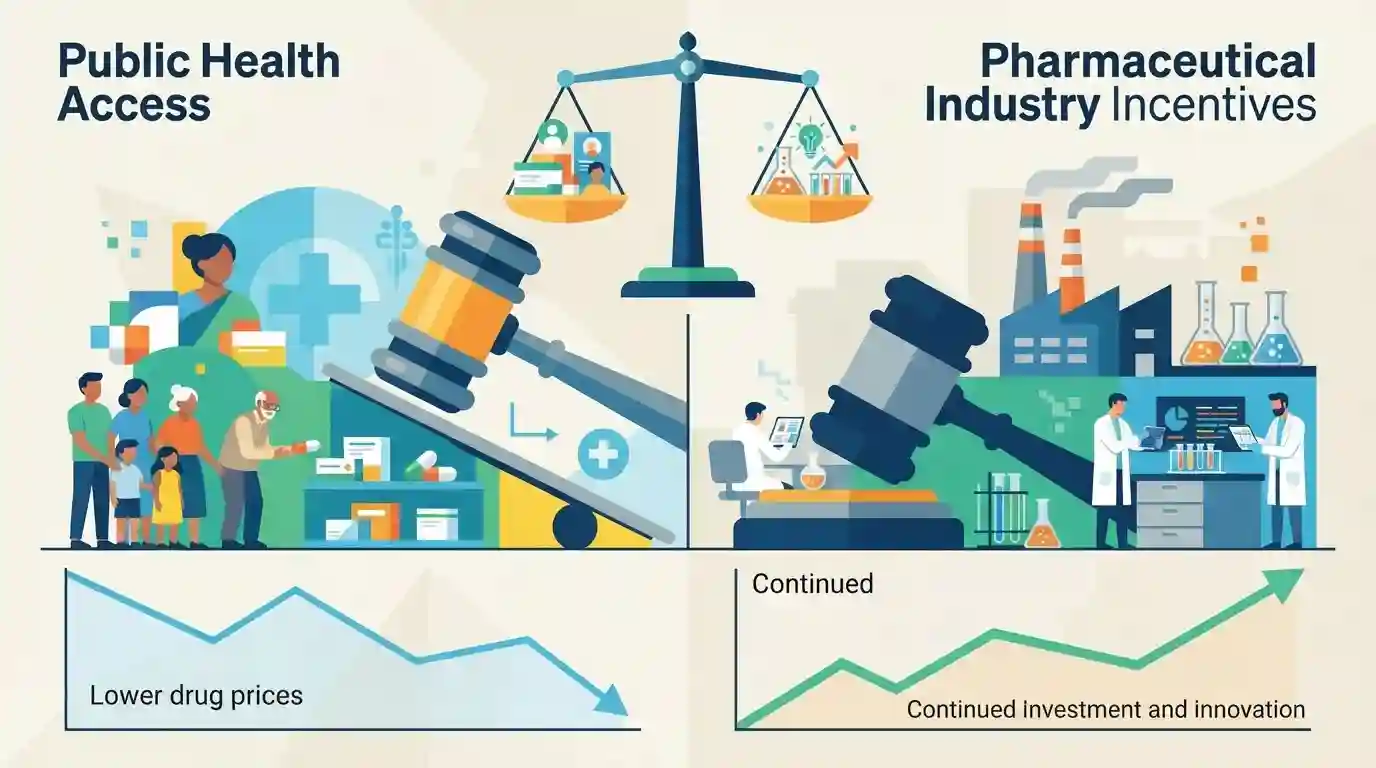
The article discusses judicial interventions concerning drug pricing in India, analyzing the delicate balance between making essential medicines affordable for the public and maintaining incentives for the pharmaceutical industry.
মূল বিষয়
- Judicial intervention in drug pricing highlights the tension between affordable public healthcare and pharmaceutical industry incentives.
- Regulation of essential medicines requires balancing cost capping with ensuring continuous drug availability and innovation.
- Affordability of drugs is a critical component of the Right to Health under Article 21 of the Constitution.
গুরুত্বপূর্ণ শব্দ
Drugs Prices Control Order

An order issued by the central government under the Essential Commodities Act, 1955, empowering the state to regulate prices of essential medicines and ensure public availability.
UPSC context
GS Paper II (Health, Welfare Schemes) and GS Paper III (Economy). Tests understanding of regulatory frameworks governing public health and commodity pricing.
Essential Medicines List
A curated list of medications compiled by the Ministry of Health and Family Welfare that satisfy the priority healthcare needs of the population.
UPSC context
GS Paper II (Social Sector/Health). Tests policy mechanisms used by the government to ensure drug affordability and universal healthcare access.
National Pharmaceutical Pricing Authority
An independent regulatory body established under the Ministry of Chemicals and Fertilizers to fix, revise, and monitor prices of scheduled drugs and enforce price controls in India.
UPSC context
GS Paper II & III. Tests knowledge of regulatory institutions, statutory bodies, and governance of the pharmaceutical sector.
Supreme Court of India
The apex judicial court of India that interprets constitutional rights, including the Right to Life encompassing health, and intervenes in policy matters regarding drug pricing.
UPSC context
GS Paper II (Indian Constitution, Judiciary, Judicial Activism). Tests understanding of judicial intervention in executive policy domains like public health.
সংযুক্ত স্থির ধারণা
What is the statutory backing and mechanism of drug price control in India?
- NPPA Role: Enforced by the National Pharmaceutical Pricing Authority (NPPA) under the Department of Pharmaceuticals.
- Legal Backing: Promulgated under Section 3 of the Essential Commodities Act, 1955.
- NLEM Linkage: Regulates ceiling prices of scheduled formulations listed in the National List of Essential Medicines (NLEM).
আন্তঃবিষয় প্যাটার্ন
Right to Health + Judicial Activism
Judicial expansion of Article 21 to include healthcare and drug pricing mirrors environmental jurisprudence where the judiciary stepped in due to executive inaction.

NPPA powers under DPCO and the Essential Commodities Act, 1955 are high-yield for matching-based prelims questions.
সংযুক্ত PYQ · 2
সংযুক্ত PYQ · 2
- 2024MainsGS2
In a crucial domain like the public healthcare system the Indian State should play a vital role to contain the adverse impact of marketisation of the system. Suggest some measures through which the State can enhance the reach of public healthcare at the grassroots level.
- 2024MainsGS3
What is the present world scenario of intellectual property rights with respect to life materials? Although, India is second in the world to file patents, still only a few have been commercialized. Explain the reasons behind this less commercialization.
