Himachal Apple Crisis Structural Bottlenecks and Policy Gaps
Source:tribuneindia ↗
Why It Matters
Apples are the backbone of Himachal Pradesh's horticultural economy and rural livelihoods. Analyzing the crisis provides crucial insights into state-specific agricultural economics, supply chain vulnerabilities, and policy interventions relevant for HPAS aspirants.
Summary
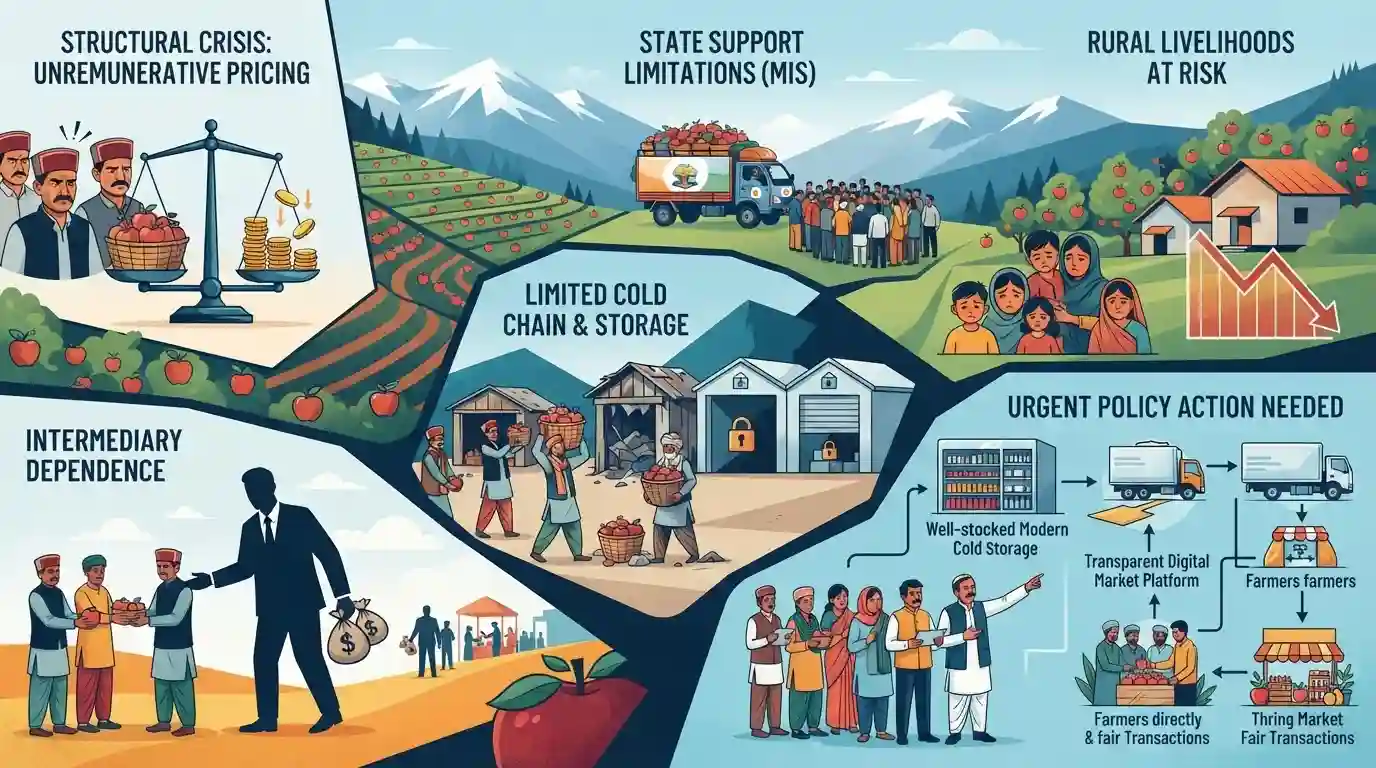
The editorial highlights the severe crisis confronting Himachal Pradesh's apple industry, emphasizing deep-rooted structural problems such as unremunerative pricing, lack of adequate storage and cold chain infrastructure, heavy reliance on intermediaries, and the limitations of existing state support mechanisms like the Market Intervention Scheme (MIS). Urgent policy action is demanded to safeguard apple growers and stabilize the state's horticultural economy.
Key Points
- Himachal Pradesh's apple industry faces a severe crisis characterized by marketing challenges, low returns, and structural bottlenecks.
- Key issues include inadequate cold storage facilities, market exploitation by middlemen, high packaging costs, and policy gaps in support schemes like the Market Intervention Scheme (MIS).
- The crisis threatens the livelihood of a massive section of Himachal's rural population dependent on horticulture and the primary sector.
Important Terms
Market Intervention Scheme (MIS)

A central-state scheme providing a price safety net to horticultural growers during market gluts by procuring non-perishable and horticultural commodities not covered under MSP.
UPSC context
HPAS Mains GS Paper-3 (Economy and Agriculture of HP): Tests understanding of state support mechanisms, agricultural marketing, and horticulture crisis management.
Prelims Trap
Market Intervention Scheme guarantees fixed statutory minimum support prices for all apples produced in Himachal Pradesh.
Aspirants often confuse the Market Intervention Scheme (MIS) as a statutory price-guarantee mechanism for all horticultural crops rather than a flexible price support scheme implemented on state request during glut years.
Static Concepts Connected
What are the objectives and operational framework of the Market Intervention Scheme (MIS) in India?
- Primary Objective: Price support for horticultural and agricultural commodities that are perishable and not covered under the Minimum Support Price (MSP) regime.
- State Request: Implemented on the specific request of state governments when prices crash due to bumper production or market gluts.
- Cost Sharing: Losses incurred under MIS are shared on a predetermined cost-sharing basis between the central government and the concerned state government.
Cross-Topic Patterns
Horticulture distress and cooperative banking NPAs
Apple pricing crises directly affect rural credit repayment rates and non-performing assets (NPAs) of cooperative banks across the hill state.
Apple marketing vs national APMC reforms
The structural dependence on intermediaries in horticulture mirrors systemic APMC reform debates at the national level.

Horticulture economy + MIS operational bottlenecks is a prime candidate for HPAS Mains GS Paper 3 (Himachal Economy).
Linked PYQs · 3
Linked PYQs · 3
- 2024HPAS_PRELIMSGS1
What percent agriculture and its allied industries account for the total Gross State Value Added (GSVA) of Himachal Pradesh ?
- 2025HPAS_PRELIMSGS1
Read the following statements : Statement I : Share of agriculture in total GSDP of Himachal Pradesh has declined from about 75 percent in 1950-51 to little above 20 percent in 2023-24. Statement II : As per economic survey 2024-25 of the state, however, in terms of employment still 54 percent of the state population is engaged in primary sector. In the light of the above statements, choose the most appropriate answer from the options given below :
- 2023HPAS_PRELIMSGS1
Consider the following statements : (1) Himachal Pradesh was ranked 18th out of 36 States/UTs/Cities in Export Preparedness Index 2021. (2) Lahaul-Spiti is at the bottom of the rankings in District Good Governance Index 2021. (3) Banks have sanctioned Rs. 63.46 crore to 476 new enterprises under Stand Up India scheme during this financial year 2022-23. (4) Banks have funded 44,398 farmers through Kisan Credit Cards during 2022-23. Choose the correct answer from the options given below :
