Cryptocurrency market decline amid US China trade war escalation
Source:The Hindu ↗
Why It Matters
The episode demonstrates the cascading impact of great power competition (US vs China) and the weaponization of supply chains (tariffs and rare earth export controls) on global economic stability. It highlights the strategic vulnerability of nations relying on concentrated supply chains for critical tech minerals, an important theme for India's own strategic autonomy and industrial policy.
Summary
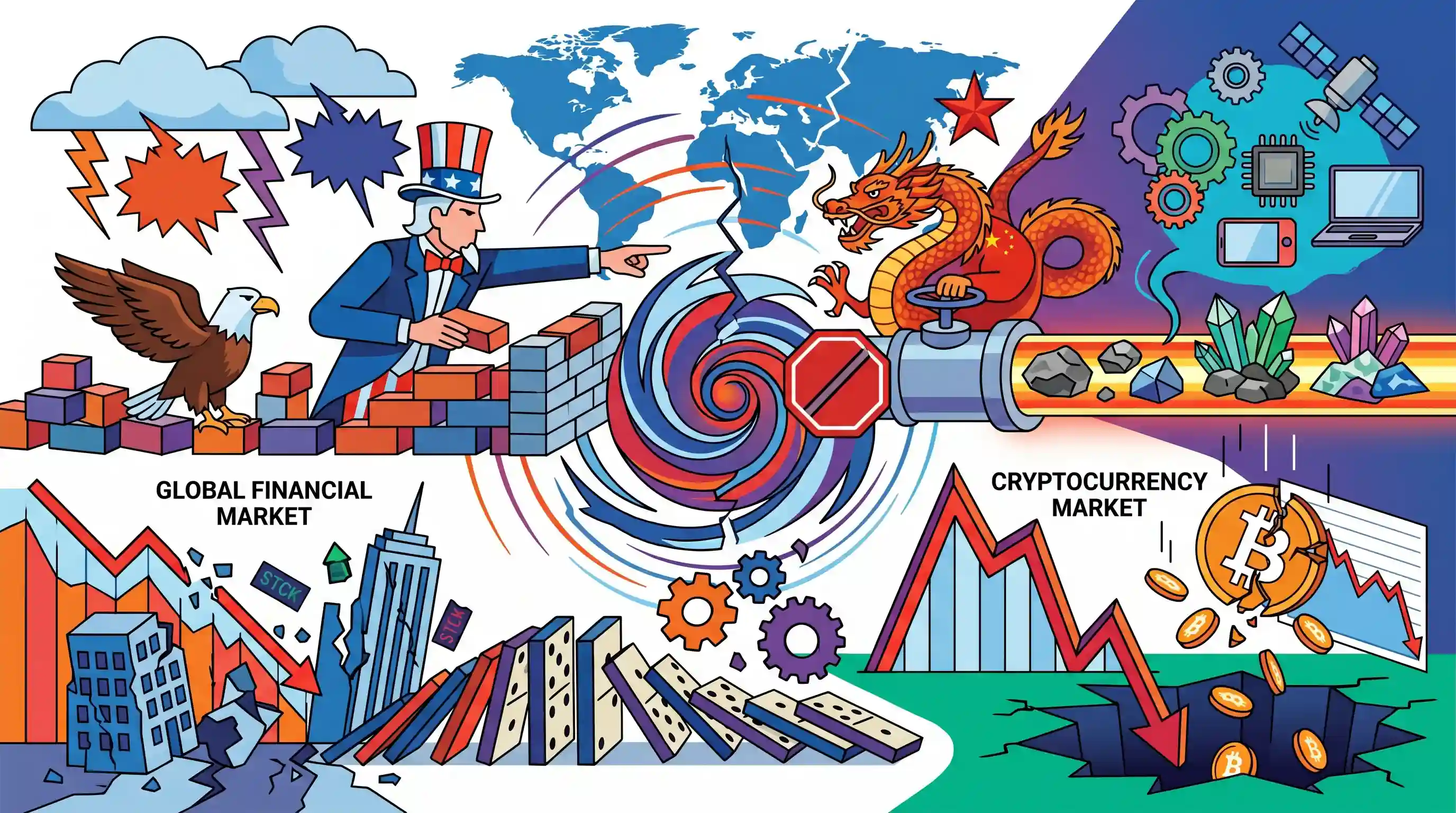
Global cryptocurrency markets and traditional equities took a sharp hit as US President Donald Trump escalated the trade war with China. Trump's threats of 100% tariffs and blanket bans on critical software exports were issued in direct response to China's recent export restrictions on rare earth minerals, foundational resources for advanced technology sectors globally. The geopolitical friction triggered an over 8% slump in Bitcoin and broad declines in indices like the S&P 500, highlighting the profound interconnectedness of global trade policies, strategic resource controls, and financial market volatility.
Key Points
- Bitcoin and Ethereum prices plummeted following US President Donald Trump's escalation of the trade conflict with China.
- Trump threatened 100% tariffs on Chinese exports to the US and strict export controls on critical software.
- The US actions were framed as retaliation against China's recent export limits on rare earth minerals, which are essential for global technology manufacturing.
- The geopolitical tension triggered widespread sell-offs across global financial markets, including a sharp decline in the S&P 500 Index.
Important Terms
Critical Minerals

Minerals essential for economic development and national security, characterized by supply chains vulnerable to disruption due to high geographical concentration.
UPSC context
GS Paper 3 (Economy/Security). Vital for India's "Critical Minerals Mission" and green energy transition.
Rare Earth Elements (REE)
A group of 17 chemical elements (lanthanides, scandium, yttrium) essential for high-tech applications like smartphones, wind turbines, and advanced defense systems.
UPSC context
GS Paper 1 (Distribution of Resources). Focuses on global monopolies (China) and strategic resource security.
Trade War
An economic conflict where nations impose reciprocal trade barriers, such as tariffs and export bans, to protect domestic interests or retaliate against foreign policies.
UPSC context
GS Paper 2 (International Relations). Tests knowledge of US-China dynamics and their impact on global trade stability.
Protectionism
Economic policies, such as tariffs and quotas, designed to restrict international trade to support domestic industries and reduce foreign competition.
UPSC context
GS Paper 3 (Economy). Analyzes the shift from globalization to economic nationalism and its impact on India.
Tariff
Taxes or duties levied by a government on imported goods, used to make foreign products more expensive and protect domestic manufacturers.
UPSC context
GS Paper 3 (Economy). Relevant for trade deficit analysis and understanding international trade barriers.
Cryptocurrency
Decentralized digital assets using cryptography for secure transactions, typically operating on blockchain technology without oversight from a central banking authority.
UPSC context
GS Paper 3 (Science & Tech/Economy). Relevant for discussing digital economy regulation and financial system stability.
Prelims Trap
Cryptocurrencies are safe-haven assets that remain immune to global macroeconomic shocks and geopolitical trade wars.
Cryptocurrencies actually behave like high-risk equities. During geopolitical crises or trade wars, they exhibit extreme volatility and tend to crash alongside traditional stock indices.
Static Concepts Connected
What are Rare Earth Elements (REEs) and their strategic significance?
- Composition: A set of 17 metallic elements comprising 15 lanthanides, plus scandium and yttrium.
- Strategic Use: Vital for manufacturing permanent magnets, EV motors, semiconductors, wind turbines, and advanced defense systems.
- Global Dominance: China controls the vast majority of global rare earth processing and refining capacity, utilizing export limits as geopolitical leverage.
How do unilateral tariff hikes differ from WTO trade remedies?
- Unilateral Tariffs: Imposing arbitrary retaliatory tariffs violates the WTO's core Most-Favored-Nation (MFN) principle and bound tariff limits.
- WTO Remedies: The WTO only permits Anti-dumping, Countervailing (anti-subsidy), and Safeguard duties following formal, evidence-based domestic injury investigations.
Cross-Topic Patterns
Tech decoupling + Mineral security
The US-China rivalry links intangible software export controls with tangible critical mineral blockades, accelerating India's push for supply chain resilience via the Quad and the Critical Minerals Mission.
Crypto's correlation with traditional equities
The synchronized plunge of Bitcoin and the S&P 500 exposes the flaw in the 'digital gold' narrative, proving crypto's severe vulnerability to macroeconomic shocks and trade policy shifts.

Expect a 2026 multi-statement question linking China's rare earth monopoly, global tech decoupling, and WTO tariff rules.
Linked PYQs · 4
Linked PYQs · 4
- 2012PrelimsGS1
Recently, there has been a concern over the short supply of a group of elements called 'rare earth metals'. Why? 1. China, which is the largest producer of these elements, has imposed some restrictions on their export. 2. Other than China, Australia, Canada and Chile, these elements are not found in any country. 3. Rare earth metals are essential for the manufacture of various kinds of electronic items and there is a growing demand for these elements. Which of the statements given above is/are correct?
- 2025PrelimsGS1
Consider the following statements : Statement I: Some rare earth elements are used in the manufacture of flat television screens and computer monitors. Statement II : Some rare earth elements have phosphorescent properties. Which one of the following is correct in respect of the above statements?
- 2018MainsGS2
What are the key areas of reform if the WTO has to survive in the present context of "Trade War', especially keeping in mind the interest of India?
- 2021MainsGS2
“The USA is facing an existential threat in the form of a China, that is much more challenging than the erstwhile Soviet Union.” Explain.
