Registration of Births and Deaths Amendment Bill and Civil System
Source:The Hindu ↗
কেন এটি গুরুত্বপূর্ণ
The article underscores critical developments in GS2 Polity: the persistent trend of passing legislation without parliamentary debate due to disruptions, the tightening of India's demographic and civil registration mechanisms, and a significant proposed constitutional amendment aimed at curbing the criminalisation of politics by enforcing strict accountability on serving ministers facing serious criminal charges.
সারসংক্ষেপ
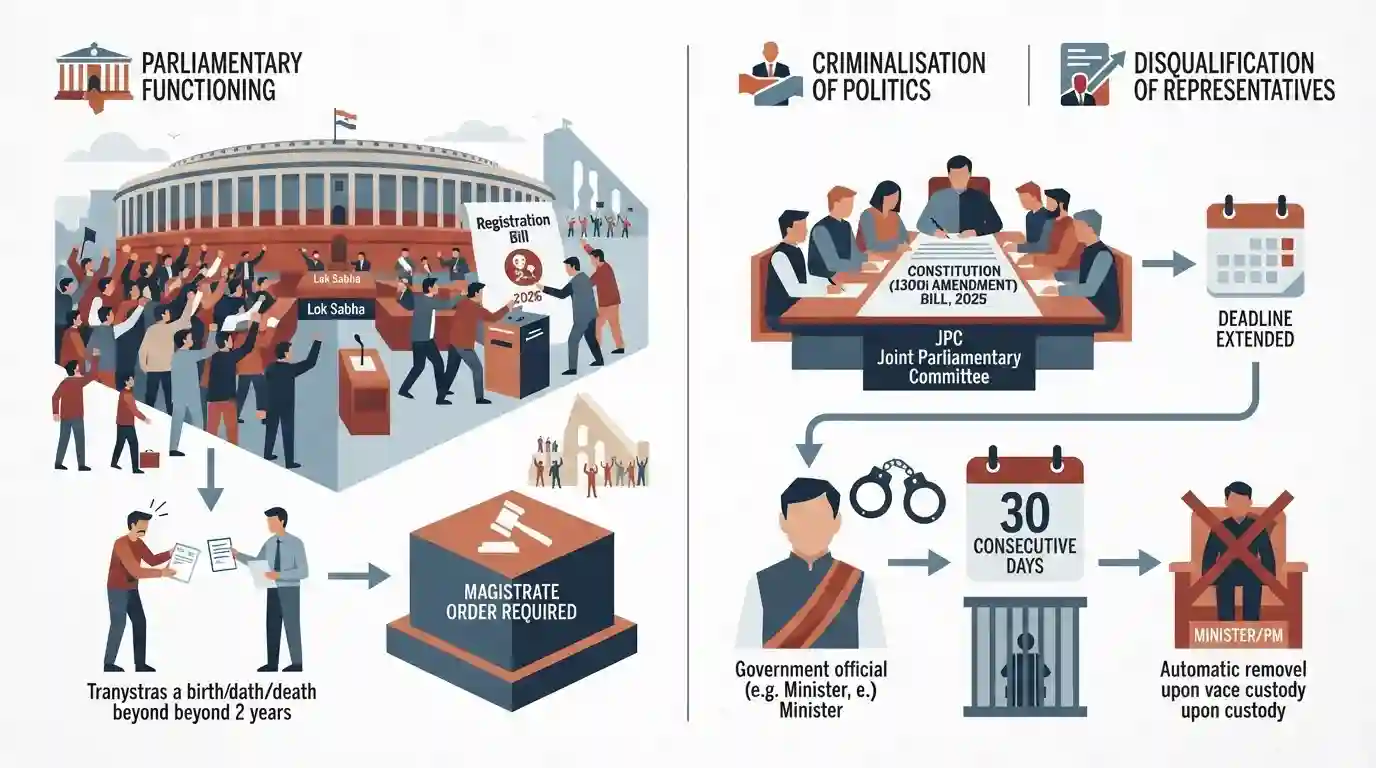
The Lok Sabha passed the Registration of Births and Deaths (Amendment) Bill, 2026, without debate amidst significant Opposition protests concerning a police crackdown on students at Jantar Mantar. The Bill tightens the Civil Registration System by requiring a judicial magistrate (first class) order for birth and death registrations delayed beyond two years. In parallel parliamentary developments, the Joint Parliamentary Committee examining the Constitution (130th Amendment) Bill, 2025, received a deadline extension. This crucial constitutional amendment proposes the automatic removal of any Union or State Minister, including Chief Ministers and the Prime Minister, if they are arrested and held in custody for 30 consecutive days on serious criminal charges (carrying a five-year minimum jail term).
মূল বিষয়
- The Registration of Births and Deaths (Amendment) Bill, 2026 was passed in the Lok Sabha via a voice vote without debate amid Opposition protests over police action against student protesters.
- The Bill makes delayed registration of births and deaths more stringent, mandating an order from a judicial magistrate (first class) for any registration delayed by more than two years.
- The Joint Parliamentary Committee (JPC) reviewing the Constitution (130th Amendment) Bill, 2025, has been granted an extension to submit its report during the upcoming Winter Session.
- The 130th Amendment proposes the automatic removal of any Union or State Minister, Chief Minister, or Prime Minister who is arrested and detained in custody for 30 consecutive days on serious criminal charges carrying a jail term of five years or more.
গুরুত্বপূর্ণ শব্দ
Registration of Births and Deaths (Amendment) Bill, 2026

A legislative proposal that amends the 1969 Act, introducing a stricter two-tier approval structure for delayed registrations and requiring a judicial magistrate's order for reporting delayed beyond two years.
UPSC context
GS Paper II: Governance. Tests knowledge of citizen services, administrative reforms, and the legislative shift from executive to judicial oversight.
Constitution (130th Amendment) Bill, 2025
A constitutional amendment bill proposing the automatic removal of the Prime Minister, Chief Ministers, and other ministers if they are arrested and held in custody for 30 consecutive days on serious criminal charges.
UPSC context
GS Paper II: Polity. Tests understanding of executive accountability, basic structure doctrine, separation of powers, and the decriminalization of Indian politics.
Civil Registration System (CRS)
A continuous, compulsory, and permanent mechanism in India under the Registration of Births and Deaths Act, 1969, for recording vital events like births, deaths, and stillbirths.
UPSC context
GS Paper II: Social Justice & Governance. Tests knowledge of demographic data collection, welfare targeting, and human development indicators.
Joint Parliamentary Committee (JPC)
An ad-hoc committee of Indian parliamentarians drawn from both the Lok Sabha and Rajya Sabha, set up to conduct detailed scrutiny of specific bills, financial discrepancies, or issues of public importance.
UPSC context
GS Paper II: Parliament. Tests understanding of legislative processes, parliamentary oversight, committee systems, and executive accountability mechanisms.
Criminalisation of Politics
The entry and growing influence of individuals with criminal backgrounds, charges, or convictions in the electoral process, legislature, and executive decision-making bodies.
UPSC context
GS Paper II: Electoral Reforms. Tests candidate knowledge of parliamentary integrity, the Representation of the People Act, 1951, and electoral cleaning efforts.
প্রিলিমস ফাঁদ
"The 130th Constitutional Amendment proposes automatic disqualification of MPs/MLAs from Parliament if detained for 30 days."
The bill targets removal from Executive office (Ministers/CM/PM) under Articles 75/164, not stripping legislative membership (which still requires conviction under the RPA 1951).
সংযুক্ত স্থির ধারণা
What is a Joint Parliamentary Committee (JPC) and its mandate?
- Formation (Ad-hoc): Created via a motion adopted by one House and agreed to by the other to examine complex bills or investigate controversies.
- Composition: Members are drawn from both Lok Sabha and Rajya Sabha, typically in a 2:1 ratio (twice as many from LS).
- Advisory Powers: Has broad powers to summon witnesses, but its final recommendations are advisory and not binding on the executive.
How do disqualification norms currently differ for Ministers vs ordinary legislators?
- MPs/MLAs (RPA 1951): Disqualified upon conviction (not mere arrest/custody) for specific offenses, or if sentenced to 2+ years imprisonment.
- Ministers (Art 75/164): Currently face no separate criminal disqualification; they must simply be (or become within 6 months) a member of the legislature.
- 91st Amendment: Any member disqualified under the 10th Schedule (defection) is also automatically barred from being appointed a Minister.
আন্তঃবিষয় প্যাটার্ন
Executive removal vs Federalism
Giving central investigative agencies the power to unseat State Chief Ministers merely via prolonged pre-trial custody raises deep federalism and basic structure concerns regarding the presumption of innocence.
Civil Registration & Vulnerable Groups
Birth certificates are now the sole proof for voting and Aadhaar. Shifting delayed registration to Judicial Magistrates increases friction for undocumented vulnerable groups, intersecting with citizenship debates.

Expect a 2026 Prelims question contrasting MP disqualification (RPA 1951) with Ministerial removal, testing the conviction vs arrest rule.
সংযুক্ত PYQ · 3
সংযুক্ত PYQ · 3
- 2020MainsGS2
There is a need for simplification of procedure for disqualification of persons found guilty of corrupt practices under the Representation of Peoples Act". Comment.
- 2019MainsGS2
Individual Parliamentarian's role as the national law maker is on a decline, which in turn, has adversely impacted the quality of debates and their outcome. Discuss.
- 2022MainsGS2
Discuss the procedures to decide the disputes arising out of the election of a Member of the Parliament or State Legislature under The Representation of the People Act, 1951. What are the grounds on which the election of any returned candidate may be declared void ? What remedy is available to the aggrieved party against the decision ? Refer to the case laws.
