Great Indian Bustard Conservation and Transmission Infrastructure
Source:The Hindu ↗
हे का महत्त्वाचे आहे
Critically endangered species conservation, balancing renewable energy infrastructure development with wildlife protection, and habitat preservation are recurrent and vital themes in UPSC GS Paper 3.
सारांश
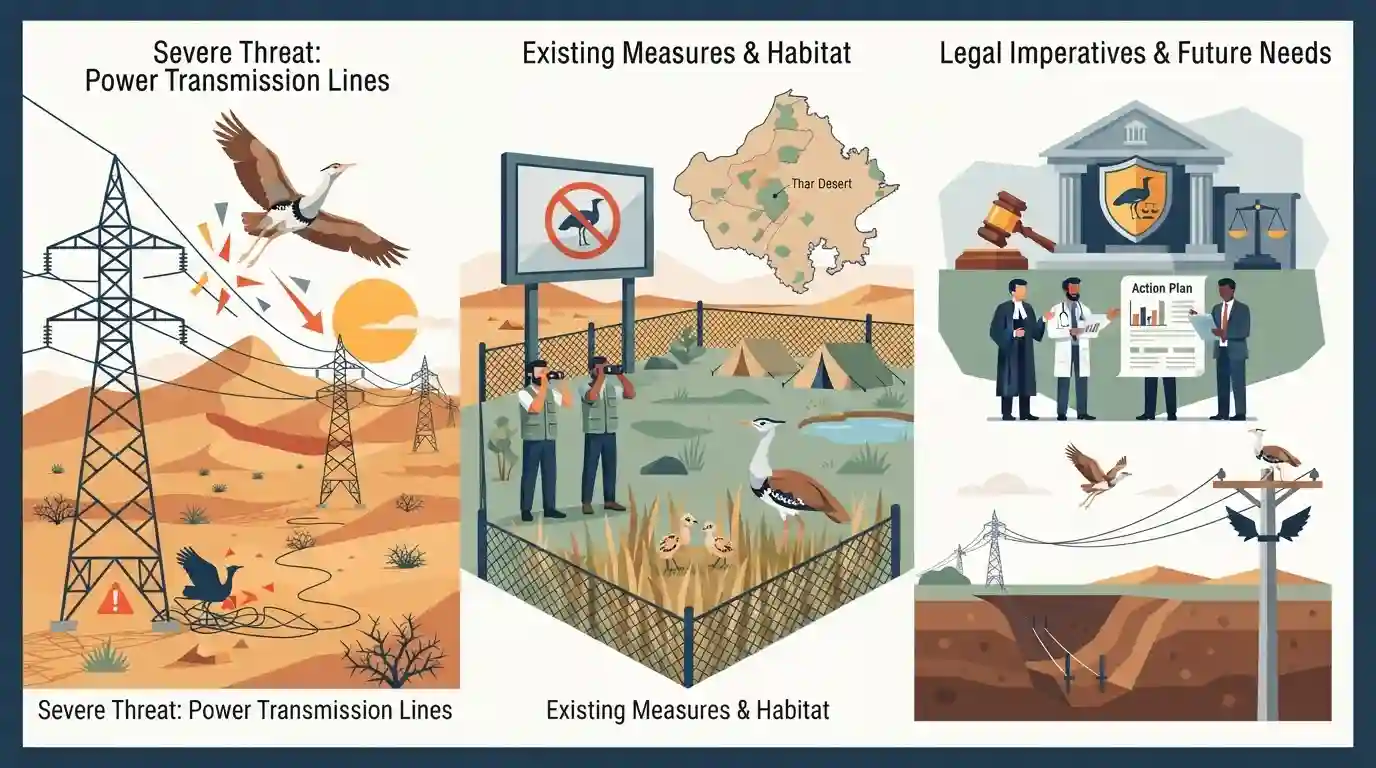
The article discusses India's conservation strategies for the Great Indian Bustard, examining the efficacy of existing measures, the severe threat posed by power transmission lines in arid habitats like Rajasthan, and the legal and ecological imperatives needed to save the species from extinction.
मुख्य मुद्दे
- The editorial analyzes India's bustard conservation programme, focusing on the grave threats facing the critically endangered Great Indian Bustard (GIB).
- Major threats include habitat loss, grassland degradation, and deadly collisions with high-voltage overhead power transmission lines.
- Conservation efforts require balancing infrastructural development (such as renewable energy transmission lines) with wildlife protection, including undergrounding power cables in critical habitats.
- Captive breeding programs and habitat protection remain critical for preventing the extinction of India's flagship grassland species.
महत्त्वाच्या संज्ञा
International Union for Conservation of Nature (IUCN)

An independent global authority that evaluates the conservation status of plant and animal species worldwide, classifying them into categories like Vulnerable, Endangered, and Critically Endangered to guide international conservation priorities.
UPSC context
GS Paper III (Environment & Ecology); frequently tested for species categorization and red list updates regarding endangered Indian wildlife.
Wildlife Protection Act
The principal Indian legislation enacted in 1972 to provide legal protection to wild animals, birds, and plants, organizing species into schedules based on the level of protection afforded to them.
UPSC context
GS Paper III (Environment & Biodiversity); questions frequently examine schedule classifications, wildlife crimes, and statutory bodies under the Act.
Supreme Court of India
The highest constitutional court of India, which plays a pivotal role in environmental jurisprudence by issuing binding directives, balancing renewable energy goals with wildlife preservation.
UPSC context
GS Paper II & III (Polity/Environment); tests judicial activism, public interest litigation (PIL), and landmark rulings on wildlife corridors and climate mitigation.
पूर्वपरीक्षा सापळा
Captive breeding programs alone are sufficient to ensure the recovery of the Great Indian Bustard in its natural habitat.
Aspirants often assume captive breeding alone can save a critically endangered species, overlooking that habitat loss and lethal overhead power lines render reintroduction ineffective without mitigation.
संबंधित स्थिर संकल्पना
What are the key provisions and protection mechanisms for the Great Indian Bustard under Indian and international law?
- IUCN Status: IUCN Status: Listed as Critically Endangered on the IUCN Red List, facing an extremely high risk of extinction in the wild.
- Legal Protection: Legal Protection: Accorded the highest level of legal protection under Schedule I of the Wildlife (Protection) Act, 1972.
- Habitat Range: Habitat Range: Primarily restricted to the Thar Desert in Rajasthan, with minor populations in Gujarat, Andhra Pradesh, Karnataka, and Maharashtra.
- Key Threats: Key Threats: High-voltage overhead power transmission lines causing fatal collisions, alongside grassland degradation and agricultural expansion.
आंतर-विषय नमुने
Renewable Energy vs. Grassland Conservation
Rapid push for solar and wind installations in arid landscapes clashes with fragile grassland ecosystems, testing India's green transition goals against wildlife conservation imperatives.
Judicial Activism in Environmental Governance
Judicial intervention through expert committees and binding directions on infrastructure illustrates the judiciary's expanding role in resolving complex ecological deadlocks.

GIB powerline collisions, IUCN status, and Supreme Court's priority area mandates are prime candidates for a multi-statement prelims question.
संबंधित PYQ · 3
संबंधित PYQ · 3
- 2012PrelimsGS1
Which one of the following groups of animals belongs to the category of endangered species?
- 2025PrelimsGS1
Regarding Peacock tarantula (Gooty tarantula), consider the following statements : I. It is an omnivorous crustacean. II. Its natural habitat in India is only limited to some forest areas. III. In its natural habitat, it is an arboreal species. Which of the statements given above is/are correct?
- 2026PrelimsGS1
With respect to the Western Hoolock Gibbons, which of the following statements is/are correct? 1. A Sanctuary in North-east India is home to this ape species listed as Endangered in the International Union for Conservation of Nature (IUCN) Red List. 2. They have specialized brachiation and can easily swing between trees. 3. They possess a strong and heavy build like gorillas, yet are remarkably agile tree climbers. Select the answer using the code given below :
