Great Indian Bustard Conservation and Landscape Management Policy
Source:The Hindu ↗
આ શા માટે મહત્વનું છે
It provides a critical evaluation of India's wildlife conservation framework, balancing species-specific recovery programs (like captive breeding of the Great Indian Bustard) against the wider need for landscape-level conservation and conflict mitigation.
સારાંશ
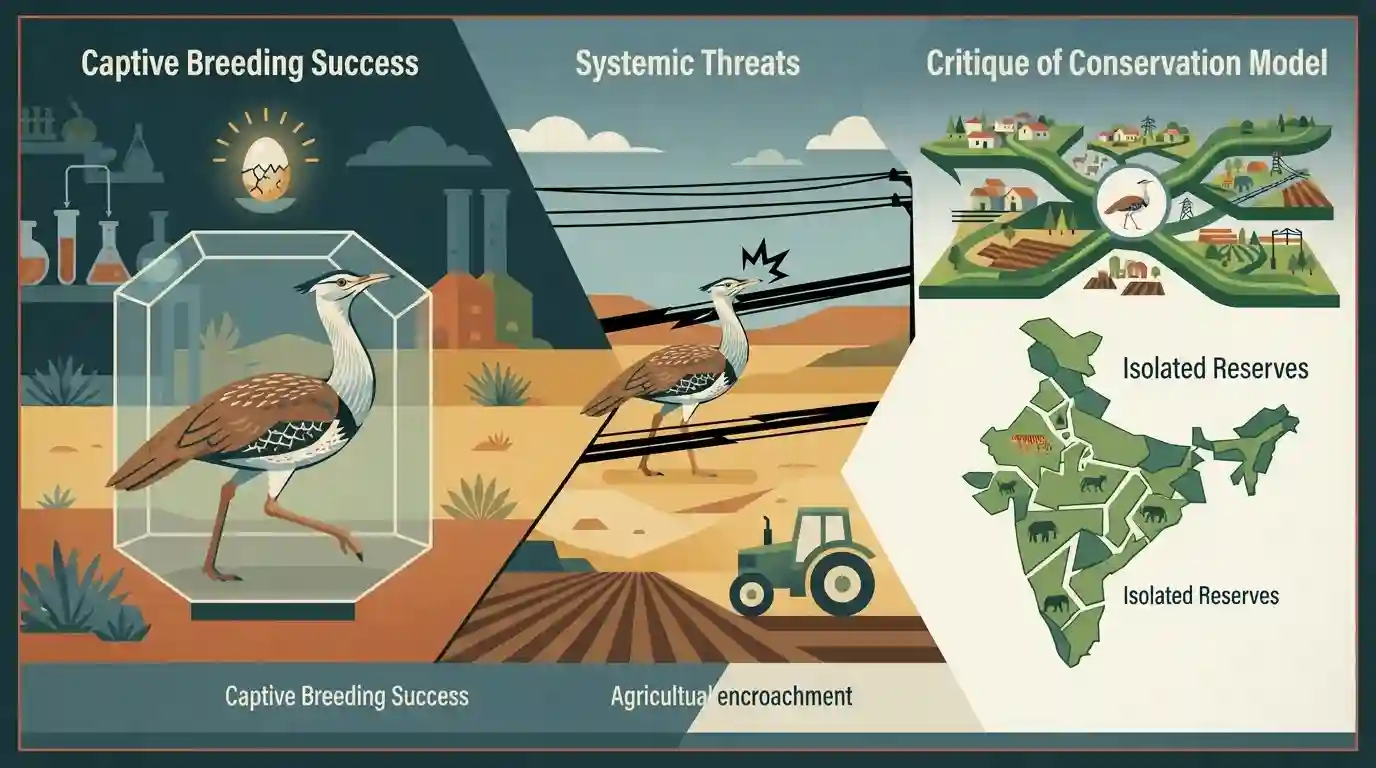
This editorial from The Hindu evaluates India's Great Indian Bustard conservation programme following the release of captive-bred birds in Rajasthan's Desert National Park. While acknowledging the success of captive breeding for a critically endangered species, the article highlights systemic threats such as power-line collisions and agricultural expansion. It broadens into a critical commentary on India's broader wildlife conservation model, arguing that policy is overly focused on isolated reserves and flagship symbolism rather than integrated landscape management.
મુખ્ય મુદ્દા
- Two male Great Indian Bustards were recently released into the wild at the Desert National Park in Jaisalmer, bringing the total in the conservation program to 97 birds.
- The Great Indian Bustard population has dwindled drastically over decades due to hunting, loss of arid grasslands to intensive irrigation, and fatal collisions with high-tension overhead power lines.
- A landmark Supreme Court order directed high-voltage power lines in priority habitats to be undergrounded, though later modified to critical habitats under pressure from renewable energy developers.
- The editorial critiques India's conservation strategy for being overly fixated on symbolic, flagship species and isolated reserves ("bird islands") rather than holistic landscape-level management.
મહત્વપૂર્ણ શબ્દો
Desert National Park

A premier protected area in Jaisalmer and Barmer, Rajasthan, known for fragile desert ecosystems and serving as a key natural habitat and release site for the critically endangered Great Indian Bustard.
UPSC context
Environment & Ecology (Prelims/Mains): Tests knowledge of protected area networks, endemic species distribution, and wildlife sanctuaries in India.
Union Ministry of Environment
The central government body responsible for formulating and implementing national environmental policies, wildlife protection acts, and species recovery programmes like the Bustard Recovery Programme.
UPSC context
General Studies Paper II/III: Tests governance frameworks, institutional mandates, and policy execution related to environmental conservation.
Supreme Court of India
The apex judicial body that issues landmark directives on wildlife conservation, balancing infrastructure development with ecological preservation, notably regarding power-line hazards for the Great Indian Bustard.
UPSC context
General Studies Paper II & III: Tests judicial activism, environmental jurisprudence, and balancing renewable energy infrastructure with wildlife protection.
પ્રિલિમ્સ ટ્રેપ
Desert National Park features dense forest cover characteristic of national parks in peninsular India.
Aspirants often assume Desert National Park is a lush oasis or forest, but it is an arid ecosystem characterized by sand dunes and sparse scrub, and it does not strictly require dense forests.
સંલગ્ન સ્થિર ખ્યાલો
What is the conservation status and legal protection of the Great Indian Bustard in India?
- IUCN Status: Listed as Critically Endangered on the IUCN Red List due to a rapid population decline.
- Wildlife Act: Protected under Schedule I of the Wild Life (Protection) Act, 1972, affording it the highest level of legal protection.
- Habitat Range: Endemic to the Indian subcontinent, with the last viable breeding population primarily surviving in Rajasthan's Thar Desert landscape.
આંતર-વિષય પેટર્ન
Renewable Energy Infrastructure vs. Wildlife Conservation
The tension between rapid green energy expansion (solar/wind transmission lines) and critical wildlife conservation highlights the classic sustainable development paradox tested in GS Paper III.
Wasteland Policy and Grassland Ecosystems
Both bustards and lesser floricans suffer from the legal neglect of arid and semi-arid grasslands, which are misclassified as 'wastelands' in official revenue records.

SC power-line mitigation order + GIB captive breeding status will likely feature as a statement-based environment question in Prelims.
સંલગ્ન PYQ · 1
સંલગ્ન PYQ · 1
- 2020PrelimsGS1
With reference to India's Desert National Park, which of the following statements are correct? 1. It is spread over two districts. 2. There is no human habitation inside the Park. 3. It is one of the natural habitats of Great Indian Bustard. Select the correct answer using the code given below:
