Biotechnology Drives Sustainable Development Goals and Innovations
Source:The Hindu ↗
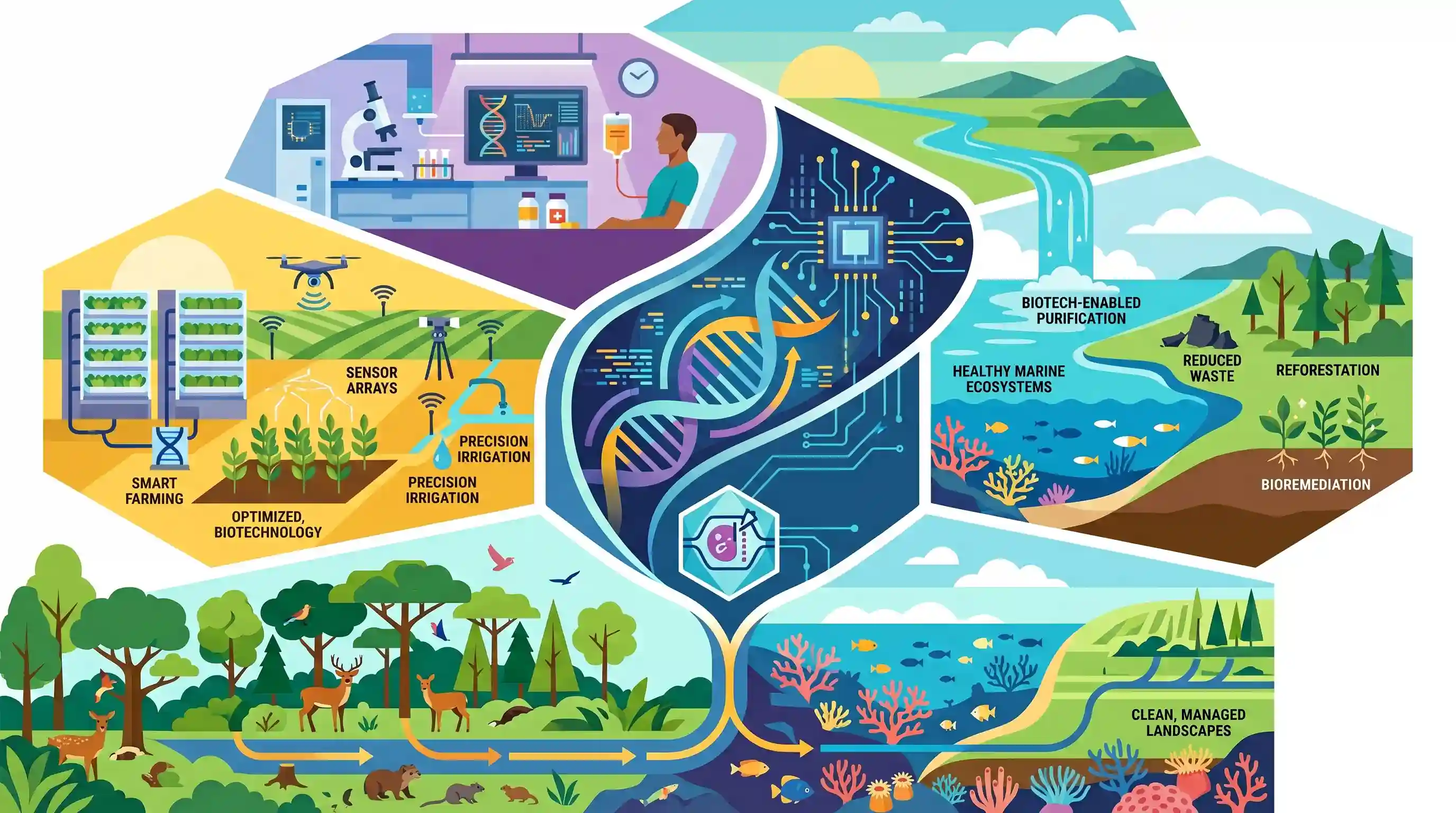
Why It Matters
It connects core GS3 science syllabus components—like biotechnology and CRISPR—to broader socio-economic and environmental challenges mapped by the SDGs, which is a common framing for Mains questions (e.g., how technology helps farmers or combats climate change).
Summary
The article discusses a national seminar focused on the intersection of biotechnology and the UN's Sustainable Development Goals (SDGs). Experts highlighted how biotechnology provides scientific precision and practical solutions across agriculture, healthcare, water management, and environmental conservation. Specifically, advanced tools like CRISPR-DNA technology and artificial intelligence were noted as key drivers for future research in biological sciences. The seminar also emphasized that the sustainable conservation of plant and animal resources is a prerequisite for achieving broader global development targets.
Key Points
- A national seminar at Gulbarga University highlighted the integral role of biotechnology in achieving the UN Sustainable Development Goals (SDGs).
- Biotechnology offers crucial interventions across various sectors, including agriculture (enhanced seeds, fertilizers, pest management), healthcare, and environmental conservation.
- Emerging technologies such as CRISPR-DNA editing and artificial intelligence are significantly expanding the scope and capabilities of biological sciences.
- The restoration, conservation, and sustainable management of plant and animal resources are fundamental to meeting the 17 SDGs and ensuring long-term human well-being.
Important Terms
Sustainable Development Goals (SDGs)

A set of 17 universal objectives adopted by UN Member States in 2015 to end poverty, protect the environment, and ensure prosperity by 2030.
UPSC context
GS-II (International Institutions) and GS-III (Environment); tests knowledge of global development targets and India's commitment to the 2030 Agenda.
Biotechnology
The application of biological systems, living organisms, or their derivatives to create or modify products and processes for specific uses in healthcare, agriculture, and environment.
UPSC context
GS-III (Science and Technology); focuses on applications in agriculture (GM crops), medicine (vaccines), and ethical/regulatory challenges.
CRISPR-Cas9
A revolutionary gene-editing technology that uses a guide RNA and the Cas9 enzyme to cut and modify DNA sequences with high precision.
UPSC context
GS-III (Science and Technology); tests understanding of genomic editing, its potential for treating genetic diseases, and agricultural improvements.
Department of Biotechnology (DBT)
An Indian government department under the Ministry of Science and Technology responsible for promoting and regulating biotechnology research, development, and commercialization.
UPSC context
GS-III (Science and Technology); relevant for institutional frameworks, funding, and national strategies like the National Biotechnology Development Strategy.
Bioeconomy
Economic activity involving the use of biotechnology and biomass in the production of food, energy, and industrial goods to achieve sustainable growth.
UPSC context
GS-III (Economy and S&T); linked to India's goal of reaching a USD 300 billion bioeconomy by 2030 and sustainable resource management.
Karnataka Science and Technology Academy (KSTA)
An autonomous organization under the Government of Karnataka's Department of Science and Technology that promotes scientific awareness and STEAM education in the state.
UPSC context
State PCS or GS-III (S&T); represents regional institutional efforts in science communication and grassroots technological promotion.
Prelims Trap
CRISPR-Cas9 gene editing invariably involves the introduction of foreign DNA to create transgenic crops.
CRISPR (specifically SDN-1 and SDN-2) edits the existing genome without introducing foreign DNA. India recently exempted these from stringent GEAC transgenic regulations.
Static Concepts Connected
How are gene-edited plants regulated in India compared to GM crops?
- GEAC Oversight: Transgenic (GM) crops with foreign DNA require strict evaluation and approval from the Genetic Engineering Appraisal Committee (GEAC) under the MoEFCC.
- SDN Exemption: SDN-1 and SDN-2 gene-edited plants (lacking foreign DNA) are exempt from stringent GEAC rules and are monitored under institutional biosafety committees (IBSCs).
What is Bioremediation and what are its key techniques?
- Bioaugmentation: Adding specialized or genetically engineered microbes to a contaminated site to rapidly degrade toxic pollutants.
- Biostimulation: Modifying the local environment (e.g., adding nutrients/oxygen) to stimulate existing native bacteria to break down contaminants.
- Phytoremediation: Using specific plants to absorb, accumulate, and detoxify heavy metals and organic pollutants from soil and groundwater.
Cross-Topic Patterns
AI-driven Gene Discovery + SDG 2
Combining AI (like AlphaFold for protein structures) with CRISPR accelerates the discovery of climate-resilient crop traits, serving as a pivotal technological intervention for achieving SDG 2 (Zero Hunger) amid climate change.
Bioremediation in River Conservation
Environmental biotechnology, utilizing customized microbial consortia to degrade organic pollutants, is increasingly deployed as a decentralized, eco-friendly solution in national ecological initiatives like the Namami Gange programme.

Expect a 2026 Prelims question testing the regulatory difference between SDN-1/SDN-2 gene-edited crops and transgenic GM crops in India.
Linked PYQs · 4
Linked PYQs · 4
- 2019MainsGS3
How can biotechnology help to improve the living standards of farmers?
- 2019PrelimsGS1
What is Cas9 protein that is often mentioned in news?
- 2021PrelimsGS1
Bollgard I and Bollgard II technologies are mentioned in the context of
- 2018PrelimsGS1
Consider the following pairs: Terms sometimes seen in news Context/Topic 1. Belle II experiment Artificial Intelligence 2. Blockchain technology Digital/Cryptocurrency 3. CRISPR-Cas9 Particle Physics Which of the pairs given above is/are correctly matched?
