Biotechnology sector in India and healthcare R and D challenges
Source:The Hindu ↗
Why It Matters
It provides a comprehensive overview of India's biotechnology sector, highlighting structural challenges in healthcare innovation and R&D that directly impact national growth and public health objectives.
Summary
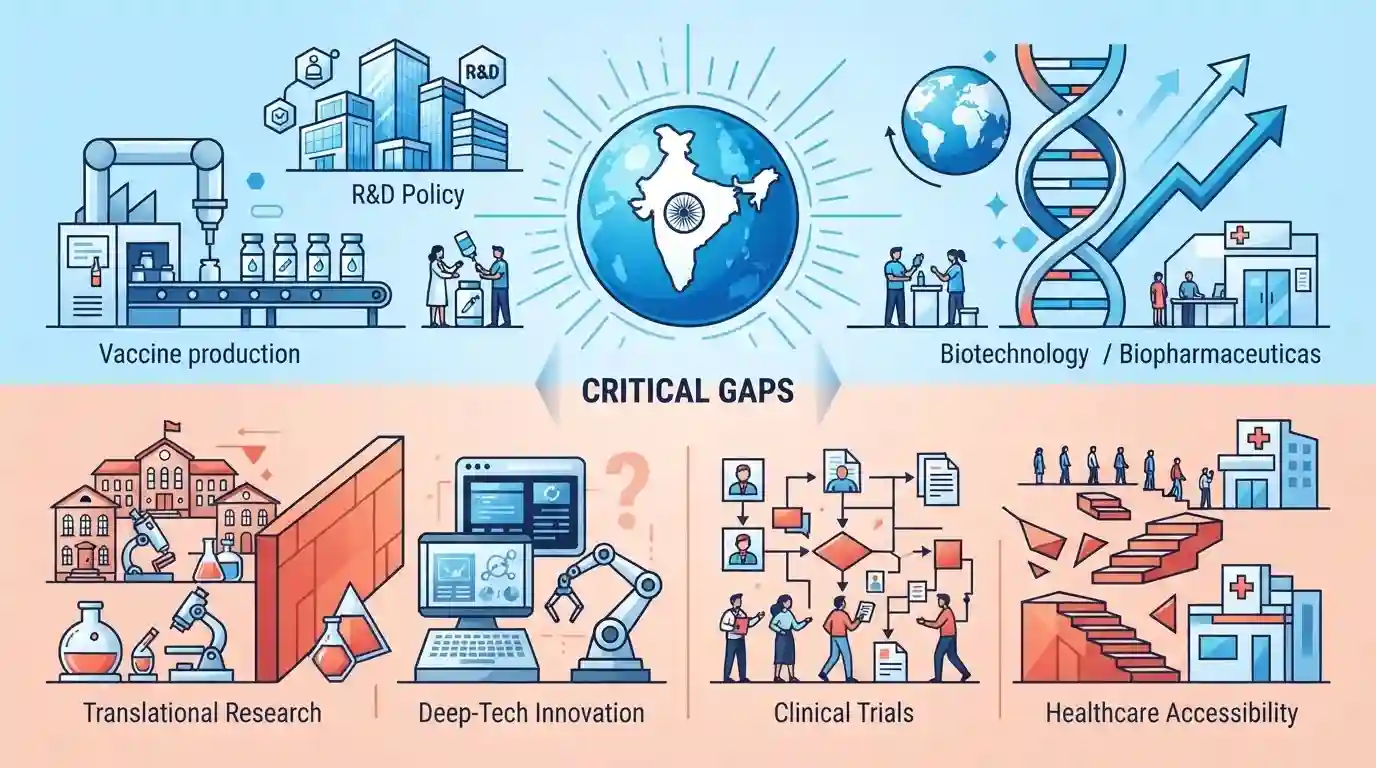
The article evaluates India's current standing in biotechnology and healthcare, emphasizing achievements in vaccine production and biopharmaceuticals alongside critical gaps in translational research, deep-tech innovation, clinical trials, and healthcare accessibility.
Key Points
- India has made significant strides in vaccine manufacturing and biopharmaceuticals, earning the moniker of 'pharmacy of the world'.
- Gaps remain in domestic R&D, translation of laboratory research to commercial healthcare products, and clinical trial infrastructure.
- Affordability and accessibility of advanced therapies (like gene therapy and stem cell therapy) continue to challenge the Indian healthcare landscape.
- Strengthening public-private partnerships and increasing funding for deep-tech biotech are crucial for India's transition toward a bio-economy.
Important Terms
National Biotechnology Development Strategy

A strategic policy framework by the Indian government aimed at accelerating biotechnology innovation, manufacturing, and research to position India as a global bio-economy hub.
UPSC context
UPSC GS Paper III: Science & Technology (R&D policy, biotechnology, and growth strategies). Essential for understanding India's roadmap in emerging tech.
Department of Biotechnology (DBT)
A nodal government department under the Ministry of Science and Technology responsible for promoting biotechnology research, capacity building, and bio-manufacturing in India.
UPSC context
UPSC GS Paper III: Science & Technology. Focuses on institutional frameworks driving biotech infrastructure, vaccine development, and research funding.
Indian Council of Medical Research (ICMR)
India's premier apex body for the formulation, coordination, and promotion of biomedical research, functioning under the Ministry of Health and Family Welfare.
UPSC context
UPSC GS Paper II (Health governance) and GS Paper III (Medical research and public health infrastructure). Tests knowledge of apex research bodies.
Prelims Trap
India leads the global landscape in both vaccine manufacturing volume and advanced clinical-stage gene therapy commercialization.
Aspirants often assume India leads globally in advanced translational deep-tech and clinical gene therapies, whereas India's strength lies primarily in volume generic manufacturing and conventional vaccines.
Static Concepts Connected
What are the core institutional bodies and strategic initiatives driving India's biotechnology sector?
- DBT Role: Apex agency under Ministry of Science & Technology promoting R&D, biosafety regulation, and institutional capacity building.
- BIRAC Mandate: Interface agency under DBT fostering start-ups, entrepreneurship, and industry-academia collaboration in biotech innovation.
- BioE3 Policy: Recent strategic policy focusing on high-performance biomanufacturing for green growth, circular economy, and bio-based products.
Cross-Topic Patterns
Biopharma Manufacturing vs. TRIPS Flexibility
India's dominance in generic biopharmaceuticals intersects with TRIPS flexibilities, compulsory licensing, and global access debates at the WTO.
Deep-Tech R&D and Intellectual Property Regimes
Scaling deep-tech biotech requires integrating domestic IP protection with global patent landscapes under India's National IPR Policy.

BioE3 policy targets + India's bioeconomy milestone figures ($300B by 2030) are prime candidates for matching or statement-based MCQs.
Linked PYQs · 2
Linked PYQs · 2
- 2021MainsGS3
What are the research and developmental achievements in applied biotechnology? How will these achievements help to uplift the poorer sections of the society?
- 2017MainsGS3
Stem cell therapy is gaining popularity in India to treat a wide variety of medical conditions including Leukaemia, Thalassemia, damaged cornea and severe burns. Describe briefly what stem cell therapy is and what advantages it has over other treatments?
