Biotechnology Applications in Human and Animal Nutrition
Source:The Hindu ↗
Why It Matters
This article highlights the multidisciplinary utility of biotechnology in addressing pressing challenges like food security, sustainable agriculture, and rural livelihood generation via livestock. These are core themes in the UPSC GS Paper 3 syllabus, demonstrating how modern technological interventions can solve socio-economic issues.
Summary
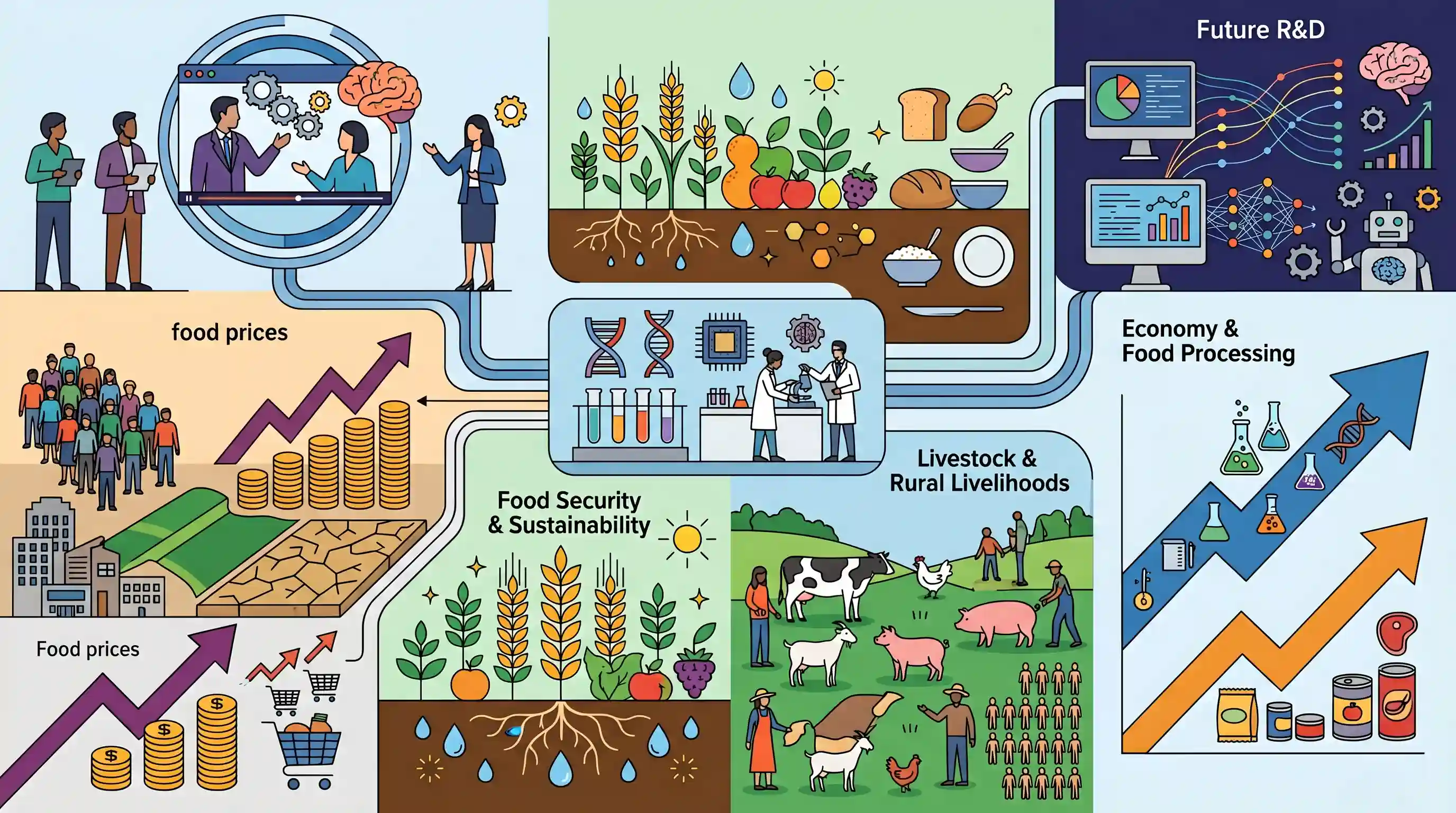
Experts at a recent webinar highlighted the pivotal role of the biotechnology industry in driving advancements in both human and animal nutrition. Amidst challenges like a growing population, shrinking agricultural land, and rising food prices, biotechnology is essential for enhancing the sustainability and quality of food production systems. India's bio-economy is expanding at a rate faster than the food processing sector, presenting vast opportunities. The integration of biotech into the livestock industry is especially significant since 70% of the rural poor rely on it. Furthermore, future biotech R&D will increasingly depend on new-age technologies like AI, machine learning, and data analytics.
Key Points
- India's bio-economy is projected to grow at a faster pace than the food processing market's 13% growth rate.
- Biotechnology is a key driver in enhancing the quality, quantity, and sustainability of food production for both human and animal nutrition.
- A rising population, shrinking arable land space, and increasing food prices make biotechnology indispensable for global food security.
- With 70% of the world's rural poor depending on livestock, the application of biotechnology in animal science is critical for rural economies.
- The future of biotech R&D requires a solid foundation in new-age technologies such as Artificial Intelligence (AI), Machine Learning (ML), and data analytics.
Important Terms
Bio-economy

Economic activities using renewable biological resources (plants, animals, microbes) to produce food, energy, and medicine. India's bio-economy aims to reach $300 billion by 2030.
UPSC context
GS-III (Economy/S&T): Vital for sustainable growth, agricultural productivity, and the "Viksit Bharat" vision of a high-tech agricultural sector.
National Institute of Food Technology, Entrepreneurship and Management (NIFTEM)
An Institute of National Importance under the Ministry of Food Processing Industries (MoFPI). It serves as a premier hub for research, education, and entrepreneurship in food technology.
UPSC context
GS-III (Food Processing): Key institution for adding value to agricultural produce, reducing waste, and modernizing the rural economy.
BioE3 Policy
Government initiative (Biotechnology for Economy, Environment and Employment) promoting high-performance biomanufacturing. It focuses on smart proteins, precision agriculture, and carbon capture to drive a green economy.
UPSC context
GS-III (S&T/Environment): Essential policy framework for biotechnology-led industrial growth and climate-resilient sustainable development goals.
Agri-biotechnology
The application of molecular tools and genetic engineering to enhance crop yields, nutritional content (biofortification), and livestock productivity while ensuring resilience to pests and climate change.
UPSC context
GS-III (Agriculture): Crucial for food security, addressing malnutrition (hidden hunger), and increasing farmers' income through technological intervention.
Industry 5.0
A paradigm shift focusing on human-machine collaboration, sustainability, and resilience. It utilizes AI and data analytics to create human-centric industrial solutions for societal challenges.
UPSC context
GS-III (S&T): Tests knowledge of emerging technologies and their role in creating a sustainable, inclusive, and technologically advanced industrial ecosystem.
Food Processing Sector
A 'sunrise sector' in India that adds value to raw agricultural products. It acts as a link between agriculture and industry, improving shelf-life and nutrition.
UPSC context
GS-III (Economics of Animal-Rearing/Food Processing): Significant for rural employment, reducing post-harvest losses, and boosting export potential.
Prelims Trap
"India's food processing sector constitutes the largest and fastest-growing segment of its national bio-economy."
The bio-economy is a distinct, broader sector (dominated by biopharma) that is projected to grow faster than the conventional food processing sector, not as a subset of it.
Static Concepts Connected
What are the main segments comprising India's Bio-economy?
- Bio-Pharma: Accounts for the largest share, primarily encompassing vaccines, diagnostics, and recombinant therapeutics.
- Bio-Agriculture: Includes genetically modified crops (like Bt Cotton), bio-fertilizers, and bio-pesticides aimed at sustainable farming.
- Bio-Industrial: Encompasses bio-fuels (like ethanol for blending), industrial enzymes, and bio-plastics.
- Bio-IT & Bioinformatics: Leverages computational tools, AI/ML, and data analytics to process biological data for genomics and clinical research.
How is biotechnology applied to improve livestock productivity?
- Artificial Insemination (AI): A widespread and cost-effective method for genetic upgrading by introducing superior male germplasm into local breeds.
- Embryo Transfer Technology: Allows rapid multiplication of elite females by transferring embryos to surrogate mothers, boosting high-yield herds.
- Genomic Selection: Analyzes specific DNA markers to predict an animal's breeding value early, significantly accelerating genetic improvement.
- Recombinant Vaccines: Develops safer and more effective vaccines for critical livestock diseases such as Foot and Mouth Disease (FMD) and Brucellosis.
Cross-Topic Patterns
Bioinformatics and AI/ML convergence
The intersection of data analytics, AI, and biology accelerates genomic sequencing, drug discovery, and climate-resilient crop modeling, shifting biotech from traditional wet-labs to computational R&D.
Livestock as rural climate insurance
With shrinking arable land and erratic monsoons, biotechnology-enhanced livestock acts as vital climate insurance for the rural poor, closely linking S&T breakthroughs to inclusive economic growth.

Expect a 2026 prelims question linking bioinformatics (AI in genomics), animal biotechnology (ETT/genomic selection) and bio-economy.
Linked PYQs · 3
Linked PYQs · 3
- 2019MainsGS3
How can biotechnology help to improve the living standards of farmers?
- 2022MainsGS3
Elaborate the scope and significance of the food processing industry in India.
- 2015MainsGS3
Livestock rearing has a big potential for providing non-farm employment and income in rural areas. Discuss suggesting suitable measures to promote this sector in India.
