Biostimulants Regulation in Agricultural Inputs
Source:Indian Express ↗
Why It Matters
Understanding the distinction between various agricultural inputs (fertilizers, pesticides, biostimulants) and their regulatory frameworks is highly relevant for GS-3 (Agriculture). The topic connects biotechnology applications, farmers' welfare, sustainable agriculture, and regulatory governance.
Summary
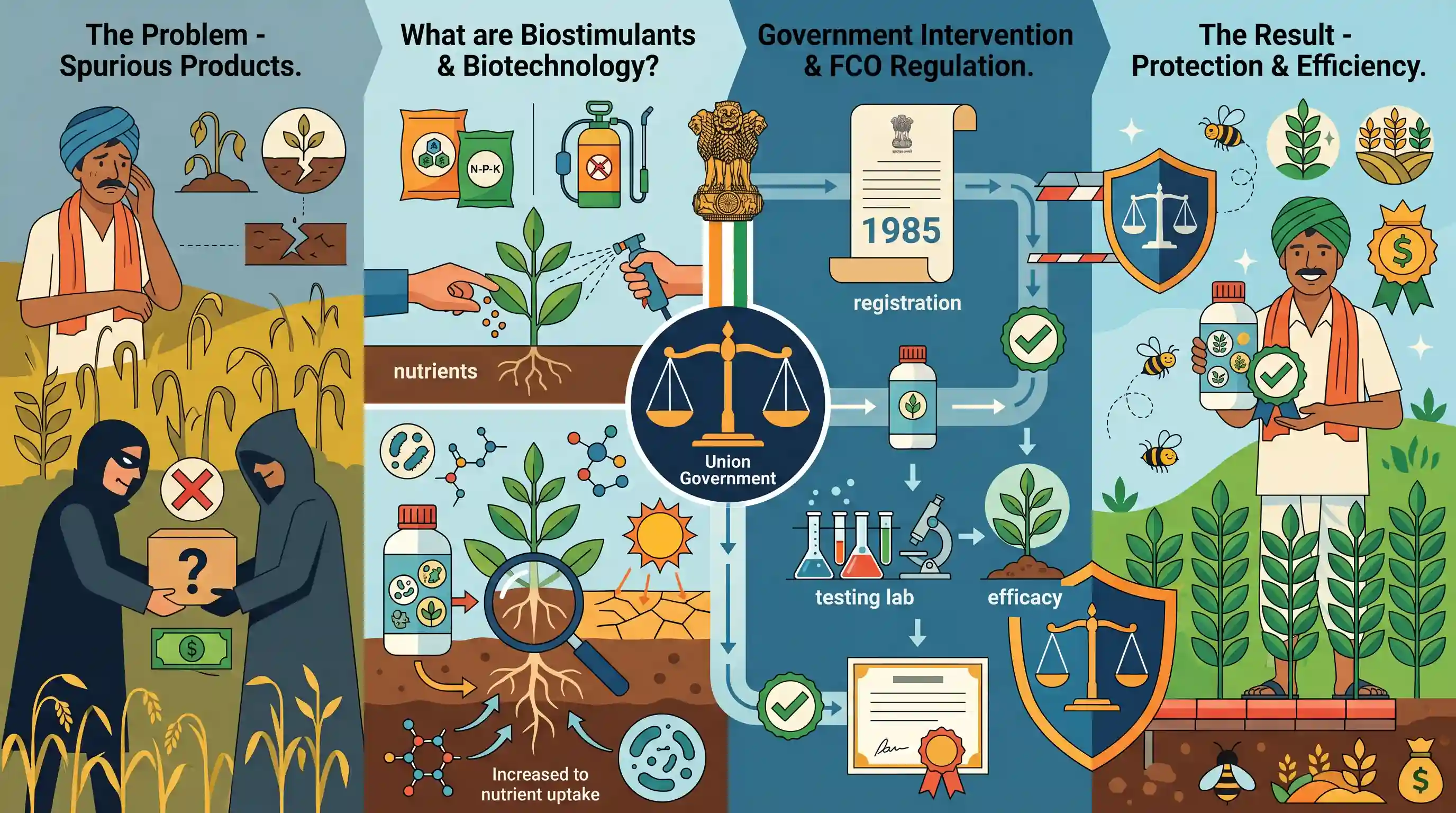
The Union Government is tightening regulations on biostimulants—substances designed to enhance plant growth, nutrient efficiency, and stress tolerance—to curb the sale of spurious agricultural products. Unlike traditional fertilizers or pesticides, biostimulants improve natural plant processes. The Centre has mandated their registration under the Fertilizer (Inorganic, Organic or Mixed) (Control) Order, 1985 (FCO), ensuring product efficacy and protecting farmers from fraudulent claims.
Key Points
- Biostimulants are substances or microorganisms applied to plants to enhance nutrient uptake, efficiency, crop quality, and tolerance to abiotic stress.
- Unlike traditional fertilizers or pesticides, biostimulants do not supply direct macronutrients or kill pests; instead, they stimulate the plant's natural physiological processes.
- The Union Agriculture Ministry is enforcing strict scrutiny on biostimulants to curb the proliferation of spurious, unverified products that cheat farmers.
- Biostimulants have been brought under the regulatory framework of the Fertilizer Control Order (FCO), 1985, meaning manufacturers must legally register their products and prove their efficacy.
- Regulation ensures that farmers have access to genuine agricultural inputs, promoting sustainable farming practices and better crop yields without unnecessary financial burden.
Important Terms
Biostimulants

Substances or microorganisms that stimulate natural plant processes to enhance nutrient uptake, growth, yield, and stress tolerance, independent of their actual nutrient content.
UPSC context
GS Paper III: Agriculture and Sustainable Farming; relates to enhancing crop productivity while reducing chemical dependency.
Fertilizer (Inorganic, Organic or Mixed) (Control) Order, 1985
A regulatory order issued under the Essential Commodities Act, 1955, governing the manufacture, quality, pricing, and distribution of fertilizers to protect farmers from sub-standard products.
UPSC context
GS Paper III: Government Policies & Interventions in Agriculture; tests knowledge of regulatory frameworks for farm inputs.
Essential Commodities Act, 1955
A 1955 law empowering the Union government to regulate the production, supply, and distribution of essential goods (like fertilizers) to prevent hoarding and ensure fair pricing.
UPSC context
GS Paper III: Indian Economy and Agriculture; critical for understanding price stability and supply chain management.
Schedule VI of Fertilizer Control Order
A dedicated regulatory list under the FCO that identifies nine specific categories of approved biostimulants, including botanical extracts, amino acids, and live microorganisms.
UPSC context
GS Paper III: Technology in Agriculture; concerns the technical categorization of biological vs. chemical farm inputs.
Central Biostimulant Committee
An advisory body chaired by the Agriculture Commissioner that reviews scientific evidence and recommends specifications for the registration and quality control of biostimulants.
UPSC context
GS Paper II: Statutory/Regulatory Bodies; tests the institutional mechanism for managing agricultural innovations.
Insecticides Act, 1968
The primary legislation regulating the manufacture, sale, and use of pesticides; biostimulants are legally distinguished from products regulated under this Act.
UPSC context
GS Paper III: Agriculture/Environment; important for understanding the legal distinction between growth enhancers and pest-control chemicals.
Prelims Trap
"Biostimulants directly supply primary macronutrients to crops and act as pesticides to eliminate insects."
Biostimulants do not provide macronutrients or kill pests. They only enhance a plant's natural processes and abiotic stress tolerance. They are regulated under the Fertilizer Control Order.
Static Concepts Connected
What is the Fertilizer (Control) Order (FCO), 1985?
- Legal backing: It was promulgated under Section 3 of the Essential Commodities Act, 1955 by the Central Government.
- Scope of regulation: It regulates the price, quality, trade, and distribution of fertilizers to ensure farmers get genuine inputs.
- Coverage: It covers inorganic, organic, mixed fertilizers, and recently, biostimulants and nano-fertilizers.
What is the difference between abiotic and biotic stress in agriculture?
- Abiotic Stress: Caused by non-living environmental extremes like drought, salinity, frost, and extreme heat. Biostimulants help mitigate this.
- Biotic Stress: Caused by living organisms like pests, fungi, and bacteria. Pesticides and insecticides are used to mitigate this.
Cross-Topic Patterns
Biostimulants + PM-PRANAM scheme
Regulating and promoting genuine biostimulants directly supports PM-PRANAM's objective of reducing the chemical fertilizer subsidy burden by shifting to alternative, sustainable farm inputs.
Essential Commodities Act's wide scope
UPSC frequently tests the scope of the ECA. Through the FCO, the ECA regulates not just food items, but critical farming inputs to prevent adulteration and hoarding.

Expect a multi-statement Prelims question contrasting biostimulants with bio-fertilizers, specifically testing the FCO 1985 regulation.
Linked PYQs · 5
Linked PYQs · 5
- 2016PrelimsGS1
Why does the Government of India promote the use of 'Neem-coated Urea' in agriculture?
- 2020PrelimsGS1
With reference to chemical fertilizers in India, consider the following statements : 1. At present, the retail price of chemical fertilizers is market-driven and not administered by the Government. 2. Ammonia, which is an input of urea, is produced from natural gas. 3. Sulphur, which is a raw material for phosphoric acid fertilizer, is a by-product of oil refineries. Which of the statements given above is/are correct?
- 2021PrelimsGS1
Bollgard I and Bollgard II technologies are mentioned in the context of
- 2020PrelimsGS1
What is the use of biochar in farming? 1. Biochar can be used as a part of the growing medium in vertical farming. 2. When biochar is a part of the growing medium, it promotes the growth of nitrogen-fixing microorganisms. 3. When biochar is a part of the growing medium, it enables the growing medium to retain water for longer time. Which of the statements given above is/are correct?
- 2019MainsGS3
How can biotechnology help to improve the living standards of farmers?
